CNC machining service provides precise control over the production of parts through computer numerical control. It is used in industries such as aerospace, automotive, medical devices, and consumer electronics. There are 3-axis, 4-axis, and 5-axis CNC machining for different parts design requirements. In 3-axis, 4-axis vs 5-axis CNC, the number of axes determines the directions in which the cutting tool can move relative to the workpiece, which then affects machining flexibility, reachable angles, efficiency, cost, and part complexity.
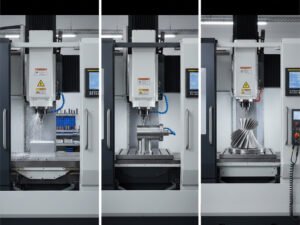
Differences Between: 3-Axis vs 4-Axis vs 5-Axis CNC Machining
The term “axis” describes the directions in which a machine tool moves during cutting. In CNC machining, more axes enable the tool or the workpiece to be positioned at additional angles, allowing more features to be produced in fewer setups.
- A 3-axis CNC machine operates along three linear axes: X for horizontal movement, Y for depth, and Z for vertical movement. This setup allows the tool to approach the workpiece from straight angles, suitable for basic operations.
- 4-axis CNC machines add one rotational axis, typically A or B, enabling the workpiece to rotate while cutting occurs. This expands capabilities to include cylindrical features without repositioning the part multiple times.
- 5-axis CNC machines add another rotational degree, often the B-axis around the Y-axis or the C-axis around the Z-axis. 5-axis supports advanced contours and deep-cavity surfaces.
What is 3-Axis CNC Machining?
3-axis CNC machining involves a machine that moves the cutting tool along three linear axes: X, Y, and Z. The tool remains perpendicular to the workpiece table, and operations are performed by translating the tool or table in these directions. This configuration is suitable for parts with flat or prismatic geometries, such as brackets, plates, and simple enclosures. It handles operations like drilling, milling slots, and contouring on one side at a time.
3-axis CNC machining provides lower equipment costs, easier programming, and straightforward operation, making it accessible for small shops. Disadvantages are the need for multiple setups to machine all sides, which can introduce alignment errors and increase production time.
Main applications are in prototyping, general fabrication, and industries like woodworking and signage production. For example, it is commonly used to create circuit board housings or basic automotive components where complexity is low.
What is 4-Axis CNC Machining?
4-axis CNC machining builds on the 3-axis setup by adding a rotational axis, usually the A-axis, which allows the workpiece to rotate around the X-axis. This enables continuous machining around the part’s circumference. It is suitable for cylindrical or symmetrical parts, such as shafts, gears, and valves, where features wrap around the axis. Operations include helical milling and indexing to access multiple faces without full repositioning.
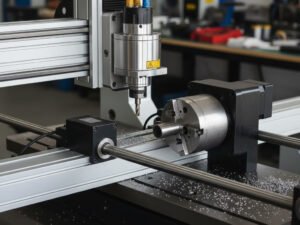
Compared to 3-axis, 4-axis reduces setup times, better accuracy for rounded features, and shorter cycle times for certain parts. Disadvantages involve higher machine costs and more complex programming compared to 3-axis systems.
Primary applications are in manufacturing camshafts, impellers, and pipe fittings in sectors like oil and gas or automotive.
What is 5-Axis CNC Machining?
5-axis CNC machining adds a second rotational axis to the 4-axis setup, allowing the tool or workpiece to tilt and rotate for access to nearly any surface without repositioning. This capability enables single-setup machining of complex geometries, compound angles, and deep cavities. It supports operations such as simultaneous 5-axis contouring, multi-face machining, and producing undercuts that 3- or 4-axis systems cannot achieve.
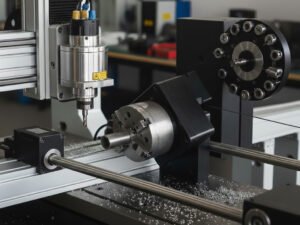
Compared to 4-axis, 5-axis offers true single-setup machining, superior surface finishes, reduced tool vibration through shorter tool lengths, and significantly improved accuracy for intricate features. Disadvantages include higher machine investment, more complex CAM programming, and a greater skill requirement for operators.
Primary applications include aerospace components, medical implants, high-performance automotive parts, and advanced mold and die manufacturing.
How to Choose Between 3-Axis, 4-Axis, and 5-Axis CNC Machining?
Selecting the right axis configuration requires evaluating several factors based on the project’s needs.
- Part geometry. Simple flat parts suit 3-axis, while cylindrical ones benefit from 4-axis, and highly contoured designs require 5-axis.
- Budget. 3-axis machines are the most affordable, with costs increasing for 4-axis and significantly for 5-axis due to hardware and software.
- Precision and tolerance requirements. 5-axis setups achieve tighter tolerances with fewer setups, reducing cumulative errors. In 3-axis vs 4-axis, 4-axis improves precision for rotational parts but may not suffice for full 3D contours.
- Production scale. Prototyping or low-volume runs favor 3-axis or 4-axis for their simplicity, while mass production leans toward 5-axis for efficiency.
- Material types. Harder materials may require the rigidity of 5-axis short-tool setups. Finally, evaluate software compatibility and post-processing needs.
Conclusion
The sequence from 3-axis to 4-axis to 5-axis represents a path of increasing complexity and precision in CNC machining. There is no single configuration that suits every project. Instead, the right choice depends on the balance between part complexity, tolerance requirements, production efficiency expectations, and available budget. For more questions about CNC components, contact Jiangzhi for solutions.