Co-injection molding is a process used in plastic manufacturing to produce parts with multiple layers of material. This method allows for the combination of different plastics in a single molding cycle, resulting in products that have specific properties in different sections. The process is applied in various industries where material efficiency and performance are required.
What is Co-Injection Molding?
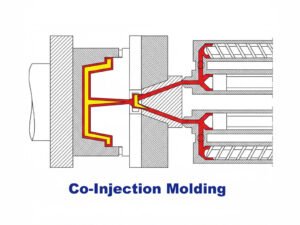
Co-injection molding is a highly specialized process in which two distinct materials are injected simultaneously into a mold to form a single part with multiple layers. The process is often referred to as “sandwich molding,” as it involves injecting one material into the core of the mold, while another material forms the outer skin of the part. The core and skin materials are typically chosen based on their complementary properties, such as combining a rigid thermoplastic for strength with a flexible elastomer for sealing or comfort.
The key characteristic of co-injection molding is the ability to create a multi-material part without the need for secondary assembly processes. The materials are injected in such a way that they form a cohesive part with well-defined boundaries between the core and skin layers. This technique allows for the creation of complex parts that meet specific functional and aesthetic requirements.
How Does Co-Injection Work?
Co-injection molding operates through a machine with two or more injection units connected to a single nozzle. The materials are melted separately and injected into the mold cavity in a specific sequence or simultaneously, depending on the method.
Sequential Co-Injection
In sequential co-injection, the process begins with injecting the skin material into the mold cavity. This material flows along the mold walls, partially filling the cavity, usually to 70-90% of the volume. Once this layer is established, the core material is injected. The core pushes the skin material further against the walls, filling the center while the skin continues to form the outer surface. A final injection of skin material seals the injection gate to prevent core exposure.
This method is suitable for parts with thicker walls, as it allows better control over the core distribution. The sequence prevents the core from breaking through the skin, a common defect if timing is incorrect.
Simultaneous Co-Injection
Simultaneous co-injection involves injecting both the skin and core materials at the same time through a coaxial nozzle. The skin material flows around the core, enveloping it as they enter the mold cavity. This creates a uniform layered structure from the start of the injection.
This approach is effective for parts with thinner walls or symmetrical designs. Flow rates must be precisely controlled to avoid mixing or uneven distribution. If the core material has lower viscosity, it might flow ahead, causing defects. Simultaneous co-injection can achieve higher production speeds but requires more advanced machine controls.
Why Choose Co-Injection Molding?
Co-injection molding offers several advantages over traditional mono-injection molding, making it a preferred method for certain applications. Below are the core benefits of co-injection molding:
Improved Part Performance
One of the primary advantages of co-injection molding is its ability to combine different materials to achieve enhanced performance characteristics. For example, a rigid thermoplastic material may provide the necessary structural strength, while a softer elastomeric material can offer flexibility, comfort, or sealing properties. This combination allows manufacturers to create products with superior functionality, such as gaskets, seals, and medical components, which require both strength and flexibility.
Cost Efficiency
One primary benefit is cost reduction through efficient material use. By placing expensive or specialized materials only in the skin layer, which constitutes a small portion of the part, manufacturers can use less costly materials for the core. This can lower overall material costs significantly. Furthermore, co-injection molding eliminates the need for secondary assembly processes, such as bonding or overmolding, reducing labor costs and improving overall production efficiency.
Design Flexibility and Aesthetics
Co-injection molding provides greater design flexibility, allowing for the creation of complex parts with multiple material properties. This flexibility extends to aesthetics, as co-injection molding enables the production of parts with multiple colors, textures, or finishes without requiring additional processing steps. For example, a product with a soft-touch exterior and a rigid internal structure can be produced in a single molding cycle, offering both functional and aesthetic advantages.
Sustainability
Co-injection molding offers a valuable sustainability solution by enabling the use of recycled materials. By using PCR in the core layer, manufacturers can reduce the environmental impact of their products while maintaining the desired performance and aesthetics.
Co-Injection vs. Other Multi-Material Processes
Co-injection molding differs from other multi-material processes like overmolding and two-shot injection molding in terms of process, applications, and outcomes.
Co-Injection vs. Overmolding
Overmolding service is a process where one material is molded onto an already molded part. In contrast, co-injection molding involves the simultaneous injection of two materials into a single mold cavity, creating a layered part in a single cycle. Overmolding requires separate molding steps, which can result in longer cycle times and increased labor costs. Co-injection molding, on the other hand, eliminates the need for secondary steps, improving production efficiency and reducing costs.
Co-Injection vs. Two-Shot Molding
Two-shot injection molding, also known as 2K molding, injects two materials sequentially into a rotating or shifting mold to create parts with materials in different zones. It uses one machine but two mold cavities, allowing for incompatible resins and visible boundaries. Co-injection, however, emphasizes a skin-core structure within the same cavity, making it better for hidden enhancements.
Product Design Considerations for Co-Injection Molding
Designing products for co-injection molding requires careful consideration of several factors to ensure the success of the process. Key design considerations include:
- Material compatibility is important. The materials used must bond effectively during the molding process, and their melt temperatures, viscosities, and shrinkage rates must complement each other to prevent warping or delamination.
- Part geometry should feature uniform wall thicknesses, ideally 2-5 mm, to ensure even material flow.
- Rounded corners are preferred, cause the sharp corners can cause air entrapment or core breakthrough. The core volume should be 20-80% of the total to allow proper filling.
- Choose the right gate location. Gate location affects layer distribution; central gates promote symmetry, while multiple gates suit larger parts.
- Tolerances are typically ±0.1 mm, but cooling differences between layers must be considered. Reinforcements like ribs can be placed in the core for strength without affecting the surface.
Typical Applications of Co-Injection Molding
Co-injection molding is used in a wide range of industries that require multi-material parts with distinct properties. Some of the most common applications include:
- Automotive: Dashboard panels, gaskets, and seals.
- Medical Devices: Surgical tools, valves, and seals.
- Consumer Goods: Toothbrushes, tool handles, and kitchen utensils.
- Packaging: Food and beverage packaging.
Is Co-Injection Molding Right for Your Product?
To determine whether co-injection molding is suitable for your product, consider the following factors:
- Material Requirements: Does your product require the combination of two materials with distinct properties?
- Design Complexity: Does your product require complex geometries or multiple layers of different materials?
- Sustainability Goals: Are you looking to incorporate recycled materials into your product design?
- Cost Considerations: Does co-injection molding offer a cost-effective solution for your production needs?
Conclusion
Co-injection molding provides a method for creating layered plastic parts with specific advantages in cost, performance, and efficiency. Understanding its operation, comparisons, and design requirements helps in applying it effectively. For suitable products, it offers practical benefits in manufacturing.