Composite materials continue to gain use in industries that require high strength combined with low weight. These materials consist of reinforcing fibers embedded in a polymer matrix. Compression molding composites provides an effective method to produce parts with consistent properties and complex geometries. This process suits both thermoset and thermoplastic systems. It supports medium to high volume production while maintaining fiber integrity and part quality.

Why Composite Materials Require Compression Molding?
Composite materials demand specific forming techniques to achieve optimal mechanical properties. Short-fiber processes, such as injection molding, limit fiber length, which reduces both strength and stiffness. Hand lay-up or filament winding often struggles with complex shapes and consistent thickness distribution. Compression molding composites addresses these issues directly.
Compression molding is characterized by pressure uniformity. When heat and pressure are applied evenly across the mold cavity, resin flow can be controlled without excessive disturbance to the fibers. This is particularly important for maintaining mechanical integrity in fiber-reinforced systems. Unlike some open-mold processes, compression molding minimizes void formation and reduces the risk of incomplete wet-out.
The Composite Compression Molding Process
The compression molding composites process follows a defined sequence of steps. While specific parameters vary by material system, the fundamental steps remain consistent.
- Material preparation: Composite feedstock may be supplied as sheet molding compound (SMC), bulk molding compound (BMC), glass mat thermoplastic (GMT), or other pre-engineered formats. These materials are typically pre-weighed and, in some cases, preheated to improve flow characteristics.
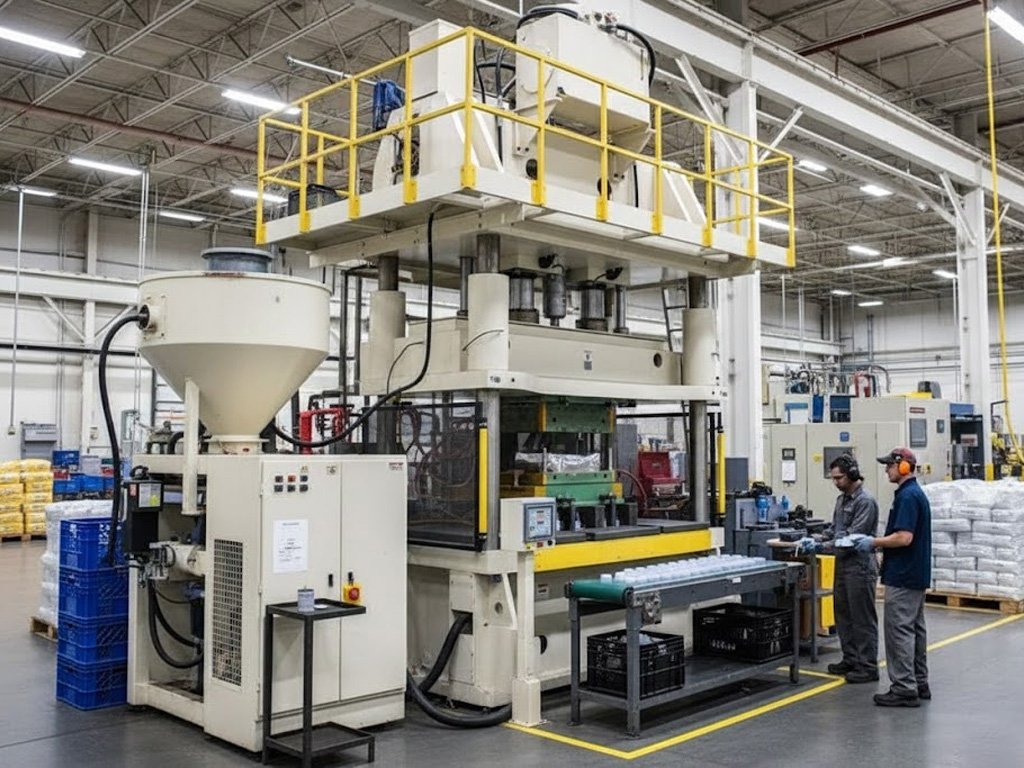
- Loading: The material charge is placed into the lower half of a heated mold. The mold is then closed, and pressure is applied using a hydraulic or mechanical press. As temperature and pressure increase, the resin softens or reacts, allowing the material to flow and fill the cavity.
- Curing or Consolidation: During the curing or consolidation phase, the composite material reaches its final shape and mechanical properties. The part remains under pressure during the cure cycle for thermosets (typically 1-5 minutes) or cooling for thermoplastics.
- Demolding and Finishing: Once the curing is complete, the mold opens, and the finished part is removed. Minor post-processing steps, such as trimming or surface finishing, may follow depending on application requirements.

Types of Composites Suitable for Compression Molding
A wide range of composite systems can be processed using compression molding.
Thermoset Composites
Thermoset composites are among the most common. Materials such as polyester, vinyl ester, and epoxy-based SMC and BMC are widely used due to their stability and mechanical performance. These systems are well-suited to high-volume production and offer good surface quality when molded under controlled conditions.
Thermoplastic Composites
Thermoplastic composites are also increasingly used in compression molding applications. GMT and long-fiber thermoplastics combine impact resistance with shorter cycle times. Because thermoplastics do not undergo chemical curing, they can be reheated and reshaped, which may support recycling or reprocessing strategies.
Advanced Composite
Advanced composite compression moulding systems may incorporate carbon fiber reinforcements or hybrid fiber architectures. These materials are selected where higher stiffness-to-weight ratios are required, though they typically involve tighter process control and higher material costs.
Advantages of Compression Molding Composites
Compression molding composites offers several practical advantages over other manufacturing methods.
- Complex geometries with ribs, bosses, and varying thickness become achievable in one step.
- Long fiber retention results in superior mechanical properties compared to injection molding.
- Integrated features such as metal inserts or reinforcements can be molded in place.
- Dimensional stability remains high due to low shrinkage in controlled cures.
- Waste levels stay low since precise charge weights minimize flash.
- Tooling costs are moderate for medium volumes, lower than injection molding for certain part sizes.
- Surface quality supports Class A finishes with appropriate mold polish and material selection.
- Weight reduction of 30-50% versus metals maintains comparable stiffness in optimized designs.
Application Scenarios Focused on Composite Components
Compression molding composites find use across multiple sectors where lightweight structural parts are required.
Aerospace: Brackets, clips, interior panels, and secondary structures.
Automotive applications: Battery enclosures, body panels, hoods, under-the-hood parts, and structural reinforcements.
Industrial equipment: Covers, housings, and supports.
Renewable energy components: Wind turbine nacelle covers.
Infrastructure and construction: Electrical housings, utility covers, and corrosion-resistant structural elements.
Conclusion
Compression molding composites remains a mature and versatile process for producing reliable high-performance components. Selecting the right manufacturing partner is as important as choosing the correct material and process. Jiangzhi specializes in compression molding composites with advanced equipment and experienced teams. We offer complete solutions from material selection and tool design to finished parts. Our facilities ensure precise control of process parameters for optimal results. Contact Jiangzhi to discuss your composite component requirements and achieve efficient production outcomes.