Injection Molding Material Selection Guide
Choosing the right material for injection molding is one of the most consequential decisions in any manufacturing project. The material you select determines the product’s mechanical performance, surface quality, production efficiency, and long-term cost. Get it wrong and you face warping, brittleness, failed certifications, or unexpected tooling costs.
This guide covers 12 injection molding materials — more than most published guides — plus a dedicated section on additives and a step-by-step selection process. Whether you’re designing for automotive, medical, consumer electronics, or industrial applications, this guide gives you a decision framework, not just a list.
Injection Molding Material Selection Guide
1. What Mechanical Demands will the Part Face?
Mechanical performance defines whether your part survives in use. Consider tensile strength (resistance to breaking under load), impact resistance (resistance to sudden shock), fatigue resistance (performance under repeated stress), and flexibility vs. rigidity.
For Example: a gear needs high fatigue strength and low friction — Nylon or POM is the right choice. A snap-fit hinge needs flexibility without fracture — Polypropylene is designed for exactly this. A safety enclosure needs to absorb impact without cracking — ABS or Polycarbonate.
2. What Temperatures Will the Part Be Exposed to?
Operating temperature is one of the most commonly underestimated factors. A material that performs well at room temperature can warp, soften, or fail at 80°C. Always evaluate the maximum continuous use temperature, not just the melting point.
- General consumer/indoor use: PP, ABS, PS are sufficient
- Moderate heat (60–120°C): Nylon, POM, PC
- High heat (above 150°C): PPS, PEEK
3. What Chemicals, Moisture, or UV Exposure Will the Part Face?
Chemical resistance varies dramatically between materials. Nylon absorbs moisture and can swell dimensionally — a critical issue for precision parts. Polypropylene resists acids, bases, and organic solvents, making it the default choice for chemical-contact parts. UV degradation affects ABS, PS, and standard PE unless stabilizers are added; ASA or UV-stabilized grades are used for outdoor applications.
4. What Aesthetic and Finish Requirements Apply?
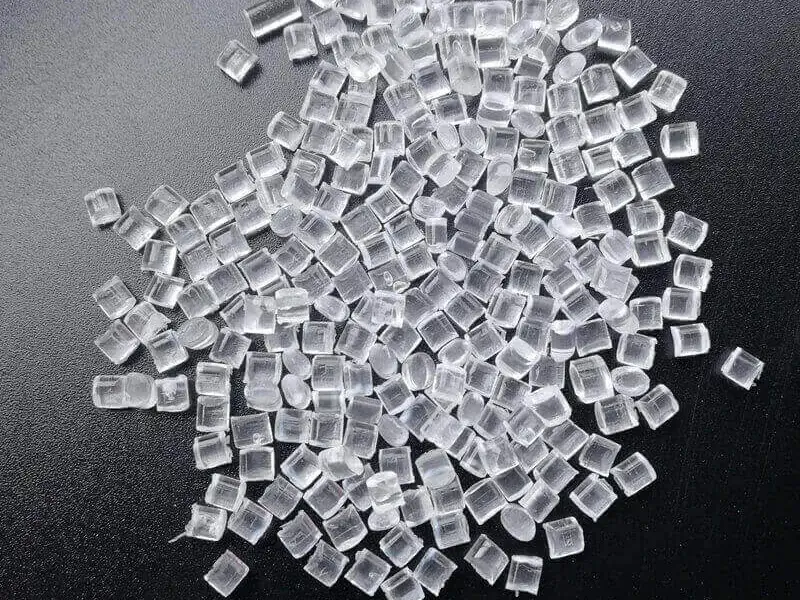
Color consistency, surface gloss, and transparency are material-specific. Polycarbonate and PMMA (Acrylic) offer optical clarity. Polystyrene achieves high-gloss finishes cost-effectively. If the part will be painted or plated, ABS bonds well to most coatings.
5. What are the Compliance and Regulatory Requirements?
Confirm compliance requirements before finalizing material selection — retrofitting after tooling is expensive. Different industries require different certifications:
- Medical / Food Contact: FDA-compliant grades of PP, PC, PE, or PEEK
- Electronics: UL 94 flame-retardant grades, RoHS-compliant formulations
- Automotive: Materials meeting OEM thermal and chemical specifications
- Aerospace: FAA / ASTM flame, smoke, and toxicity requirements
6. What is the Production Volume and Cost Target?
Commodity resins (PP, PE, PS) reduce per-unit material cost and allow shorter cycle times — ideal for high-volume production. Engineering resins (PC, Nylon, POM) cost more but deliver performance that commodity plastics cannot. High-performance resins (PEEK, PPS) are justified only when the application demands it; using them unnecessarily inflates cost without benefit.
Injection Molding Material Selection Guide
| Thermoplastic | Thermoset | |
|---|---|---|
| Can be Remelted? | Yes — reprocessable and recyclable | No — permanently set after curing |
| Typical Applications | Packaging, consumer products, automotive parts, medical devices | Electrical insulation, aerospace components, structural parts |
| Common Materials | PP, ABS, Nylon, PC, POM, TPE | Epoxy, Phenolic, Polyester |
| Strengths | Lightweight, flexible, recyclable, shorter cycle times | Superior heat resistance, dimensional stability, chemical resistance |
| Limitations | Temperature-sensitive; some grades lack rigidity | Cannot be remolded; longer cure times; more brittle |
Injection Molding Material Plastic Selection Guide
1. Polypropylene (PP) — Best All-Around Commodity Resin
Polypropylene is the most widely used injection molding material in the world, and for good reason: it combines adequate mechanical performance with excellent chemical resistance and very low cost. It is also the only common plastic with true living hinge capability — the ability to flex millions of times without fracturing.
Choose PP when: you need chemical resistance, moisture resistance, flexibility for snap fits or hinges, or a low-cost material for high-volume production.
Don’t choose PP when: the part operates above 100°C continuously, requires high rigidity, or needs to resist UV without additives.
- Strengths: good chemical resistance, high fatigue resistance (living hinges), lightweight, low cost, low moisture absorption
- Limitations: poor UV resistance without stabilizers, lower stiffness than engineering resins, not suitable for high-temperature applications
Typical applications: packaging containers, bottle caps, medical syringes, battery cases, automotive interior panels, and living hinge components.
2. Acrylonitrile Butadiene Styrene (ABS) — Best for Consumer Products Requiring Impact Resistance + Aesthetics
ABS is the default material for consumer-facing parts that need to look good and survive daily use. Its combination of impact resistance, dimensional stability, and excellent surface finish makes it the most common plastic in consumer electronics and automotive interiors. It also machines, bonds, and paints well — useful for parts that need secondary operations.
Choose ABS when: the part is consumer-facing, needs a clean surface finish, requires tight dimensional tolerances, or will be painted, plated, or bonded.
Don’t choose ABS when: the part is exposed to direct sunlight (yellows over time), strong solvents, or continuous heat above 80°C.
- Strengths: high impact resistance, good dimensional stability, excellent surface finish, easy to process, and accepts coatings well.
- Limitations: poor UV resistance, limited chemical resistance, flammable without FR additives
Typical Applications: laptop housings, remote controls, automotive dashboards and trim, appliance enclosures, and power tool bodies.
3. Polyethylene (PE) — Best for Flexible, Chemical-Resistant Parts at Low Cost
Polyethylene comes in two main forms for injection molding: HDPE (high-density, stiffer) and LDPE (low-density, more flexible). Both offer exceptional chemical resistance and low moisture absorption, making them the default choice for containers, packaging, and fluid-contact components.
Choose PE when: the part contacts chemicals, food, or bodily fluids; needs to be flexible or squeezable; or requires very low cost.
Don’t choose PE when: the part requires high stiffness, tight tolerances, or high-temperature performance.
- Strengths: excellent chemical resistance, good impact resistance, very low moisture absorption, low cost
- Limitations: low stiffness and strength, poor UV resistance, and limited high-temperature performance
Typical Applications: containers, squeeze bottles, caps and closures, tubing, medical packaging, and chemical storage parts.
4. Polycarbonate (PC) — Best When You Need Optical Clarity and High Impact Resistance Together
Polycarbonate is one of the strongest transparent plastics available. It transmits light with clarity comparable to glass, while offering impact resistance that glass cannot match. It also withstands sterilization by gamma radiation and EtO gas, making it a common choice in medical devices.
Choose PC when: the part requires transparency combined with toughness — lenses, light covers, protective shields — or when the part needs to survive sterilization.
Don’t choose PC when: the part contacts strong solvents (PC stress-cracks easily under chemical load) or requires scratch resistance without coating.
- Strengths: high impact resistance, excellent optical clarity, good thermal stability (up to ~120°C), high dimensional stability
- Limitations: susceptible to scratching, poor chemical resistance, higher cost than commodity resins
Typical Applications: safety goggles, optical lenses, medical device housings, automotive headlamp covers, and electrical enclosures.
5. Polyamide / Nylon (PA) — Best for Mechanical Parts Under Continuous Load
Nylon is the engineering material of choice for moving mechanical parts. Its high fatigue strength, excellent wear resistance, and natural lubricity make it ideal for gears, bearings, and bushings that need to function reliably over millions of cycles. Glass-filled grades (PA6-GF30, PA66-GF30) add stiffness and heat resistance for under-the-hood automotive applications.
Choose Nylon when: the part is a mechanical component subject to repeated stress, sliding contact, or high loads, and when dimensional stability in dry conditions is acceptable.
Don’t choose Nylon when: the part requires tight tolerances in humid environments (Nylon absorbs moisture and expands dimensionally) or contact with strong acids.
- Strengths: high tensile strength, excellent wear and fatigue resistance, good chemical resistance (oils, fuels), natural lubricity
- Limitations: absorbs moisture (up to 8% by weight for PA6), dimensional changes with humidity, susceptible to hydrolysis
Typical Applications: gears, bearings, bushings, cable ties, automotive intake manifolds, power tool housings, and industrial fasteners.
6. Polystyrene (PS) — Best for Low-Cost, High-Clarity Disposable Parts
Polystyrene is a general-purpose commodity resin that achieves good optical clarity and a high-gloss surface finish at very low cost. It is easy to process and well-suited to disposable or single-use applications. High-Impact Polystyrene (HIPS) adds rubber tougheners to improve impact resistance at a modest cost premium.
Choose PS/HIPS when: the part is disposable, packaging-oriented, or requires a high-gloss clear finish at the lowest possible cost.
Don’t choose PS when: the part faces impact loading, chemical exposure, or needs UV stability.
- Strengths: good clarity (crystal PS), easy to process, low cost, high-gloss surface
- Limitations: brittle, poor chemical resistance, poor impact resistance (crystal PS), low UV stability
Typical Applications: food packaging containers, disposable cutlery, laboratory petri dishes, display cases, toy parts.
7. Thermoplastic Elastomers (TPE) — Best When You Need Rubber-Like Flexibility in a Thermoplastic
TPEs combine the processing advantages of thermoplastics with the elastic, rubber-like performance of elastomers. They can be overmolded onto rigid substrates (ABS, PP) to create soft-touch grips, seals, and gaskets — without the vulcanization process required for traditional rubber.
Choose TPE when: the part needs to flex, seal, or provide a soft-touch grip; or when you need rubber-like behavior with the recyclability of a thermoplastic.
Don’t choose TPE when: the part operates at high temperatures (TPEs generally soften above 100°C) or requires high tear strength under severe mechanical load.
- Strengths: excellent flexibility, good weather resistance, recyclable, compatible with overmolding
- Limitations: lower mechanical strength than rigid thermoplastics, limited chemical resistance, and higher cost than traditional rubber
Typical Applications: grips and handles, seals and gaskets, medical tubing, soft-touch consumer product housings, and footwear components.
8. PTFE (Polytetrafluoroethylene) — Best for Extreme Chemical and Temperature Resistance
PTFE has the broadest chemical resistance of any common plastic — it resists virtually all solvents, acids, and bases — and maintains performance from -200°C to +260°C. Its extremely low coefficient of friction makes it useful for seals and sliding surfaces. Note: PTFE is difficult to injection mold in the traditional sense; most PTFE parts are compression-molded or machined from rod/sheet stock.
Choose PTFE when: the part contacts aggressive chemicals or must perform across a very wide temperature range, and processing difficulty is acceptable.
- Strengths: exceptional chemical resistance, very wide temperature range, lowest friction of any plastic, biocompatible
- Limitations: poor mechanical strength, difficult and expensive to process, high cost, cannot be welded or bonded easily
Typical Applications: chemical seals and gaskets, bearing surfaces, medical implants, laboratory equipment, semiconductor components.
9. PMMA / Acrylic — Best for Optical Clarity Without the Cost of Polycarbonate
PMMA (commonly called Acrylic or Plexiglas) offers better optical clarity and UV resistance than Polycarbonate, at a lower cost. It achieves a glass-like appearance and weathers well outdoors. The trade-off is brittleness: PMMA cracks under impact, where PC would deform.
Choose PMMA when: the part is primarily visual — lenses, signage, display covers — and impact loading is not a concern.
Don’t choose PMMA when: the part will be dropped, struck, or subjected to sudden loads.
- Strengths: excellent optical clarity (92% light transmission), good UV resistance, easy to polish, lower cost than PC
- Limitations: brittle, low impact resistance, susceptible to surface scratching
Typical Applications: display panels, light diffusers, signage, optical lenses, aquarium glass, automotive tail lamp covers.
10. POM / Acetal — Best for Precision Mechanical Parts Requiring Dimensional Stability
POM (also called Acetal or Delrin) is the go-to material for small, precision mechanical parts. Its high stiffness, low friction, and exceptional dimensional stability make it ideal for gears, cams, and sliding components that must maintain tight tolerances over time and temperature. POM is stiffer than Nylon and absorbs almost no moisture — an advantage in humid environments.
Choose POM when: the part is a precision mechanical component (gear, cam, bearing, precision fitting) that must maintain dimensional accuracy in varying humidity.
Don’t choose POM when: the part contacts strong acids or bases, or is exposed to UV (POM degrades rapidly in sunlight without stabilizers).
- Strengths: high stiffness, very low friction, excellent dimensional stability, low moisture absorption
- Limitations: poor UV resistance, sensitive to strong acids and bases, limited high-temperature use (softens above 120°C)
Typical Applications: gears, cams, bearings, precision fittings, conveyor components, pump parts, door handles.
11. PVC (Polyvinyl Chloride) — Best for Cost-Effective Chemical Resistance with Flame Retardancy
PVC is one of the most widely produced plastics in the world. Rigid PVC offers good chemical resistance and inherent flame retardancy at low cost. Flexible PVC (plasticized with additives) provides rubber-like flexibility for cables, hoses, and medical tubing. Processing requires attention to temperature control; PVC degrades and releases corrosive HCl gas if overheated.
Choose PVC when: the part needs flame retardancy without added FR agents, chemical resistance, or the flexibility of plasticized grades.
Don’t choose PVC when: the part will be exposed to temperatures above 60°C (rigid) or 80°C (flexible), or in applications where environmental concerns around chlorine content are relevant.
- Strengths: good chemical resistance, inherently flame retardant, low cost, available in rigid and flexible grades
- Limitations: brittle at low temperatures, poor high-temperature performance, and processing releases HCl if overheated
Typical applications: pipes and fittings, electrical cable insulation, medical tubing, window profiles, and flooring.
12. PC/ABS Blend — Best When You Need PC Strength Without PC’s Processing Difficulty
PC/ABS is an alloy that combines the impact strength and heat resistance of Polycarbonate with the easier processability and lower cost of ABS. The result is a material that outperforms pure ABS at elevated temperatures and under impact, while being easier to mold than pure PC. It is the dominant material in automotive interior trim and electronic device housings.
Choose PC/ABS when: the part needs better heat resistance and impact strength than ABS alone, but full PC performance isn’t required — and when cost is a consideration.
- Strengths: high impact resistance, better heat resistance than ABS, good dimensional stability, easier to mold than PC
- Limitations: moderate chemical resistance, higher cost than ABS, limited use above 110°C
Typical applications: automotive interior trim, laptop and tablet housings, electrical junction boxes, and medical device enclosures.
Injection Molding Material Selection Guide
| Additive | What It Does | When to Use It |
|---|---|---|
| Glass Fiber Reinforcement | Increases stiffness, strength, and heat resistance (e.g., PA6-GF30 has 3× the stiffness of unfilled PA6) | Load-bearing structural parts; under-the-hood automotive components |
| Carbon Fiber Reinforcement | Even higher stiffness-to-weight ratio than glass fiber; also adds electrical conductivity | Aerospace, robotics, high-performance structural parts where weight matters |
| UV stabilizers | Prevent yellowing, embrittlement, and surface degradation from sunlight | Any part used outdoors or near windows |
| Flame Retardants | Achieve UL 94 V-0 or V-2 ratings required for electrical/electronic applications | Electronics housings, connectors, cable components |
| Plasticizers | Increase flexibility and reduce brittleness | Flexible PVC applications; soft-touch components |
| Impact Modifiers | Improve toughness in otherwise brittle materials (e.g., PS or PMMA) | Parts subject to occasional impact that don't need full elastomer flexibility |
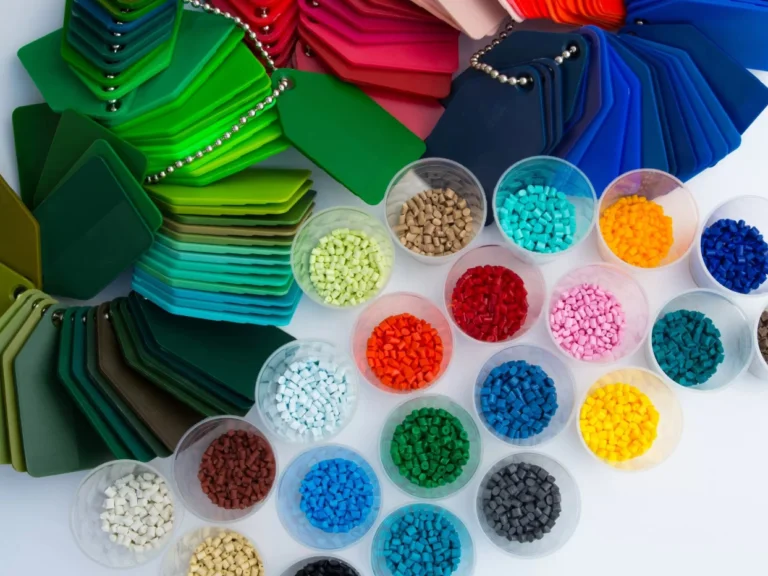
| Colorants / Masterbatch | Achieve consistent, specific colors; can also include special effects (metallic, pearlescent) | Consumer-facing parts with brand color requirements |
| Antistatic agents | Reduce surface charge that attracts dust or risks ESD damage | Electronic components; packaging for sensitive devices |
| Antimicrobial additives | Inhibit bacterial and fungal growth on the part surface | Medical devices, food-contact components, healthcare environments |
| Lubricants / PTFE additives | Reduce friction and improve sliding performance without external lubrication | Gears, bearings, and sliding mechanisms in unfavorable lubrication conditions |
Important
Adding reinforcing fillers (glass or carbon fiber) changes shrinkage rates and flow behavior, which affects mold design. Notify your mold designer and material engineer before finalizing the additive specification — the mold may need adjustment.
Injection Molding Material Selection Guide
1. Define the Requirements
Before looking at any material datasheet, document the part’s requirements:
- Operating temperature range (minimum and maximum)
- Chemical or fluid contact (list the specific chemicals)
- Mechanical loads (static, dynamic, impact, fatigue)
- Regulatory compliance requirements (FDA, UL, RoHS, etc.)
- Aesthetic requirements (color, gloss, transparency)
- Annual production volume and target unit cost
2. Screen by Hard Constraints
Eliminate any material that fails a non-negotiable requirement. If the part must be FDA-compliant, eliminate all non-FDA grades immediately. If the operating temperature exceeds 130°C, eliminate PP, ABS, PS, and standard PE. This narrows the field quickly.
3. Compare Shortlisted Candidates
For the materials that pass Step 2, compare them on secondary factors: cost, processability, availability, cycle time, and secondary operation compatibility. For critical applications, review full material datasheets (CAMPUS database or manufacturer datasheets), not just summary tables.
4. Prototype and Validate
Create prototypes using the shortlisted material. For injection-molded prototypes, even small sample runs reveal real processing behavior. Test under actual operating conditions — not just room temperature, room humidity. If mechanical performance is critical, conduct testing per relevant ASTM or ISO standards.
5. Final Selection and Documentation
Select based on prototype test results, cost analysis, and supply chain reliability. Document the material specification (grade, supplier, key properties) in your engineering BOM. Locking in a specific grade (not just a generic material name) prevents substitution issues in production.
FAQs About Injection Molding Materials Selection
There is no single "best" material — it depends entirely on the application. For most general-purpose, cost-sensitive applications, Polypropylene offers the best balance of performance and cost. For consumer electronics enclosures, ABS is the standard choice. For structural mechanical parts, Nylon or POM are preferred. For optical parts, Polycarbonate or PMMA. For extreme environments, PEEK.
PEEK (Polyether Ether Ketone) offers the highest combination of tensile strength, heat resistance, and chemical resistance among common injection molding materials. For applications where PEEK is too expensive, glass-filled Nylon (PA66-GF30) or glass-filled POM provide significantly higher strength than unfilled grades at lower cost.
Polypropylene and Polyethylene are generally the lowest-cost options for injection molding, both in raw material price and processing cost (short cycle times, minimal mold wear). Polystyrene is similarly low-cost for non-structural applications.
Several materials can be formulated to meet FDA requirements for medical applications, including Polypropylene (PP), Polycarbonate (PC), medical-grade ABS, Polyethylene (PE), and PEEK. The key requirement is that the specific grade — not just the base resin — must be certified for the intended contact type (blood contact, food contact, implantable, etc.). Always request FDA compliance documentation from the material supplier.
Material selection directly affects shrinkage rate, which determines cavity dimensions; melt temperature and viscosity, which affect gate size and runner design; and cooling requirements, which affect cycle time and cooling channel layout. Switching materials after the mold is built often requires reworking the tool. Material and mold design should be finalized together.
Sometimes — but with limitations. Materials with similar shrinkage rates and processing temperatures can sometimes be substituted with minor mold adjustments. However, switching from an unfilled to a glass-filled grade, or from a low-shrinkage to a high-shrinkage material, typically requires significant mold rework. Consult your mold engineer before making any material substitution.
Work With Jiangzhi on Material Selection
Selecting the right material for a complex part involves tradeoffs that a guide alone can't fully resolve. Our engineering team works with customers to evaluate material options based on your actual part requirements, volume, and budget — and we stock a broad range of plastic, rubber, and TPE materials for immediate production.
We can help you with:- Material selection for new part designs
- Re-evaluation of existing parts experiencing performance issues
- Prototype molding to validate material choices before production tooling
- FDA-compliant and specialty material sourcing
Available Processing Material
Plastic Material

Rubber Material