Aluminum injection molds are often considered when companies need faster tooling development, lower initial mold costs, or a practical solution for prototype and low-volume production. But are aluminum molds suitable for your injection molding project?
What Are Aluminum Injection Molds?
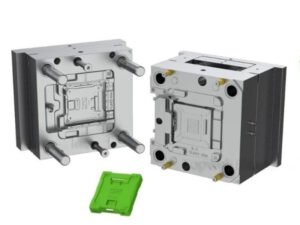
An aluminum injection mold is a mold tool manufactured primarily from aluminum alloys instead of traditional mold steels. Like steel molds, aluminum molds contain core and cavity components that define the shape, dimensions, and surface features of an injection molded part.
The main difference between aluminum molds and steel molds comes from the material properties of the mold base and cavity components.
Faster Machining Speed
Aluminum alloys are softer and easier to machine compared with hardened steel. CNC machining operations such as CNC milling, drilling, and cavity finishing can usually be completed in less time. This shorter machining process reduces tooling lead time, which is especially valuable during product development stages where engineers may need several design iterations before final production.
Better Thermal Conductivity
Aluminum has higher thermal conductivity than most steel materials used for injection tooling. This allows heat from molten plastic to transfer through the mold more efficiently. In some applications, improved heat transfer can help shorten cooling cycles and improve production efficiency.
Common Aluminum Alloys Used for Injection Molds
The performance of aluminum injection molds depends significantly on the selected aluminum alloy. Different alloys provide different levels of hardness, machinability, corrosion resistance, and surface finishing capability.
6061-T6 Aluminum
6061-T6 is one of the most commonly used general-purpose aluminum alloys. It offers good machinability, corrosion resistance, and balanced mechanical properties.
This material is often selected for prototype molds, low-volume injection molding, and projects where fast manufacturing and cost control are priorities.
However, compared with harder aluminum grades, 6061-T6 has lower wear resistance. It is better suited for applications with moderate production requirements rather than long-term continuous molding.
7075-T6 Aluminum
7075-T6 aluminum provides higher strength and hardness compared with 6061-T6. Its improved mechanical properties make it more suitable for applications requiring better dimensional stability and increased mold durability.
For projects with higher production volumes or more demanding tolerance requirements, 7075-T6 can provide better performance than standard aluminum grades.
However, higher hardness can increase machining difficulty and tooling cost compared with softer aluminum alloys.
QC-10 Aluminum
QC-10 is a mold-grade aluminum alloy developed specifically for tooling applications. It provides good machinability, dimensional stability, and surface finishing capability.
This material is commonly used when molded parts require better cavity surface quality, tighter control, or improved mold performance compared with general-purpose aluminum alloys.
Advantages and Disadvantages of Aluminum Injection Molds
Understanding the benefits and limitations of aluminum injection molds is important before selecting them for a project.
Advantages of Aluminum Injection Molds
Shorter Tooling Lead Time
The lower hardness of aluminum allows faster CNC machining and finishing. Compared with steel tooling, aluminum molds can often be completed within a shorter development cycle. This makes them suitable for companies that need to validate product designs quickly or move from prototype parts to initial production.
Lower Initial Tooling Cost
Aluminum molds generally require less machining time and lower material costs compared with steel molds. For products that may require design changes during development, using aluminum tooling can reduce the financial impact of multiple mold modifications.
Faster Cooling Performance
The higher thermal conductivity of aluminum allows heat to transfer more quickly from the molded part into the mold. Depending on the part design and cooling system, this can contribute to reduced cooling time and improved molding efficiency.
Easier Mold Modification
During product development, engineers often need to adjust dimensions, add features, or modify part geometry. Because aluminum is easier to machine, design changes can usually be implemented faster compared with steel molds.
Disadvantages of Aluminum Injection Molds
Lower Wear Resistance
Aluminum is softer than mold steel, which means the cavity surface is more vulnerable to wear during repeated injection cycles. Materials containing abrasive additives, such as glass fibers or mineral fillers, can accelerate surface damage.
Shorter Mold Lifespan
Aluminum molds are generally designed for lower production volumes. They can provide reliable performance for many prototype and low-volume applications, but they are not usually selected for millions of production cycles. For long-term manufacturing, hardened steel molds typically provide better value.
Limited Material Compatibility
Some engineering plastics require high processing temperatures, high injection pressure, or contain abrasive fillers. In these situations, steel tooling may be a better option because it can maintain cavity accuracy and surface quality for a longer period.
Is Your Project Suitable for Aluminum Injection Molds?
Aluminum molds are not suitable for every injection molding project. The correct choice depends on production requirements and part specifications.
Choose Aluminum Injection Molds When:
Prototype Validation Is Required
For new product development, aluminum molds allow manufacturers to produce functional injection molded parts before investing in expensive production tooling. They are commonly used for design verification, assembly testing, and market evaluation.
Bridge Tooling Is Needed
Bridge tooling is used as an intermediate solution between prototype development and final production molds. When a company needs to start production while a long-life steel mold is being prepared, aluminum molds can provide a practical temporary solution.
Production Volume Is Below 50,000 Parts
For many low-to-medium volume projects, aluminum molds can provide sufficient mold life without the higher investment required for steel tooling. The exact lifespan depends on factors such as resin type, part geometry, mold design, and molding conditions.
Frequent Design Changes Are Expected
Products under development often require multiple revisions. Aluminum molds allow faster and more economical modifications, making them suitable for projects with evolving designs.
Avoid Aluminum Injection Molds When:
Glass Fiber Filled Materials Exceed 30%
Glass fiber reinforced plastics are highly abrasive. Continuous molding with these materials can cause faster cavity wear in aluminum molds. Steel molds are usually recommended for applications requiring long-term production with highly filled materials.
Hot Runner Systems Are Required
Hot runner systems involve additional thermal management and long-term operating requirements. For complex hot runner applications, steel molds are often preferred because they provide better durability under continuous production conditions.
Tight Tolerance Requirements Are Below ±0.025 mm
Applications requiring extremely tight dimensional control may benefit from steel tooling due to its higher hardness and dimensional stability.
Production Volume Exceeds 50,000 Parts
For larger production quantities, the longer lifespan of steel molds generally provides better cost efficiency over the entire manufacturing cycle.
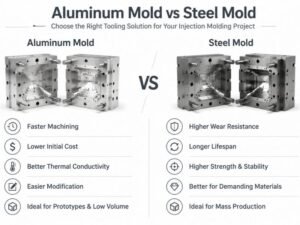
Aluminum Mold vs Steel Mold: Cost, Lead Time, and Lifespan
| Factor | Aluminum Mold | Steel Mold |
|---|---|---|
| Tooling Cost | Lower | Higher |
| Manufacturing Lead Time | Shorter | Longer |
| Machining Difficulty | Easier | More complex |
| Cooling Performance | Higher thermal conductivity | Lower thermal conductivity |
| Mold Lifespan | Suitable for low to medium volume | Suitable for high volume |
| Wear Resistance | Lower | Higher |
Design Considerations for Aluminum Injection Molds
Although aluminum molds are faster to manufacture, they still require proper injection mold design to achieve stable production.
Draft Angle Design
Draft angles help molded parts release from the cavity and core without excessive friction. Proper draft design reduces ejection force and prevents surface damage. This is especially important for aluminum molds because repeated friction can accelerate cavity wear. The required draft angle depends on factors such as plastic material, surface texture, and part depth.
Wall Thickness Design
Uniform wall thickness helps maintain consistent filling, cooling, and shrinkage behavior. Sudden thickness changes can create defects such as warpage, sink marks, and uneven cooling. Instead of adding unnecessary material thickness, designers should consider ribs, supports, and structural features.
Fillet and Corner Radius Design
Sharp corners can restrict plastic flow and increase stress concentration in molded parts. Adding appropriate fillets improves material flow and makes mold machining easier. Rounded corners also reduce stress on aluminum cavity surfaces during repeated molding cycles.
Conclusion
Aluminum injection molds provide a practical tooling option for prototype development, bridge tooling, and low-to-medium volume injection molding. However, aluminum molds have limitations in some other aspects. Before starting mold production, it is important to communicate closely with your tooling manufacturer and evaluate whether an aluminum mold or steel mold is more suitable for your project.
Jiangzhi provides professional mold manufacturing services and can help customers select and build the right tooling solution based on specific project requirements. Contact us to discuss your injection molding project.