Thread turning is one of the most precise and demanding operations performed on a lathe, responsible for the majority of load-bearing threads used across mechanical and industrial parts today. It behaves quite differently from ordinary turning, following its own set of rules and constraints. This article walks through what thread turning is, how the process actually unfolds on the machine, and how it compares to other threading methods, making it much easier to judge whether a threaded component has been made correctly.
What Is Thread Turning?
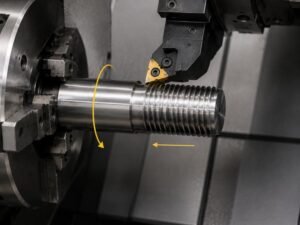
Thread turning is a lathe operation that cuts a helical groove — a thread — into a rotating workpiece, either on the outside surface (external threading) or inside a bore (internal threading). A single-point cutting tool, typically fitted with an indexable insert shaped to match the thread profile, moves along the workpiece at a precisely controlled rate while the spindle rotates.
The result looks simple: a spiral groove of consistent depth and pitch. Getting there, however, is a different matter entirely.
How Thread Turning Works
Thread turning works by synchronizing the tool’s feed rate to the spindle’s rotation, so the tool advances exactly one pitch per revolution, which is the defining constraint of the process. Unlike ordinary turning, where speed, feed, and depth of cut can be adjusted independently, this relationship is fixed. Any deviation can cause the thread geometry to break down.
Because of this, the full thread depth is never cut in one pass. It is divided into a series of progressively lighter passes, often 4 to 20 depending on pitch and material, to avoid overloading the insert’s nose radius and damaging the finish.
If you’re curious about how this fits into the broader turning process, refer to our guide to CNC Turning.
Types of Thread Turning: External vs. Internal Thread Turning
Not all thread turning is equal in difficulty, and that difference shows up directly in cost and lead time.
External threading is a process of cutting threads on the outside diameter of a workpiece. External threading is generally the more forgiving of the two, and this is reflected in the price. Fewer passes are typically needed, tool wear is more predictable, and most shops can hold tight tolerances without special tooling. If a design allows a thread to be external rather than internal, it is almost always the more economical choice.
Internal threading is a process of cutting threads inside a hole or bore. Internal threading is a different challenge altogether. The tool has to be longer and more slender to reach into the hole, which makes it more prone to deflection and chatter. Chip evacuation becomes a real problem, especially in blind holes. Machinists often address this with “pull threading”, using a left-hand tool to cut a right-hand thread, or vice versa, which pulls chips out toward the bore entrance rather than pushing them deeper in.
The deeper or smaller the internal thread, the more these constraints compound. As a rough guide, internal threads below roughly 10–12 mm in diameter, or with a depth-to-diameter ratio beyond 3:1, start to move from “routine” into “specialty” territory. These factors are worth flagging early in a design review, since they can meaningfully affect both cost and achievable tolerance.
Thread Turning Tools
A thread turning tool consists of a toolholder and an indexable insert ground to match the thread profile. Holders and inserts are matched by thread hand, including right-hand or left-hand, to properly support cutting forces during the pass. Inserts come in two main types:
- Full profile inserts cut both the crest and root in one pass, producing an exact match to a specific pitch. Accuracy is high, but each pitch requires its own insert.
- Partial profile inserts cut only the root, leaving the crest untouched. One insert can cover a range of pitches, making it more flexible but less precise than a full profile insert.
Infeed Methods: How the Tool Approaches the Cut
One detail that separates a well-executed thread from a mediocre one is the infeed method — essentially, the path the tool takes on each pass.
- Radial infeed feeds the tool straight into the thread profile. It’s the simplest method and works well for small pitches, but both flanks of the insert cut simultaneously, generating a V-shaped chip that’s harder to control and accelerates wear.
- Flank infeed angles the tool along one side of the thread profile. Chip control and heat dissipation improve, and it’s the standard approach on CNC lathes for larger pitches.
- Modified flank infeed adjusts that angle slightly further, eliminating the rubbing that plain flank infeed can cause on the non-cutting side. It’s frequently the preferred method for internal threads and finish-critical work.
How Thread Turning Compares to Other Threading Methods
Threads can be produced through tapping, thread milling, or thread turning. The main difference between these methods lies in how the cutting tool interacts with the workpiece.
Tapping uses a multi-edge cutting tool to form internal threads by cutting along the hole axis. Thread milling uses a rotating cutter to create threads through a helical motion. Thread turning uses a single-point threading tool on a lathe to create both internal and external threads.
The table below summarizes how the three methods typically compare:
| Factors | Tapping | Thread Milling | Thread Turning |
|---|---|---|---|
| Thread type | Internal only | Internal & external | Internal & external |
| Best-fit material | Standard materials | Hard/tough materials (stainless, titanium) | Standard to moderately hard materials |
| Relative speed | Fastest | Slower | Moderate |
| Tool breakage risk | Higher, especially in blind holes | Low | Low |
| Flexibility (sizes per tool) | Low — one tap per size | High — one tool, multiple sizes | Moderate |
| Ideal volume | High-volume, standard threads | Low-to-mid volume, difficult materials | Parts already being turned; precision-critical threads |
| Setup efficiency | Separate operation | Separate operation | Same setup as turning |
None of these methods is categorically “best.” Each method has its own suitable application range. Tapping is often preferred for high-volume production of standard internal threads where machining speed is the priority. Thread milling is a strong choice for difficult materials, larger threads, or applications requiring greater flexibility. Thread turning is particularly suitable for parts already processed on a lathe, especially when thread accuracy and alignment with other turned features are important.
How Thread Quality Is Controlled
A few practices consistently help ensure reliable thread performance and prevent downstream issues:
- Verify pitch precisely. Thread pitch should be checked with thread gauges or optical measurement to identify deviations before they affect part fit, cause binding, or lead to premature wear.
- Match flank finish to the thread load. A clean and consistent flank surface reduces friction and improves durability under repeated loading, while rough or uneven flanks can reduce fatigue life.
- Maintain consistency throughout the production batch. A thread that passes inspection on the first part but gradually changes during production may indicate tool wear or an unsuitable infeed method. In-process checks help identify these issues before they affect more parts.
- Apply the correct lead-in chamfer. A chamfer of around 30° with slightly greater depth than the thread helps protect the insert during initial engagement and improves assembly.
Good thread quality starts before machining begins. Proper thread specifications, suitable tolerances, and consideration of material and application requirements help create a more reliable and efficient manufacturing process.
Conclusion
Thread turning may seem like a small part of machining, but it requires high precision. Factors such as feed-to-pitch synchronization, infeed methods, and thread type determine whether the finished thread meets performance requirements.
Achieving consistent thread quality requires careful control of the machining process, tooling, and setup. At Jiangzhi, we provide CNC machining solutions for threaded components used in custom assemblies, including precision-turned metal inserts and fittings. Contact our team to discuss your project.