
Threads are one of the most common features in machined parts. They hold assemblies together, transmit motion, and allow parts to be adjusted or removed. Thread milling is one of the most reliable methods for producing precise, durable threads, especially in demanding applications. This guide explains what thread milling is, how it compares to tapping, and when it makes sense for your project.
What Is Thread Milling?
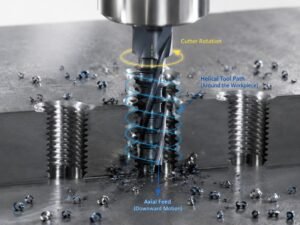
Thread Milling is a CNC machining process that uses a rotating thread mill to cut threads by moving along a helical path inside or around a workpiece. A thread mill moves in a helical path around the workpiece while also rotating on its own axis. This combined motion cuts the thread profile gradually, pass by pass, rather than forming it in a single stroke.
How Does Thread Milling Work?
Thread milling relies on a machining technique called helical interpolation. The CNC machine moves the cutter in a circular path around the hole while simultaneously feeding it downward (or upward) along the thread’s pitch. Three axes move together to create this motion, which requires a CNC milling machine capable of coordinated multi-axis control.
The process typically takes multiple passes to reach full thread depth, with the number of passes depending on material hardness, thread size, and desired finish. To learn more about the equipment and processes behind this, see our guide about CNC Milling.
Thread Milling vs. Tapping
Tapping and thread milling are the two most common methods for producing internal threads. Both are widely used, but they differ in speed, flexibility, and suitability for different materials and part designs.
| Factor | Thread Milling | Tapping |
|---|---|---|
| Speed | Slower, multiple passes required | Faster, single pass |
| Tooling | One tool can cut multiple thread sizes | Requires a dedicated tap for each size and pitch |
| Thread quality | Smoother, more consistent finish | Can be rougher, especially in hard materials |
| Hard materials | Well suited to titanium, stainless steel, Inconel | Higher risk of tap breakage in hard materials |
| Blind holes | Better chip evacuation, lower breakage risk | Chips can pack at the bottom of the hole |
| Tool cost | Higher upfront tool cost | Lower cost per tool |
| Programming | Requires CNC programming and helical interpolation | Simple, standard G-code cycles |
| Best for | Low to medium volume, custom or hard-to-machine parts | High volume runs of standard thread sizes |
When Should You Use Thread Milling?
Use thread milling when the material or the part itself makes tapping risky. In hard alloys like stainless steel, titanium, or Inconel, the tool engages only a small portion of material at a time instead of cutting the full thread profile in one pass, which keeps cutting force low and reduces tool wear. That same light cutting force protects thin-wall parts from distorting under pressure, and it lowers the chance of a tap snapping off in a blind or deep hole, where a broken tool is difficult and costly to remove.
It is also worth using on high-value components, where the extra control is cheap insurance against scrapping an expensive part. And because a thread mill can adapt to different thread sizes through programming rather than a dedicated tool, it fits naturally into small batch and custom work, where requirements change from one order to the next.
Types of Thread Milling Cutters and How to Choose
Different thread milling cutters suit different applications. Choosing the right one depends on thread size, material, and production volume.
Single-Form Thread Mills
These cutters have a single row of cutting teeth shaped to match one thread pitch. They cut the full thread profile over several passes and are commonly used for large diameter threads or custom pitches.
Multi-Form Thread Mills
These cutters have several rows of teeth stacked along the tool length, allowing them to cut a full thread in fewer passes than a single-form cutter. They are efficient for medium to large batches with a consistent thread size.
Indexable Thread Mills
These use replaceable carbide inserts rather than a solid cutting edge. When an insert wears out, it can be replaced without changing the entire tool, which reduces tooling costs over long production runs.
Solid Carbide Thread Mills
Made from a single piece of carbide, these tools offer high rigidity and wear resistance. They are well suited to hard materials such as stainless steel and titanium, and are often the preferred choice when thread quality and tool life are top priorities.
Advantages of Thread Milling
Compared with tapping, thread milling offers several practical benefits that make it a preferred choice for many precision and custom machining jobs. The main advantages include:
Cleaner, More Consistent Threads
Because the cutter removes material gradually across several passes, the resulting thread surface tends to be smoother and more uniform, an advantage that becomes more noticeable when working with harder alloys.
One Tool, Multiple Thread Sizes
A single thread mill can often handle several diameters and pitches within its range, so shops do not need to keep a separate tool on hand for every thread variation they encounter.
Lighter Cutting Forces, Fewer Tool Failures
The cutting action puts less strain on both the tool and the part than tapping does, which helps prevent breakage in situations that are typically harder on tooling, such as blind holes or dense materials.
Choosing the right threading process affects both part quality and production cost. If you are unsure which approach fits your part, our engineering team can help you decide.
Limitations of Thread Milling
Despite its advantages, thread milling is not always the most practical choice.
Higher Setup Complexity and Initial Requirements
Thread milling requires CNC equipment, specialized cutters, and helical interpolation programming, which increases setup time and preparation costs compared with standard tapping. This makes it less economical for simple, high-volume threading applications.
Challenges with Very Small Diameter Threads
For extremely small threads, such as those found in watches or some medical devices, the tool size and machining conditions may limit achievable accuracy. Tapping or thread grinding may be better suited for these applications.
Design and Machining Tips for Successful Thread Milling
Getting consistent results from thread milling depends on a few key practices. Keep the following in mind:
1. Select the Correct Cutter Diameter: Choose a cutter diameter that leaves enough clearance inside the hole for the helical tool path, typically no more than about two-thirds of the hole diameter.
2. Optimize Tool Path and Cutting Strategy: Plan the entry and exit moves carefully to avoid marking the thread surface, and use a smooth helical ramp rather than a direct plunge into the cut.
3. Use Proper Radial Passes: Splitting the cut into multiple radial passes, rather than removing all material in one pass, reduces tool wear and improves thread accuracy.
4. Ensure Effective Chip Evacuation: Use appropriate coolant and, where possible, program the tool path to help chips clear the hole, particularly important for blind and deep holes.
5. Maintain Proper Cutting Parameters: Match spindle speed and feed rate to the material and tool manufacturer’s recommendations. Parameters that are too aggressive can shorten tool life and affect thread quality.
Thread Milling for Precision CNC Machining
Thread milling delivers the precision and consistency many CNC parts require, but results depend on the right tooling, process planning, and a manufacturing partner who can execute it reliably.
At Jiangzhi, our CNC milling services include precision thread milling for custom and wholesale orders. We work with a range of metal materials and support both prototype and production volumes, from small batch custom sizes to ongoing wholesale supply, with quality checks in place to maintain thread accuracy across every batch.
Whether you need a single custom part or an ongoing supply of threaded components, our team can help you select the right machining solution for your material and application. Contact us to get a quote for your project.


