CNC machining services offer precision and efficiency in producing complex components across various materials in the modern manufacturing industry. Among the most commonly used machines are the CNC mill vs CNC router. Both machines serve similar purposes but have significant differences that make them suitable for different applications.
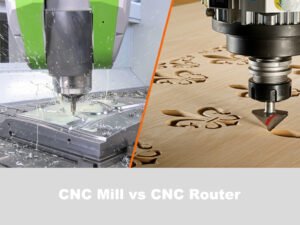
What is a CNC Mill?
A CNC mill is a versatile machine used for machining solid materials into precise shapes using a rotating tool. The machine operates on multiple axes (3, 4, 5-axis), allowing for intricate and detailed cutting of metals, plastics, and other hard materials. CNC mills are designed to handle operations such as drilling, turning, and shaping, and they can produce components with high precision and tight tolerances.
How Does a CNC Mill Work?
In a CNC milling machine, a rotating cutter (tool) is used to remove material from a workpiece. The machine’s computer-controlled system moves the workpiece and tool along the predetermined axes, enabling it to cut the material into the desired shape. The process often involves various steps, including roughing (initial cuts) and finishing (detailed cuts). The machine’s rigid structure, combined with its multi-axis control, enables the production of complex shapes and intricate details with exceptional accuracy.
What is a CNC Router?
A CNC router is a similar machine but typically used for cutting softer materials like wood, plastics, foam, and some metals. CNC routers are generally lighter in construction and are optimized for high-speed operations that involve larger parts. The frame is usually constructed from aluminum or composite materials for a lighter weight. They are often used in industries such as woodworking, sign-making, and large-scale plastic fabrication.
How Does a CNC Router Work?
CNC routers operate in much the same way as CNC mills, using a rotating tool to cut material. However, routers are usually designed for higher speeds and larger working areas. The router’s movement is controlled via computer software, guiding the tool to make precise cuts based on pre-programmed instructions. While the cutting speed is typically faster than that of a CNC mill, routers are less rigid and are best used for less precise, larger-scale work compared to the CNC mill.
Key Differences: CNC Mill vs CNC Router
When comparing CNC mill vs router, several factors highlight their distinctions. Here are the main differences.
Processing Materials
CNC mills are best suited for hard materials such as metals (aluminum, steel, etc.), composites, and even tougher plastics. In contrast, CNC routers are more suited for softer materials like wood, foam, and certain plastics. While they can handle light metals, they are not as effective when it comes to working with harder materials due to their lighter structure and higher cutting speeds.
Precision and Tolerances
CNC mills achieve high precision, with positioning errors as low as 0.005 mm and surface finishes of Ra 0.4 to 1.6 microns. This makes them ideal for parts requiring tight tolerances. CNC routers offer accuracy around 0.05 to 0.2 mm, which is sufficient for many applications but not for high-precision work due to potential vibrations.
Tools and Cutting Capabilities
CNC mills support a wide range of tools, including end mills, face mills, drills, and taps made from high-speed steel or carbide. They can perform deep cuts over 10 mm and handle side milling. CNC routers use tools like straight bits, V-groove bits, and ball-end mills, focused on shallow cuts up to 20 mm.
Speed and Torque
CNC routers operate at speeds of 18,000 to 30,000 RPM, suitable for quick cuts in soft materials. CNC mills run at 8,000 to 15,000 RPM but provide higher torque, from 10 to 50 Nm, for cutting tougher materials.
Structure and Rigidity
CNC mills are built with a more rigid structure to support the high cutting forces involved in machining metals. CNC routers, in contrast, have a less rigid structure. While this allows them to achieve faster cutting speeds, it also limits their ability to maintain precision when cutting harder or more detailed parts.
Working Area (Part Size)
CNC milling is suited for compact parts. Typical parts range from small brackets (under 500 g) to medium-sized components, with work envelopes limited to around 1×2 meters. CNC routing handles large parts effectively. Parts can be up to several meters in size, such as full sheets of material.
Operation Difficulty (Software)
Operating a CNC mill requires advanced software like Fusion 360 or Mastercam, involving complex path programming. CNC routers use user-friendly programs such as Aspire or VCarve, with simpler interfaces for beginners.
Cost Differences
Parts from CNC milling often carry higher per-unit costs due to material handling, tooling, and longer machining times. CNC routing parts are generally more cost-effective because of Lower material costs, faster production, and simpler setups, which reduce expenses.
Typical Applications: CNC Mill vs CNC Router Comparison
In practical use, the CNC mill vs CNC router machine distinction influences their roles. CNC mills are used in industries requiring precision, such as aerospace for turbine blades from heat-resistant alloys, automotive for molds with complex surfaces, and medical for titanium implants with micro-features.
CNC routers apply to scenarios with larger, softer materials, like furniture prototyping for wooden components, signage production for foam or plastic boards, and packaging for routing plastic enclosures.
How to Choose the Right Processing Equipment?
Selecting between CNC mill vs CNC router depends on project requirements.
- First, consider the materials: hard metals favor mills, while soft sheets suit routers.
- Next, evaluate precision needs: tight tolerances point to mills, looser ones to routers.
- Then, consider the part size. For larger components or mass production of non-metal parts, a CNC router may be more efficient.
- Budget and space are factors; routers are cheaper and easier to set up for startups.
Conclusion
CNC mill vs CNC router is not a matter of one being better than the other, but rather choosing the right tool for the job. CNC mills excel in precision and the ability to work with hard materials, while CNC routers are faster and better suited for softer materials and large parts. By understanding the key difference between the CNC router and CNC mill and evaluating the specific needs, you can select the best CNC machining solution for your project. For more information or if you have any questions about precision CNC machining services, feel free to contact our team at Jiangzhi for expert advice and tailored solutions.