Holding pressure in injection molding plays a critical role among the many parameters. While injection pressure fills the mold cavity, holding pressure ensures that the part maintains dimensional accuracy, surface quality, and structural integrity as it cools and solidifies。
What is Holding Pressure in Injection Molding?
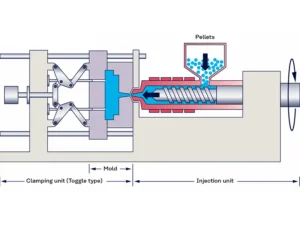
Holding pressure, often referred to as packing pressure, is the pressure applied after the mold cavity has been filled but before the part has fully cooled. Its main function is to compensate for material shrinkage and maintain the intended geometry. Holding pressure primarily pushes molten plastic into the mold during the filling stage. Holding pressure ensures that the material remains properly packed as it solidifies, preventing voids and sink marks. During the molding cycle, the sequence typically follows: filling → packing/holding → cooling → ejection. Holding pressure begins immediately after filling and lasts until the gate freezes, meaning the flow of plastic from the sprue to the cavity effectively stops.
Difference Between Holding Pressure and Injection Pressure
Injection pressure and holding pressure serve distinct purposes in the molding cycle.
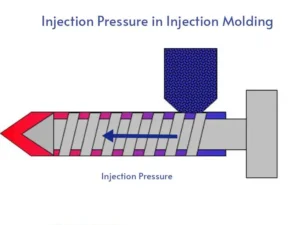
- Injection pressure is applied during the filling stage to force molten plastic into the mold cavity. Its main goal is to fill the cavity completely and uniformly. It drives the high-speed filling of the mold cavity and operates under velocity control, with the screw moving at a set speed to achieve rapid fill, usually reaching peak pressures to overcome flow resistance.
- Holding pressure uses lower values—commonly 50-65% of peak injection pressure, or about 0.6-0.8 MPa below the transfer pressure. The screw speed drops significantly, and the focus shifts to sustained pressure rather than speed.
Why Holding Pressure Matters for Part Quality
Holding pressure in injection moulding directly influences final part performance. As plastic cools, it shrinks, creating voids or surface irregularities if uncompensated. Adequate holding pressure packs additional material to offset this shrinkage, leading to uniform density and stable dimensions.
For materials with high shrinkage rates, such as semi-crystalline resins, holding pressure becomes especially important. It helps achieve tight tolerances, minimizes warpage from differential cooling, and improves mechanical properties like strength and impact resistance. In production environments, consistent holding pressure reduces shot-to-shot variation, supporting better process capability indices (Cpk).
Common Defects from Incorrect Holding Pressure
Incorrect holding pressure can produce a variety of defects, impacting both appearance and function.
Holding Pressure Too Low
When holding pressure falls short, shrinkage proceeds unchecked:
- Sink marks appear on surfaces, particularly over ribs, bosses, or thick sections.
- Internal voids or shrinkage holes form within the part.
- Overall, the part size becomes undersized.
- Dimensional variation increases across shots.
- Warpage occurs due to uneven shrinkage.
- Weld lines remain visible or weak.
- Backflow causes orientation issues near the gate.
These problems are more pronounced in thin-walled parts, long-flow distances, or crystalline materials.
Holding Pressure Too High
Excessive holding pressure overpacks the cavity:
- Flash develops along parting lines or vents.
- Gate blush, stress marks, or vestiges appear near the gate.
- Parts stick during ejection, leading to deformation or cracking.
- Residual stresses build, risking delayed cracking or creep.
- Differential density causes warpage despite a high pack.
- Clamp force requirements rise, potentially damaging the mold.
Thick sections or small gates amplify these effects.
How to Set Holding Pressure in Injection Molding
Setting holding pressure requires a systematic approach based on material, part geometry, and machine capabilities.
Start with 50-65% of peak injection pressure observed during filling. Adjust in increments of 5-10% while monitoring part weight, critical dimensions, and visual quality.
Key considerations when setting holding pressure:
Holding time: Set duration until gate seal occurs, typically 25-35% of cooling time. Perform a gate-seal study by incrementally increasing hold time until part weight stabilizes—no additional material enters after seal.
Material-specific ranges: Amorphous resins tolerate wider variations; crystalline types often need higher initial pressure and tighter control.
Mold temperature stability: Consistent mold temperature interacts strongly with holding pressure—changes of 10-20°C may require 10-20% pressure adjustments.
Holding Pressure Strategies in Injection Molding
Modern injection molding employs several strategies to optimize holding pressure:
- Multi-Stage Holding Pressure: Instead of a single constant pressure, the process uses a high initial pressure followed by a reduced pressure phase. This approach compensates for shrinkage while minimizing stress.
- Pressure Ramping or Decay: Gradually reducing pressure over the holding phase can prevent overpacking and reduce residual stress.
- Time Coordination: Holding pressure is carefully coordinated with cooling time to ensure complete gate freeze before release.
- Data-Driven Adjustments: Advanced molding machines often include sensors and feedback systems to adjust holding pressure dynamically, improving part consistency and reducing scrap rates.
Conclusion
Holding pressure in injection molding is a critical factor for achieving high-quality, precise, and defect-free parts. Correctly managing packing pressure and injection molding pressure settings ensures dimensional stability, superior surface finish, and consistent mechanical performance. At Jiangzhi, with rich experience in custom plastic injection molding and full-service capabilities from mold design to high-volume production, we help clients implement these best practices effectively. Contact us today to discuss your project and receive expert support for reliable, high-quality molded parts.