
Injection molding clamping force is a central parameter in producing consistent plastic parts. Manufacturers rely on accurate clamp force management to maintain mold closure during injection. Without proper attention to injection molding clamping force, defects appear, and production costs rise.
What Is Injection Molding Clamping Force?
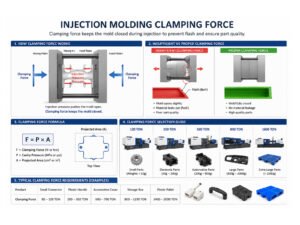
Injection molding clamping force is the force that holds the two halves of a mold together while molten plastic is injected under pressure. It acts against the internal pressure generated inside the mold cavity. The machine’s clamp unit generates this force, usually measured in tons.
Clamping force keeps the mold securely closed so that plastic does not escape at the parting line. It also ensures the mold remains stable throughout the filling, packing, and cooling phases. Different machines use different systems to generate this force, such as toggle mechanisms or hydraulic cylinders, but the purpose stays the same: to counteract the pressure of the melt.
Basic Calculation Formula of Injection Molding Clamping Force
The standard approach to estimate the required clamping force follows this formula:
Clamping Force (tons) = (Projected Area (cm²) × Average Cavity Pressure (kg/cm²) × Safety Factor) / 1000
Sometimes use variations based on units. In imperial units, the calculation often becomes:
Clamp Force (US tons) = Projected Area (in²) × Melt Pressure (psi) / 2000 or similar adjusted constants.
- Projected area refers to the area of the part as seen from the direction of clamp movement.
- Cavity pressure is the maximum pressure exerted by the molten plastic. It depends on material, part geometry, and process settings.
- The safety factor is a multiplier accounting for variations in material properties, cavity design, and process inconsistencies. The number typically ranges from 1.5 to 2.5, depending on the application.
How to Calculate Injection Molding Clamping Force?
Calculating the correct clamping force is not just about plugging numbers into a formula. It requires a systematic approach to ensure accuracy and reliability. The calculation typically involves four steps:
1. Calculate Product Projected Area
Start by determining the projected area of all cavities as viewed along the clamp axis. For a flat rectangular part, multiply length by width. For multi-cavity molds, add the projected areas of all parts plus any runners that lie across the parting line. Ignore features that run parallel to the clamp direction, such as tall ribs or bosses, because they do not contribute to separating force. Software or simple CAD measurements can provide accurate values quickly.
2. Estimate Cavity Pressure
Typical cavity pressure values range from 300 to 800 kg/cm², depending on the material viscosity and type, wall thickness, part geometry, number of cavities in the mold, injection speed,d and temperature. Thin-walled parts or high-viscosity materials such as polycarbonate require higher pressures. Thicker parts made from easy-flow materials like polypropylene need lower pressures. Jiangzhi engineers often start with recommended values based on material data sheets and experience.
3. Apply Safety Factor
Multiply the result by a safety factor. Safety factors typically range from 1.1 to 1.5, depending on the risk tolerance and precision requirements of the production run. Use higher factors (up to 2.5) for materials with high shrinkage, glass-filled compounds, or molds with complex geometries. Lower factors may apply when processing data from sensors shows consistent low pressure and the mold has excellent venting.
4. Convert to Machine Tonnage
Once the projected area, cavity pressure, and safety factor are known, the final calculation converts these parameters into machine tonnage. Divide the final figure by 1000 to obtain metric tons.
Example Calculation
Consider a simple single-cavity part with a projected area of 200 cm², a recommended cavity pressure of 80 kg/cm², and a safety factor of 1.2. The required clamping force would be calculated as: Clamping Force = (200×80×1.2)=19.2 tons
Why is Clamping Force Critical in Injection Molding?
The correct clamping force is more than a mere technical specification—it directly impacts product quality, mold longevity, and operational efficiency. The consequences of incorrect clamping force can be severe.
When the clamping force is too low, the mold may open slightly under injection pressure. This can cause:
- Flash: Excess plastic escaping from the mold cavity
- Short Shots: Incomplete filling of the mold
- Dimensional Inaccuracy: Parts failing to meet tight tolerances
Overly high clamping force can strain both the machine and the mold, leading to:
- Premature wear of machine components and mold surfaces
- Higher energy consumption
- Increased maintenance costs
Key Factors Affecting Clamping Force
Several variables determine the final clamping force needed:
- Material Properties: Materials with higher viscosity or those containing glass fibers demand higher pressures. Shrinkage behavior also influences packing pressure requirements.
- Part Design: Larger projected areas and thinner walls increase force needs. Complex geometries with varying wall thicknesses create localized high-pressure areas.
- Mold Design: Cavity layout, runner size, gate type, and venting quality all affect pressure distribution. Poor venting forces higher clamp settings to compensate for air traps.
- Process Parameters: Higher injection speeds and lower melt temperatures raise peak pressures. Holding pressure and time also contribute to the total force requirement.
- Machine Characteristics: Toggle machines and hydraulic machines behave differently at various force levels. Platen deflection and parallelism directly impact effective clamping.
How to Optimize Clamping Force Requirements?
Optimizing clamping force requires a combination of design insight, material knowledge, and process control.
Optimize Material Selection
Different plastics require different injection pressures. For instance, polycarbonate and ABS often need higher cavity pressures than polyethylene. Correctly matching material and machine specifications reduces unnecessary clamping.
Optimize Mold Design
Factors such as the number of cavities, runner system design, and wall thickness uniformity influence the required clamping force. Balanced cavity layouts and uniform wall thickness help minimize excessive force requirements.
Optimize Vent and Exhaust Systems
Adequate venting prevents trapped air from increasing resistance during injection, allowing lower clamping forces to produce defect-free parts.
Dynamic Adjustment
Many modern injection molding machines offer adjustable clamp force during the cycle. Fine-tuning the force based on part geometry and injection stage improves both quality and energy efficiency.
Use Simulation Tools
Mold flow analysis and simulation software can predict cavity pressures and identify potential issues before manufacturing, guiding proper clamping force selection.
Common Misconceptions About Clamping Force
Several misunderstandings appear regularly in production environments.
Selecting a Machine Based on Maximum Tonnage
Many assume that a machine with higher clamping capacity is always better. In reality, oversizing can lead to unnecessary energy consumption and mechanical stress.
Ignoring Material Differences
Treating all plastics as equal can result in either insufficient or excessive clamping, depending on the material’s viscosity and shrinkage characteristics. Each material needs its own evaluation.
Poor Venting Design
Assuming the mold will automatically vent properly can cause air entrapment and flash, despite adequate clamping force.
“More is Better” Mentality
Simply increasing the clamping force does not solve defects. The correct force balances pressure, mold design, and material behavior.
Conclusion
Injection molding clamping force is a critical yet often underestimated factor in manufacturing high-precision plastic parts. At Jiangzhi, we combine accurate force calculation with real-world process validation, regularly reviewing cavity pressure and part quality data to optimize every injection molding run. This ensures stable production, lower defect rates, and cost-efficient high-quality injection-molded components.


