
Insert molding is a specialized injection molding process used to integrate metal, ceramic, or other rigid components directly into a plastic part during molding. By eliminating secondary assembly, it improves structural strength, reduces production cost, and enables more compact product designs.
Because insert molding combines different materials in a single molding cycle, insert molding design must be carefully engineered to ensure reliable part performance. Proper design helps prevent common defects such as voids, warping, insert misalignment, and poor bonding, while ensuring manufacturability and consistent quality in production.
How does Insert Molding Work?
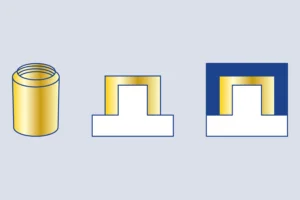
Insert molding begins by placing a pre-formed insert into a mold cavity. The mold is then closed, and molten plastic is injected under high pressure.
During injection, the plastic flows around the insert and fills the cavity completely. As the material cools and solidifies, it mechanically locks and sometimes partially bonds to the insert surface, forming a single integrated component.
Unlike standard injection molding, which produces a single-material part, insert molding creates a hybrid structure that combines the strength of metal or ceramic with the flexibility of plastic.
Why does Insert Molding Need Special Design Considerations?
Insert molding introduces several engineering challenges that do not exist in conventional molding processes. These factors directly influence how insert molding should be designed.
Thermal imbalance
Metal or ceramic inserts absorb heat from the molten plastic, causing uneven cooling rates. This can lead to shrinkage stress, warping, or cracking.
Flow disruption
The insert changes how plastic flows inside the cavity. Improper design can result in weld lines, air traps, or incomplete filling.
Mechanical stress concentration
Differences in shrinkage between materials create internal stress around the insert, increasing the risk of cracking or deformation.
Insert stability
If the insert is not properly secured, it may shift or rotate during injection, affecting dimensional accuracy and functionality.
Key Design Considerations for Insert Molding
Before designing an insert molding part, several key factors must be considered to ensure reliable performance and stable mass production. These include material selection, insert geometry, mold design, process control, and manufacturability requirements.
1. Material Selection
Successful insert molding starts with selecting compatible materials.
- Insert materials: Typically steel, brass, aluminum, or ceramic. Surface texture and thermal conductivity directly affect bonding performance.
- Plastic materials: Should have good flowability and controlled shrinkage to ensure complete encapsulation and stable dimensions.
Material mismatch can significantly increase internal stress and reduce part reliability.
2. Insert Design Considerations
Insert geometry plays a critical role in bonding strength.
- Add knurls, grooves, or threads to improve mechanical interlocking.
- Ensure the insert is embedded with sufficient plastic coverage (typically at least 0.4 mm or more on all sides).
- Use proper boss-to-insert ratios (commonly 1.5× diameter) to improve structural stability.
These features help prevent delamination and improve long-term retention.
3. Mold Design Considerations
Mold design must be adjusted to accommodate the presence of the insert.
- Gate location: Must ensure balanced flow around the insert to prevent air traps or weld lines.
- Venting system: Proper venting reduces the risk of voids caused by trapped air.
- Cooling layout: Must compensate for heat concentration caused by metal inserts to avoid uneven shrinkage.
Good mold design ensures stable filling and consistent part quality.
4. Process Control
Process parameters directly affect final part quality.
- Injection speed must be controlled to avoid insert displacement.
- Injection pressure should be balanced to ensure full cavity filling without overstressing the insert.
- Temperature must be optimized to maintain flowability while minimizing thermal stress.
Stable process control is essential for repeatable production.
5. Design for Manufacturability (DFM)
Insert molding design must also consider mass production feasibility, not just part performance.
- Insert positioning affects cycle time and automation feasibility, especially in high-volume production.
- Manual vs automated insert loading impacts consistency, cost, and production efficiency.
- Tolerance stack-up between the insert and mold cavity can influence dimensional accuracy and assembly stability.
- In mass production, small variations in insert placement may lead to significant part-to-part inconsistencies.
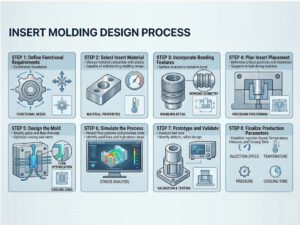
Step-by-Step Insert Molding Design Workflow
A structured design process helps reduce risk and improve manufacturability.
- Define functional requirements, including mechanical, electrical, and thermal needs
- Select compatible insert and plastic materials
- Design mechanical interlocks, such as grooves or knurls, on the insert
- Plan insert positioning and ensure stable fixturing inside the mold
- Optimize mold design, including gates, vents, and cooling channels
- Simulate filling behavior using injection molding analysis tools
- Build prototypes and validate part performance
- Finalize production parameters based on test results
Common Defects and How to Prevent Them
Common issues in insert molding parts include:
- Sink marks from thin wall sections
- Cracking caused by shrinkage stress
- Insert shifting due to poor fixing
- voids or short shots from trapped air
- Warping can result from uneven cooling
- Poor adhesion due to insufficient mechanical interlocking
- Flow lines and weld marks from disrupted melt flow
Most of these problems can be prevented through proper wall thickness design, secure insert positioning, optimized mold flow, effective venting, and well-planned cooling.


