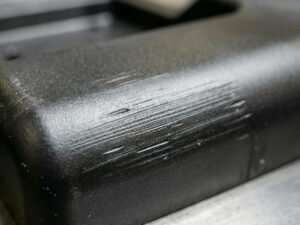
What Causes Drag Marks in Injection Molding?
Drag marks in injection molding occur when the frictional force during ejection exceeds the surface strength of the plastic part. Three main categories account for nearly all instances of this defect.
Product Design
Insufficient draft angles on vertical walls, sharp transitions, or narrow ribs in the part geometry often lead to high friction during ejection. Jiangzhi avoids this by conducting a thorough DFM review at the quotation stage. We check all vertical features for adequate draft (typically 1.5° or more) and recommend geometry adjustments before tooling begins, ensuring the design supports smooth release from the start.
Mold Factors
Rough cavity surfaces, improper polishing direction, misaligned ejector pins, or wear on the mold core commonly create localized friction points that produce drag marks. We prevent these issues through scheduled maintenance. We polish vertical walls to the required surface finish, verify ejector alignment, and apply protective coatings, keeping the mold in optimal condition for consistent part release.
Process Conditions
Excessive packing pressure, uneven cooling, or suboptimal mold temperatures can increase material adhesion and shrinkage forces against the mold wall. Jiangzhi minimizes this risk by standardizing process validation for every material batch or mold setup. We monitor cooling uniformity within ±2°C and adjust parameters based on real-time data, ensuring process settings do not amplify friction during ejection.
Injection Molding Drag Marks by Severity
Drag marks are surface defects caused when the molded part rubs against the mold during ejection. Different levels of drag marks require different handling depending on product appearance and functional requirements.
1. Light Drag Marks
Light drag marks are shallow and only slightly visible.
How to handle:
- Acceptable for hidden or non-cosmetic areas
- Can be reduced by light polishing or minor process adjustment
- Usually acceptable for industrial parts
2. Medium Drag Marks
Medium drag marks are clearly visible and may affect product appearance.
How to handle:
- Rework by polishing if possible
- Use for internal or less visible applications
- Often rejected for consumer-facing products
3. Heavy Drag Marks
Heavy drag marks are deep scratches or grooves.
How to handle:
- Usually rejected
- May require remolding or mold correction
- Not suitable for cosmetic, precision, or transparent parts
4. Quality Control Suggestion
The acceptable level depends on the product use:
- Industrial parts: Light marks may be accepted
- Consumer products: Very light or no marks preferred
- Decorative or clear parts: No drag marks allowed
Jiangzhi can control drag marks based on your product quality standards and application needs.
How to Prevent Drag Marks in Future Projects?
Prevention is always more efficient than correction. Structured procedures integrated into project workflows and daily operations will prevent the defect effectively.
Design Optimization
Begin with a mandatory design for manufacturability review at the quotation stage. Require three-dimensional models that include specified draft angles on all vertical surfaces. Flag features below one degree of draft or with high aspect ratios. Suggest minor geometry adjustments that maintain functional requirements while improving release characteristics. This step catches potential issues before steel is cut.
Mold Quality and Maintenance
Establish standardized mold maintenance intervals based on shot count. After every 5,000 to 10,000 cycles, schedule cleaning and polishing of cavity surfaces, with particular focus on vertical walls and ejector areas. Inspect and realign the ejection system at the same interval to prevent progressive misalignment. You can get more details from our guide to mold maintenance.
Process Control
Implement process standardization for every material batch change or mold installation. Conduct a full parameter validation run on the first articles, recording injection pressure, cooling time, and mold temperature at each step. Employ mold flow analysis using flow simulation software during tool design to predict potential high-friction zones. Maintain cooling channel balance so that temperature variation across the mold stays within plus or minus two degrees Celsius.
Training and Best Practices
Train production teams and educate operators on identifying drag marks early in production. Analyze causes and record them in a shared knowledge base, and update standard operating procedures accordingly. Over multiple projects, this practice reduces overall defect rates to below one percent through accumulated, data-supported improvements.
Conclusion
Injection molding drag marks are a prevalent issue in plastic manufacturing, but with a structured approach, they can be identified, corrected, and prevented. Understanding the causes is essential for efficient troubleshooting. Jiangzhi can provide custom injection molding services, including careful product design, mold maintenance, and process optimization, which can significantly reduce the occurrence of drag marks in injection molding, ensuring high-quality parts and improved production reliability. Welcome to contact us and get a professional solution for your project.