
Metal heat treatment changes how a steel part or mold performs, and it also changes how that part measures. Two molds built to the same drawing can differ in service life, final tolerance, and price, depending on whether the steel was used as supplied or hardened after machining.
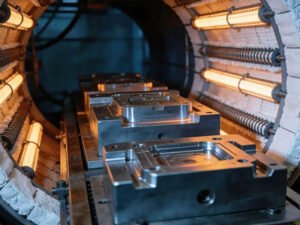
What Is Metal Heat Treatment?
Metal heat treatment is the controlled heating and cooling of a metal to change its internal structure and, with it, properties such as hardness, strength, toughness, ductility, wear resistance, and machinability. The shape of the part stays the same while its properties change. Temperature, time, and cooling rate are all specified, and together they determine the result.
Steel is the most common material, including tool steels, alloy steels, and stainless grades. Some non-ferrous metals, such as aluminum, copper alloys, and titanium, can also be heat treated, although not every metal hardens this way. The treatment usually follows forming or rough machining and brings the part to the properties its use requires.
How Does Metal Heat Treatment Work?
Most conventional heat treatment processes involve three stages: heating, soaking, and cooling. The temperature, holding time, and cooling conditions depend on the material grade and the intended properties.
Heating
The metal is raised to a target temperature set by the material and the process. Heating should be even, because large temperature differences within a part add to the risk of distortion.
Soaking
The metal is held at temperature long enough for the whole cross-section to reach it and for the structure to change. The time depends on section thickness and material. Too short leaves the surface and core inconsistent, and too long can coarsen the grain or decarburize the surface.
Cooling
The cooling rate sets the final structure. Rapid cooling, called quenching, produces a hard and brittle structure, while slow cooling in the furnace produces a soft and ductile one. Quenching media include water, oil, polymer solutions, and gas. The more severe the quench, the stronger the hardening and the higher the risk of distortion and cracking.
These stages must be planned together. A suitable heating temperature alone does not guarantee the required result. Cooling rate, part geometry, material composition, and subsequent tempering or finishing operations also influence final performance.
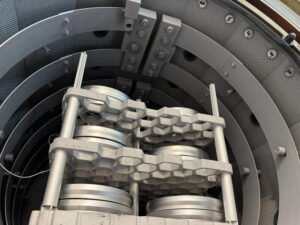
What Are the Main Types of Heat Treatment?
The main types of heat treatment differ in their purposes and effects on metal properties.
Annealing
Annealing involves heating a material to a specified temperature, holding it, and cooling it under controlled conditions. Annealing can make certain metals easier to machine or form. Depending on the material and annealing method, it can reduce hardness, improve ductility, relieve stress, or prepare the material for further processing.
Normalizing
Normalizing is commonly used for suitable steels. The steel is heated into the required transformation range and then cooled in still air under controlled conditions. This process can refine the microstructure and produce more consistent mechanical properties.
Normalizing is not interchangeable with annealing. The cooling conditions and resulting properties differ, so the choice depends on the steel grade and required performance.
Quenching
Quenching rapidly cools a suitable steel from its specified hardening temperature to develop a harder microstructure. The cooling medium and rate must be selected according to the steel grade, section thickness, and part geometry.
Tempering
Quenched steel can be hard but brittle, with residual stresses and distortion risks. Tempering is therefore commonly performed after quenching. It reheats the hardened steel to a specified temperature and holds it before cooling. This adjusts hardness and improves toughness for the intended application.
The combination of quenching and tempering is widely used for tooling and precision components that require a controlled balance of hardness, strength, and resistance to fracture.
Surface Hardening
Surface hardening increases the hardness or wear resistance of a part’s surface. Depending on the material and process, methods include carburizing, nitriding, and induction hardening.
- Carburizing introduces carbon into the surface of suitable steels.
- Nitriding introduces nitrogen into the surface of suitable steels.
- Induction hardening uses electromagnetic heating to harden selected regions of suitable steel components.
The following table summarizes common types.
| Heat treatment | Main purpose | Typical applications |
|---|---|---|
| Annealing | Reduce hardness and improve ductility or machinability | Softening before machining; stress relief after roughing |
| Normalizing | Refine or adjust the microstructure of suitable steels | Structural parts and shafts; improving structure before hardening |
| Quenching | Increase hardness in suitable steels | Tool steels, shafts, and wear-resistant components |
| Tempering | Reduce brittleness and adjust hardness and toughness | Hardened tools, molds, and machine components |
| Surface hardening | Increase surface hardness while retaining a tougher core where applicable | Gears, shafts, and selected mold components |
Heat Treatment for Mold Steel and Precision Parts
Heat Treatment for Mold Steel
Mold steel must withstand repeated mechanical loading, contact pressure, friction, and, in injection molding applications, thermal cycling. Some mold steels are supplied in a pre-hardened condition and may be machined without additional through-hardening. Other grades require hardening and tempering to achieve the specified hardness and wear resistance. Nitriding may be appropriate for certain mold steels when improved surface hardness and wear resistance are required.
A typical sequence for hardened mold steel is:
- Rough machining
- Stress relief
- Semi-finish machining
- Hardening and tempering, usually in vacuum
- Finish grinding and EDM
- Polishing and assembly
Heat Treatment for Precision Parts
Precision shafts, gears, fixtures, and CNC-machined components may require heat treatment to achieve their specified mechanical properties.
A common approach is to rough-machine the part, perform the required heat treatment, and then finish-machine or grind critical features. Rough machining removes most material before treatment, while subsequent finishing corrects dimensional changes and meets required tolerances.
This approach is not universal. The process plan should consider material behavior, distortion risk, stock allowance, and the required final surface finish.
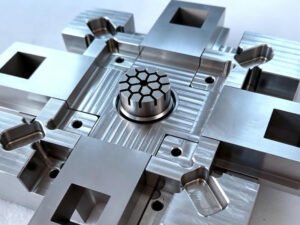
How Does Heat Treatment Affect Dimensional Accuracy?
Heat treatment distortion refers to dimensional or shape changes that occur during or after heat treatment. Parts may bend, twist, change diameter, or develop uneven surfaces.
Several factors contribute to heat treatment distortion. Uneven heating or cooling can create temperature differences within a part. Phase transformations can cause local volume changes in some steels. Existing residual stresses may be released as the material is heated, while differences in section thickness and part geometry can lead to uneven deformation.
Long, thin components, asymmetric parts, deep cavities, and parts with substantial differences in wall thickness may require particular attention. The amount and direction of distortion depend on the material, heat treatment process, geometry, and initial stress condition.
The risk can be reduced through several measures:
- Plan Machining Allowances: Leave sufficient stock on critical surfaces when post-treatment machining is required. The allowance should be based on material behavior, part geometry, and process experience rather than a universal value.
- Optimize the Machining Sequence: Consider rough machining, stress relief, heat treatment, and final machining as a complete process plan.
- Control the Heat Treatment Process: Use suitable fixtures, heating methods, cooling conditions, and process parameters for the part geometry and material.
- Inspect Critical Features: Measure dimensions and geometric tolerances after treatment, particularly on parts with precision interfaces.
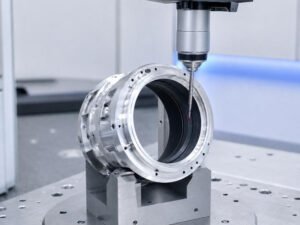
How to Choose the Right Heat Treatment Process?
The correct process starts with the part’s functional requirements. Identify whether the main objective is higher overall hardness, improved wear resistance, greater toughness, better machinability, or reduced residual stress. Different objectives may require different treatments, and some requirements involve trade-offs.
Next, confirm the material grade and its initial condition. Not every steel can achieve the same hardness or respond to the same process.
Part geometry is another important factor. Thin walls, sharp transitions, holes, slots, and uneven cross-sections may increase distortion or cracking risks. If the part has tight dimensional tolerances, the design and machining plan should allow for the expected effects of heat treatment.
Finally, confirm how the result will be verified. Depending on the application, inspection may include hardness testing, dimensional measurement, case-depth verification, or checks for cracks and other defects.
The following information needs to be confirmed:
- Material grade and initial condition.
- Required hardness or mechanical properties.
- Surface hardness or case-depth requirements, if applicable.
- Critical dimensions and geometric tolerances.
- Part geometry and planned machining sequence.
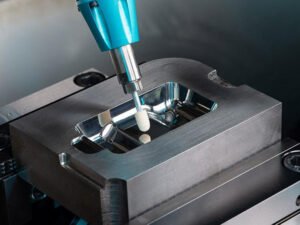
How Does Heat Treatment Affect Manufacturing Costs?
Heat treatment affects more than the direct processing charge. It can influence machining time, tooling consumption, inspection requirements, production yield, and lead time.
Hardening may make subsequent machining more difficult and require grinding or specialized cutting tools. If the process causes distortion, additional finishing may be needed to restore critical dimensions.
Inspection also adds cost. Parts with critical hardness, case depth, or dimensional requirements may need additional testing and documentation. The required inspection level should match the part’s function and the risks associated with failure.
Production planning can help control these costs. Rough machining before hardening may reduce the amount of difficult post-treatment machining, while appropriate machining allowances provide material for correcting distortion. Selecting a suitable heat treatment process also avoids paying for properties that the application does not require.
Conclusion
Metal heat treatment affects mold life, dimensional stability, and lead time at once, so the choice comes down to function, material, geometry, tolerance, and cost, not hardness alone.
If you are planning a new project, send us your part drawing and material specifications. We can review mold steel selection, hardness requirements, and tolerance feasibility during mold design.


