
Plastic extrusion is the manufacturing process behind products that look unrelated at first glance, such as window seals, cable trunking, water pipes, and light diffusers. What they share is a cross-section that stays the same along the entire length. Parts with that kind of geometry are usually extruded rather than injection molded. This article explains what plastic extrusion is, how the plastic extrusion process works, the main types of plastic extrusion, common materials, design tips for extruded profiles, the advantages and limits of the process, and how to judge whether a part belongs in extrusion or in injection molding.
What Is Plastic Extrusion?
Plastic extrusion melts a thermoplastic, supplied as pellets or powder, and pushes it under pressure through a shaped opening called a die. The material leaves the die in the shape of that opening and is then cooled until it holds its form. The output is a continuous length of plastic, which is cut or coiled afterward.
The defining feature is the constant cross-section. A die gives the part one profile, and that profile runs unchanged from one end to the other. This is what makes extrusion efficient for long parts such as pipes, profiles, sheets, films, and wire insulation. It is also what limits the process, because any feature that changes along the length has to be added afterward or made by another method.
Injection molding works differently. It produces one discrete part per cycle and can form three-dimensional shapes with ribs, bosses, and varying wall sections. The two processes serve different geometries, and a later section compares them in more detail.
The Plastic Extrusion Process
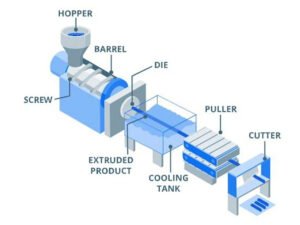
A typical plastic extrusion process includes several connected stages. The exact setup depends on the material, profile geometry, production speed, and dimensional requirements.
Material Feeding
Plastic pellets, granules, or other feedstock are loaded into the extruder hopper. Some materials, such as hygroscopic engineering plastics, may require drying before processing.
Melting and Plasticizing
The material enters the heated barrel and is transported forward by a rotating screw. Heat comes from both external barrel heaters and mechanical shear generated by the screw. The screw must provide sufficient melting and mixing without creating excessive shear or thermal degradation. Different materials require different processing temperatures and screw configurations.
Filtering and Pressure Building
The melt passes through a screen supported by the breaker plate, which removes contaminants and builds back pressure that helps the material mix evenly.
Shaping
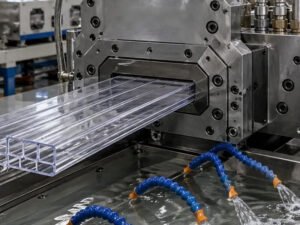
The molten plastic is forced through the extrusion die. The die determines the basic cross-sectional geometry. For simple tubes or solid profiles, the die can have a relatively straightforward structure. Complex hollow profiles may require mandrels, multiple flow channels, or carefully balanced melt paths.
Cooling and Sizing
The extrudate is cooled in a water bath or on cooling rolls. Plastics conduct heat poorly, so cooling has to be controlled. Tubes are usually drawn through a vacuum sizing tank to keep them from collapsing, while sheet passes over a set of rolls.
Pulling and Cutting
A haul-off or pulling system continuously moves the cooled profile through the production line. The pulling speed affects the final dimensions and production rate. After reaching the required length, the profile can be cut into individual sections. For products such as film, flexible tubing, or certain sealing profiles, the material may instead be wound into rolls.
Types of Plastic Extrusion
Different extrusion methods are used according to the product geometry and production requirements.
Sheet Extrusion
Sheet extrusion produces relatively flat plastic sheets with controlled thickness.
The molten material passes through a flat die and then through cooling and sizing equipment. Sheet extrusion is commonly used for packaging, protective panels, industrial covers, and fabricated plastic components.
Film Extrusion
Film extrusion produces thin plastic film. Two common methods are blown film extrusion and cast film extrusion.
Blown film extrusion forms a tubular film bubble that is cooled and collapsed into a flat film. Cast film extrusion produces film through a flat die followed by rapid cooling on a chill roll.
The choice depends on film thickness, optical requirements, mechanical properties, and production specifications.
Pipe and Tube Extrusion
Pipe and tube extrusion is used for products with circular hollow sections.
A die and internal mandrel create the hollow geometry. Vacuum sizing is often used to control the outside diameter and maintain dimensional consistency.
Applications include fluid transport, electrical conduit, pneumatic tubing, and industrial piping.
Profile Extrusion
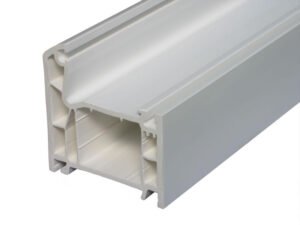
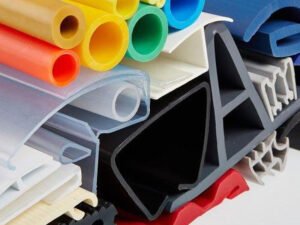
Profile extrusion is used for non-circular cross-sections such as channels, trims, frames, guides, and structural sections.
The profile can be simple or highly complex, but the cross-section remains substantially consistent along the extrusion direction.
Custom profile extrusion is often used when a standard commercial shape cannot meet the required dimensions or functional requirements.
Co-Extrusion
Co-extrusion combines two or more plastic materials in a single extrusion process.
Different materials can provide different functions. For example, one layer may provide structural support while another provides sealing, flexibility, chemical resistance, or a different surface appearance.
Co-extrusion can reduce assembly steps, but it requires careful control of material compatibility and melt-flow conditions.
Over-Jacketing and Extrusion Coating
Extrusion can also be used to apply a plastic layer around another material.
Common examples include wire and cable insulation, protective coatings, and plastic layers over metal or other substrates.
The extrusion material must bond properly to the substrate while maintaining the required thickness and surface quality.
Plastic extrusion is just one of several extrusion molding methods. Learn about 10 Types of Extrusion Processes to understand other processes and their applications.
Common Plastic Extrusion Materials
Most thermoplastics can be extruded. The table below summarizes the materials that appear most often, along with the characteristics that usually drive the choice.
| Material | Main Characteristics | Typical Extrusion Applications |
|---|---|---|
| PE | Good chemical resistance, low moisture absorption, flexible grades available | Pipes, tubing, films, protective profiles |
| HDPE | Higher stiffness and strength than standard PE | Pipes, ducts, industrial profiles |
| LDPE | Flexible, lightweight, good film processing | Films, flexible tubing, coatings |
| PP | Low density, good chemical resistance, higher temperature capability than PE | Tubes, sheets, profiles, automotive parts |
| PVC | Available in rigid and flexible grades, good chemical resistance | Pipes, window profiles, cable insulation |
| TPU | Flexible, abrasion-resistant, good mechanical properties | Tubing, seals, protective profiles |
| TPE | Flexible and available in different hardness levels | Sealing profiles, grips, flexible components |
| PA | High strength and wear resistance but moisture sensitive | Tubes, structural profiles, engineering components |
| PC | High impact resistance and dimensional performance | Transparent or high-strength profiles |
| ABS | Good rigidity and surface appearance | Industrial profiles, trims, housings |
| POM | Low friction and good dimensional stability | Precision profiles and mechanical components |
| PEEK | High temperature and chemical resistance | High-performance industrial components |
Design Tips for Extruded Profiles
Good profile design can reduce extrusion problems and simplify tooling.
- Keep wall thickness uniform. Large thickness differences make the melt flow unevenly through the die, which distorts the profile. Thick and thin sections also cool at different rates, and that causes bowing.
- Make thickness transitions gradual. An abrupt change can leave marks or waviness on the opposite surface.
- Limit hollow sections. Hollow profiles need more complex dies and usually vacuum sizing or internal pressure, which raises cost. A hollow is justified when it helps balance wall thickness or serves the function of the part.
- Avoid internal legs and hollows within hollows. Tolerances are hard to hold on these features, and they are costly to produce. If an internal leg is needed, it should not project into the cavity farther than the wall thickness.
- Use generous corner radii. Sharp corners are weak points that can crack, especially in rigid materials, and they are harder on the die. Minimum radii vary by material, so confirm them with the extruder.
- Set realistic tolerance expectations. Extruded profiles are generally held to looser tolerances than machined or injection molded parts, because thermoplastics expand and contract with temperature and the extrudate swells on leaving the die. Tighter tolerances often mean slower line speeds or more scrap.
- Plan for die swell and shrinkage early. These effects are compensated in the die design, not after production starts, so bring the extruder into the design process before the die is cut.
- Keep walls thin when clarity matters. In clear materials, thinner walls give better optical quality, and die lines can still appear.
Advantages and Disadvantages of Plastic Extrusion
Advantages of Plastic Extrusion
- Continuous production suits long parts in large quantities.
- Die costs are generally lower than injection mold costs.
- Shape freedom is high within a constant cross-section, including hollow chambers, ribs, and surface textures.
- The process handles a wide range of thermoplastics and can combine materials through co-extrusion.
- Lines can be highly automated, which supports consistent quality.
Disadvantages of Plastic Extrusion
- Only constant cross-sections are possible. Features that vary along the length need secondary operations or a different process.
- Tolerances are looser than injection molding, and die swell is difficult to predict exactly.
- Any change to the cross-section requires a new die.
- A production line, including the extruder, sizing tank, puller, and cutter, is a large capital investment.
- Recycled material can bring impurities and variable properties.
Secondary Operations for Extruded Parts
Extruded lengths often need further work before they are ready to use. Extruders and fabricators typically offer the following operations:
- Cutting to length, often in line with the extruder.
- Punching and notching to add holes, slots, or cutouts. Punching is generally faster than drilling at higher volumes and leaves cleaner edges.
- Drilling and CNC routing for holes, notches, and complex outlines, especially in smaller runs.
- Thermal bending to form curves or angles after heating.
- Welding and bonding, including ultrasonic welding, to join profile sections or attach other parts.
- Printing and marking for logos, scales, or labels.
- Annealing to relieve internal stress where needed.
- Assembly of the profile with end caps, seals, and hardware.
Applications of Plastic Extrusion
Plastic extrusion is used across many industries because continuous profiles can be manufactured in different materials, sizes, and cross-sections.
- Construction: window frames, door profiles, seals, trims, drainage components, and protective channels.
- Automotive: weatherstrips, trim profiles, tubing, cable protection, and sealing components.
- Electrical and Electronics: cable insulation, wire jackets, conduit, protective channels, and insulating profiles.
- Medical: tubing, fluid-handling profiles, catheter components, and other controlled plastic profiles.
- Industrial Equipment: guides, rails, protective covers, machine seals, conveyor components, and structural profiles.
- Packaging: plastic film, sheets, flexible tubing, and protective packaging profiles.
- Consumer Products: edge trims, flexible seals, handles, channels, and decorative profiles.
Conclusion
Plastic extrusion fits long parts, has a constant cross-section, and is made in quantities large enough to justify a die. When a part has features that change along its length, needs three-dimensional detail, or is produced in smaller volumes, injection molding or a combination of an extruded profile and molded components is usually the more practical choice. If you are deciding between the two for a new part, or you need injection-moldedend caps, connectors, or brackets to go with an extruded profile, send us your drawings and expected volume, and we can help you evaluate the options.


