High pressure injection molding is a critical manufacturing process for industries that require precision, durability, and high-performance plastic components. This process allows for the creation of complex parts with excellent surface finish and mechanical properties while supporting high-volume production.
What Is High-Pressure Injection Molding?
High-pressure injection molding refers to a process that uses elevated injection pressure to fill mold cavities with molten plastic resin. The key factor is the pressure level applied during the filling stage. Industry standards classify injection pressures into distinct ranges based on the force needed to overcome flow resistance in the mold.
- Standard pressure injection molding operates between 1,200 and 1,700 kg/cm². This range suits many conventional parts with moderate wall thickness and simpler geometries.
- High-pressure injection molding begins at 1,800 kg/cm²50 and above. This category allows the resin to travel through longer flow paths and fill intricate details without defects.
- Ultra-high pressure injection molding reaches 2,500 to 3,000 kg/cm² or higher. It becomes necessary for very thin walls or highly complex designs where material flow would otherwise stop prematurely.
Detailed Process of High-Pressure Injection Molding
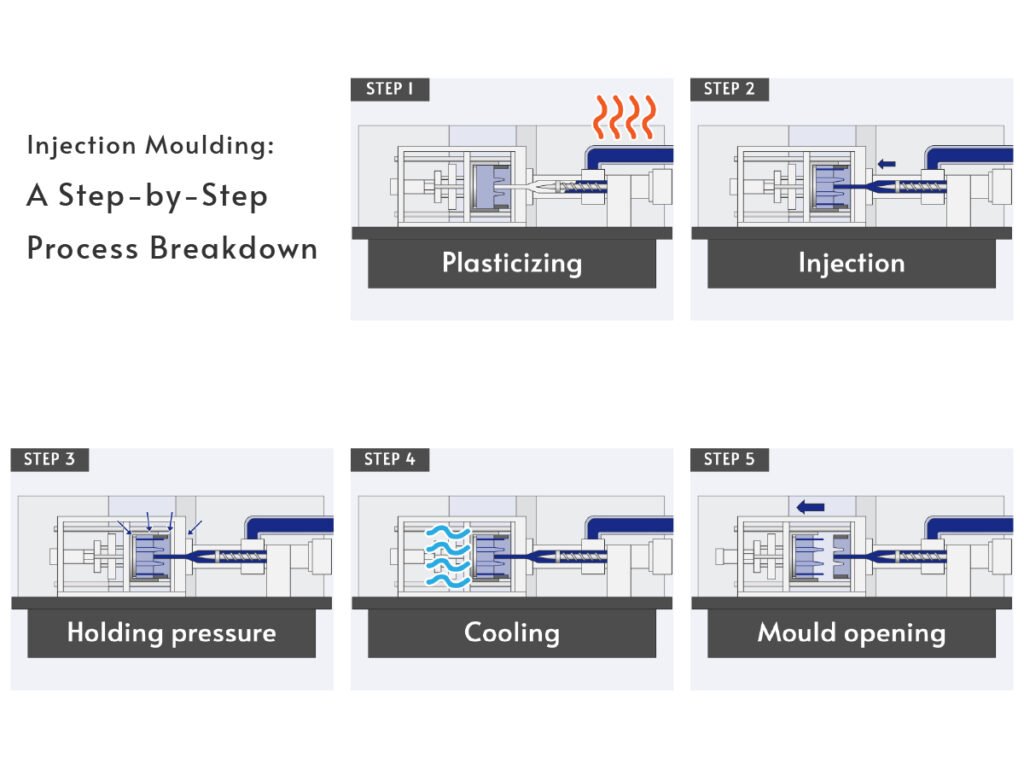
High-pressure injection molding follows a similar basic cycle to conventional injection molding, but it uses significantly higher injection pressure to improve material flow and part quality, especially for complex geometries and thin-wall components.
1. Plasticizing: Plastic pellets are heated and melted into a uniform resin flow. Material temperature and viscosity must be properly controlled to ensure smooth filling under high pressure.
2. High-Pressure Injection: The molten resin is injected into the mold cavity at high pressure, allowing it to fill long flow paths, intricate details, and thin sections that may be difficult to achieve with lower-pressure processes.
3. Pressure Holding: Additional pressure is applied after filling to compensate for material shrinkage during cooling. This helps improve part density and dimensional consistency.
4. Cooling & Solidification: The molded part cools inside the mold until it reaches sufficient strength. Proper cooling helps maintain dimensional accuracy and reduce defects such as warpage.
5. Ejection: After solidification, the finished part is removed from the mold and inspected to ensure it meets required specifications.
At Jiangzhi, our high-pressure injection molding process incorporates real-time monitoring at every stage. Clients receive detailed process data upon request, which supports traceability in regulated industries. This step-by-step control reduces variability and helps maintain the performance standards you expect from high-pressure moulding.
Advantages of High-Pressure Injection Molding
High-pressure injection molding offers several practical benefits for production.
High Repeatability
It achieves high repeatability across large batch sizes. Once parameters are dialed in, parts maintain consistent weight, dimensions, and mechanical properties from the first shot to the last.
Excellent Complex Geometry Capability
The process handles complex geometries effectively. Thin walls down to 0.5 mm or long flow paths become feasible without short shots. This capability is essential for industries requiring compact, high-precision components.
Improved Structural Strength
Parts produced through high-pressure molding reduce internal voids and porosity and often exhibit improved structural integrity. The rapid and uniform filling reduces internal stresses and weld lines, resulting in stronger components under load.
Short Cycle Time & High Efficiency
Cycle times remain short. The combination of quick filling and efficient cooling supports higher output rates, which can lower per-part costs in volume production. Our high-pressure injection molding lines are configured to balance speed with quality, giving clients predictable lead times.
Wide Material Compatibility & Good Surface Finish
The technology accommodates a wide range of materials, including engineering resins and filled compounds. Surface finish quality is typically high, reducing the need for secondary operations such as polishing or painting.
Challenges Faced by High-Pressure Molding
Despite its advantages, high-pressure injection molding presents certain operational considerations that must be addressed.
- Strict Process Control Requirements: High-pressure injection molding requires precise control of processing parameters, including injection pressure, temperature, and filling speed. Improper settings may cause defects such as flash, flow marks, or dimensional inconsistencies. Optimized process parameters help maintain stable part quality and consistent production results.
- Higher Tooling and Design Requirements: The higher forces involved in high-pressure injection molding require molds and part designs with sufficient strength and stability. Proper mold design, venting, cooling channels, and part geometry optimization help prevent defects such as warpage, burn marks, and incomplete filling. These requirements may also increase tooling complexity and initial costs.
- Material Selection Considerations: Material selection plays an important role in high-pressure injection molding. Some resins may experience degradation, flow marks, or reduced performance if processing conditions are not properly matched with material properties. Choosing a suitable material helps achieve the required strength, appearance, and dimensional stability.
Material Selection for High-Pressure Injection Molding
1. How to Select the Right Material
Selecting the right material is essential for achieving stable and high-quality molding results. Key factors include:
- Flowability Under High Pressure: Ensures the material can fully fill complex or thin-wall cavities.
- Part Geometry: Consider thin-wall or complex structures that require good filling capability.
- Mechanical Requirements: Include strength, stiffness, and impact resistance.
- Thermal Stability During Processing: Avoid degradation or performance loss under heat.
- Surface Finish Requirements: Achieve the desired appearance and reduce post-processing needs.
In general, the material must be compatible with both the molding pressure and the performance demands of the final part.
2. Common Materials Used
Common materials include:
- ABS: balanced strength and processability
- PP: lightweight and chemical resistant
- PC: high impact strength and transparency
- PA (Nylon): strong and wear-resistant
- POM: rigid with low friction properties
- Reinforced Resins: glass fiber-filled PA, PC/ABS for higher strength and stability
Applications of High-Pressure Injection Molding
High-pressure injection molding is widely used across industries where precision, strength, and complex geometry are required. Key application areas include:
Automotive Applications in Injection Molding
- Dashboards
- Structural components
- Engine covers
- Interior trim panels
- Switch bezels
- Under-hood components
Packaging Applications in Injection Molding
- Thin-walled containers
- Caps
- Closures
Electronics Applications in Injection Molding
- Housings
- Connectors
- Lens frames
- Enclosures
Medical Applications in Injection Molding
- Syringe barrels
- Diagnostic cassettes
- Surgical instrument handles
- Surgical tools
- Diagnostic devices
Conclusion
High-pressure injection molding is ideal for producing complex, high-precision plastic parts with high density and reliable performance. It is widely used in demanding industries such as automotive, medical, electronics, and industrial equipment. To better understand process selection, you may also refer to our article on low-pressure injection molding for a comparison of different molding pressure levels.
If your project requires high-pressure injection-molded parts, Jiangzhi can evaluate your design, material, and production needs to provide the right manufacturing solution. Contact us today to discuss your custom project.