
Oil resistant rubber is widely used in applications where rubber components are exposed to oils, fuels, and lubricants that may cause swelling, softening, cracking, or loss of sealing performance over time. To address these challenges, specially formulated rubber materials are developed to maintain stability and durability in oil-contact environments. Understanding how these materials work, their common types, and selection factors can help achieve better performance in demanding applications.
What Is Oil Resistant Rubber?
Oil resistant rubber is a rubber compound engineered to maintain its physical properties, including flexibility, tensile strength, and dimensional stability, after prolonged exposure to petroleum-based oils, fuels, and lubricants. In practice, “resistant” doesn’t mean “immune.” It means the material swells minimally, doesn’t soften or become brittle, and continues to perform its sealing or cushioning function over the expected service life of the part.
Why Does Oil Resistant Rubber Resist Oil?
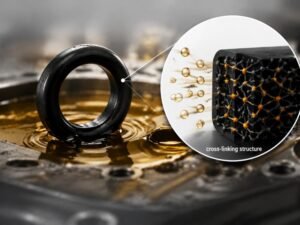
Oil resistant rubber achieves its performance through its chemical composition and molecular structure. Its dense polymer network limits oil penetration and reduces the risk of swelling, softening, or degradation when exposed to hydrocarbons. Key factors include:
- Chemical Structure: Polar components in some rubber types reduce compatibility with oil molecules, improving resistance to absorption.
- Cross-linking Structure and Low Swelling Property: A strong molecular network enhances stability and prevents excessive swelling.
Types of Oil Resistant Rubber
Nitrile Rubber (NBR)
Nitrile rubber, also known as Buna-N, is the industry’s default choice for oil-resistant applications. NBR is a copolymer of acrylonitrile and butadiene, and its oil resistance is directly proportional to its acrylonitrile (ACN) content: the higher the ACN percentage, the better the resistance to oil and fuel, though this comes with a trade-off in low-temperature flexibility.
Key Characteristics:
- Excellent resistance to petroleum oils, hydraulic fluids, and fuels
- Good abrasion resistance and tensile strength
- Available in a range of ACN grades to balance oil resistance against cold-weather performance
- Cost-effective compared to specialty elastomers like Viton
Common Applications:
O-rings, oil seals, fuel hoses, gaskets, grommets, and molded parts for automotive and industrial machinery. If you are sourcing general-purpose oil seals or hydraulic components, NBR is almost always the starting point for evaluation.
Neoprene (Chloroprene Rubber, CR)
Neoprene owes its moderate oil resistance to the chlorine atoms built into its polymer backbone. It won’t match nitrile’s performance in continuous oil immersion, but it brings a broader set of environmental resistances to the table.
Key Characteristics:
- Moderate resistance to petroleum-based oils and greases
- Strong resistance to weathering, ozone, and UV degradation
- Good flame resistance and flexibility across a wide temperature range
- Performs well where oil exposure is intermittent rather than constant
Common Applications:
Gaskets, weatherstripping, hoses, and molded parts that need to handle occasional oil or grease contact alongside outdoor exposure. Neoprene is a strong choice when you need one material to handle several environmental factors at once, not just oil.
Viton (Fluoroelastomer, FKM)
Viton, a DuPont trademark for fluoroelastomer (FKM), sits at the top of the oil-resistance hierarchy. Its fluorine content gives it exceptional chemical inertness, making it the material of choice for the most demanding environments.
Key Characteristics:
- Outstanding resistance to oils, fuels, and a broad range of aggressive chemicals
- Stable performance at high temperatures (up to roughly 200°C / 400°F)
- Excellent resistance to ozone, weathering, and oxidation
- Higher material cost than NBR or Neoprene, reflecting its specialty performance
Common Applications:
Seals and gaskets in aerospace, high-performance automotive, oil and gas, and chemical processing equipment, anywhere both high heat and continuous oil or chemical exposure are present.
Rubber Types with Poor Oil Resistance
Just as important as knowing what to specify is knowing what to avoid. Two common rubber types are frequently misapplied in oil-exposed environments:
EPDM (ethylene propylene diene monomer) is prized for its excellent resistance to weathering, ozone, steam, and many polar chemicals — but it has poor resistance to petroleum oils and hydrocarbons. Its non-polar structure means it swells significantly on contact with oil. EPDM is an outstanding choice for outdoor seals, HVAC gaskets, and washers exposed to water or steam, but it should not be specified where oil contact is expected.
Natural Rubber (NR) offers excellent elasticity, tensile strength, and tear resistance, but its non-polar hydrocarbon structure makes it highly susceptible to swelling and degradation in oil. Natural rubber is best reserved for applications built around mechanical properties, including vibration damping and shock absorption, rather than chemical resistance.
How to Choose the Right Oil Resistant Rubber Material
Selecting the right oil-resistant rubber requires more than considering oil resistance alone. The material should be evaluated based on the following factors:
- Oil type, exposure conditions, and temperature range: Different fluids, such as mineral oils, synthetic lubricants, and fuel blends, can affect rubber compounds differently. The operating temperature and exposure duration also determine whether a material can maintain its properties over time.
- Mechanical performance requirements: In addition to oil resistance, factors such as tensile strength, compression set, elongation, and abrasion resistance should meet the application’s needs to ensure reliable performance.
- Industry standards and application requirements: Certain industries, including automotive, food processing, and aerospace, may require materials that comply with specific standards such as SAE, FDA, or ASTM.
- Long-term cost considerations: A higher-performance rubber may provide better value over time by reducing maintenance, replacement frequency, and part failure risks.
- Compatibility with the rubber molding process: Compression molding, injection molding, and extrusion all interact differently with various rubber materials, so material selection and manufacturing method need to be considered together.
Conclusion
As industrial and automotive systems continue to push toward higher operating temperatures, more aggressive synthetic lubricants, and tighter emissions and efficiency standards, the demands placed on oil-resistant rubber components will only increase. We’re already seeing growing interest in advanced FKM formulations and hybrid compounds designed to combine oil resistance with better low-temperature flexibility.
At Jiangzhi, we work every day to translate application requirements into the right material and molding solution. If you’re sourcing custom rubber parts solutions and want a second opinion on material selection, or need a reliable manufacturing partner who can scale with your order volume, get in touch with our team. We’re happy to review your specifications and recommend the right compound for the job.


