
Plastic melting point is one of the first properties checked when choosing a material and setting up a process. It decides how a plastic is shaped, how much heat it can handle, and how stable production will be. This guide covers what melting point means, the temperatures of common plastics, the factors that change them, and how melting point affects real manufacturing.
What Is Plastic Melting Point?
Plastic melting point is the temperature at which a solid plastic turns into a flowing liquid. For most plastics, this falls between about 100°C and 350°C, far below the melting point of metals such as aluminum (660°C) or steel (about 1,500°C). The exact value depends on the plastic type and grade.
Plastics that can melt are called thermoplastics. Their melting behavior depends on how the polymer chains are arranged. Based on this structure, thermoplastics are divided into two groups, crystalline and amorphous plastics, and the two groups respond to heat in different ways.
Crystalline vs Amorphous Plastics
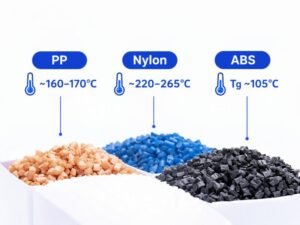
Crystalline plastics, such as PP, PE, nylon, POM and PET, contain ordered molecular regions. These regions break down at a fairly high temperature, so a clear melting point can be measured. Once that temperature is passed, the material flows quickly.
Amorphous plastics, such as ABS, PS, PMMA, PVC and PC, have a random molecular structure and no sharp melting point. They soften gradually as temperature rises above the glass transition temperature (Tg), the point where the material changes from rigid to rubbery. Processing then takes place in a higher temperature range where the material flows well enough to be shaped. For these plastics, Tg and the recommended processing range are used in place of a melting point.
How to Measure the Melting Point of Plastic
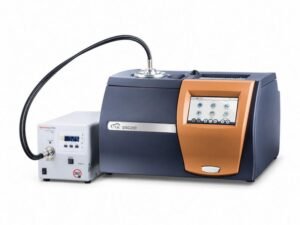
Differential scanning calorimetry (DSC) is the standard method. A small sample is heated at a controlled rate while heat flow is recorded. Melting appears as a peak, and the glass transition appears as a step change in the curve. Common standards include ASTM D3418 and ISO 11357.
Other methods include melting point apparatus and hot stage microscopy for a quick check of crystalline plastics. For amorphous plastics and heat resistance, Vicat softening temperature (ASTM D1525, ISO 306) and heat deflection temperature (HDT) testing are widely used. For most projects, datasheet values from the material supplier are enough for planning.
Melting Temperatures of Common Plastics
The table below lists typical values for widely used plastics. Exact figures vary with grade, additives, and reinforcement, so the supplier datasheet should always be checked for a specific material.
| Plastic | Structure | Melting Point or Tg | Typical Processing Temperature | Typical Applications |
|---|---|---|---|---|
| ABS | Amorphous | Tg about 105°C | 200 to 250°C | Housings, automotive interior parts |
| PP (Polypropylene) | Crystalline | Tm 160 to 170°C (homopolymer) | 200 to 250°C | Containers, automotive parts, living hinges |
| HDPE | Crystalline | Tm 120 to 135°C | 180 to 250°C | Bottles, pipes, storage containers |
| Nylon 6 (PA6) | Crystalline | Tm about 220°C | 230 to 290°C | Gears, bushings, wear parts |
| Nylon 66 (PA66) | Crystalline | Tm 255 to 265°C | 270 to 300°C | Under-hood parts, connectors, gears |
| PVC | Mostly amorphous | Tg about 80°C | 160 to 200°C | Pipes, cable insulation, profiles |
| Acrylic (PMMA) | Amorphous | Tg about 105°C | 200 to 250°C | Lenses, light covers, display panels |
| PS (Polystyrene) | Amorphous | Tg about 100°C | 180 to 250°C | Packaging, disposable items, housings |
Common plastics stay within the ranges above, but some high-performance plastics go much higher. PEEK melts at about 343°C, PTFE at about 327°C and PPS at about 280°C. PTFE is a special case. Its melt viscosity is so high that it does not flow like other thermoplastics and is usually shaped by sintering.
What Factors Affect Plastic Melting Point?
Several factors decide where a plastic melts or softens. Some come from the polymer itself, while others come from what is blended into it. This is why grades of the same plastic can have different processing temperatures.
- Molecular Structure and Crystallinity: Rigid, tightly packed chains and higher crystallinity raise the melting point. Flexible or branched chains lower it. This is why HDPE melts at a higher temperature than LDPE.
- Molecular Weight: Higher molecular weight increases melt viscosity and can raise the softening range slightly, which changes how easily the material flows during processing.
- Additives and Plasticizers: Plasticizers lower Tg and soften the material. Flexible PVC is a common example.
- Fillers and Reinforcement: Glass fiber and mineral fillers change the melting point very little, but they raise heat resistance under load and affect flow and shrinkage.
- Blends and Recycled Content: Mixed polymers can show more than one melting peak. Recycled material may also carry contaminants that shift the processing behavior.
How Plastic Melting Point Affects Manufacturing Processes
Melting point sets the temperature window for every melt-based process. Too little heat leaves the material unmelted and hard to shape. Too much heat causes degradation. Each process uses this window differently.
Injection Molding
In the injection molding process, barrel temperatures are set in stages, usually above the melting point for crystalline plastics and within the recommended range for amorphous plastics. Mold temperature is just as important. It controls cooling speed, crystallinity, shrinkage and surface finish. Crystalline materials such as nylon and PP tend to shrink more and need tighter mold temperature control. Materials with a narrow window, such as PVC, require careful control to avoid degradation.
Extrusion
Extrusion runs continuously, so a stable melt temperature along the barrel and at the die is essential for consistent output. Melt temperature also affects melt strength, which determines whether the extruded shape holds its form before cooling.
Blow Molding and Thermoforming
Blow molding requires a heated parison with enough melt strength to be inflated without tearing or sagging. Bottles and hollow containers are typical results. Thermoforming heats a sheet to a softened state rather than a full melt. Amorphous sheets have a wider forming range, while crystalline sheets such as PP have a narrow one, because the material goes from stiff to sagging within a small temperature change near the melting point. Trays, packaging and covers are common products.


