In CNC manufacturing, material properties play a decisive role in machining outcomes, including dimensional accuracy, surface quality, and process stability. Polypropylene is widely used across industrial sectors due to its chemical resistance, low density, and cost efficiency. Understanding polypropylene machining helps to select appropriate methods to produce reliable parts.

What is Polypropylene (PP)?
Polypropylene (PP) is a lightweight, semi-crystalline thermoplastic from the polyolefin family, valued for its excellent chemical resistance, fatigue durability, and balanced mechanical performance. With a low density of 0.89–0.91 g/cm³ and a melting point of around 160–170°C, PP is resistant to acids, bases, and many solvents while maintaining flexibility under repeated stress. It is commonly supplied as sheets or rods for CNC machining, where homopolymer grades offer higher rigidity and copolymer grades provide improved impact resistance. Due to its relatively high thermal expansion, dimensional stability should be considered during machining, especially for precision components.
Why Choose CNC Machining for Polypropylene?
Polypropylene machining through CNC methods offers distinct advantages, especially when producing parts that require precision, flexibility in design, or limited production volumes.
- CNC machining is suitable for small to medium batch sizes. CNC machining of polypropylene eliminates tooling expenses. This makes it cost-effective for prototypes, custom runs, or orders under a few hundred pieces.
- CNC machining of polypropylene provides flexibility for complex geometries. PP CNC processes handle varied part shapes effectively, supporting applications that demand precise features like threaded holes, contoured surfaces, or multi-axis cuts.
- Precision is the core benefit in CNC PP operations, typically ±0.05 mm or better.
- The process also supports material efficiency and reduces waste. CNC machining polypropylene removes material subtractively from solid stock, allowing optimization of toolpaths to minimize scrap.
- CNC machining of polypropylene accommodates modifications easily. Design changes can be implemented by updating the CAD file and reprogramming the machine, without needing new tooling.
Common CNC Machining Methods for Polypropylene
Several CNC processes are commonly used in polypropylene machining, each with specific considerations.
CNC Milling for Polypropylene
Milling is one of the most frequently used techniques in PP CNC operations. It employs rotating cutters to remove material and create features like slots, pockets, and contours. This method is effective for producing flat surfaces and intricate designs on PP sheets or blocks. Due to the material’s softness, tool sharpness and chip evacuation are critical to avoid material smearing.
CNC Turning for Polypropylene
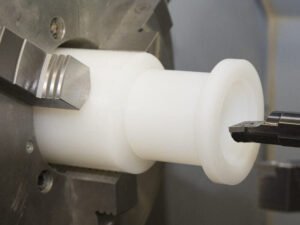
Turning rotates the workpiece while a stationary tool cuts away material, ideal for cylindrical parts such as tubes, shafts, or threaded components. Turning ensures symmetry and smooth finishes on rotational features. In turning operations, controlling cutting speed and feed rate is particularly important to maintain surface consistency.
CNC Drilling and Tapping
Drilling and tapping are supplementary methods often integrated into PP CNC workflows. Drilling creates holes for fasteners or fluid passages, while tapping adds internal threads. These operations require careful control to prevent material tearing due to PP’s softness.
Lasering Cutting
Laser cutting can be used for thin PP sheets in some CNC setups, though it is less common for thicker materials because of heat-related issues.
Polypropylene CNC Machining Parameters and Best Practices
Effective polypropylene machining requires specific parameters to achieve quality results.
Recommend Parameters for Polypropylene Machining
For milling in CNC PP, spindle speeds typically range from 4,000 to 12,000 RPM. Feed rates should be set between 200 and 1,500 mm/min, or 8 to 60 IPM, to balance material removal and surface quality. Depth of cut is kept shallow, usually 0.2 to 1.5 mm per pass, to minimize heat buildup.
In turning operations for CNC machining polypropylene, spindle speeds of 1,000 to 4,000 RPM are common, with feed rates of 0.1 to 0.5 mm per revolution.
Best Practices for Polypropylene Machining
Best practices include using sharp carbide tools with high rake angles to reduce cutting forces and prevent melting.
Tooling: Tools should have positive front angles for clean chip evacuation.
Clamping: Clamping must be secure but not excessive to avoid deforming the soft material; soft jaws or vacuum fixtures work well.
Pre-machining Annealing: Pre-machining annealing at 80-100°C for several hours can relieve internal stresses, improving dimensional stability during PP CNC.
Regular Inspection: Regular inspection and replacement maintain precision. These parameters and practices ensure consistent outcomes in polypropylene machining.
Common Challenges in Polypropylene Machining and Solutions
Polypropylene machining presents several challenges that can affect part quality.
Thermal Deformation
Thermal deformation is caused by PP’s low melting point and high thermal expansion. This leads to warping or dimensional inaccuracies during CNC PP processes.
Solutions: To address this, use low cutting depths and high spindle speeds combined with effective air cooling to dissipate heat quickly.
Chip Melting and Adhesion
Another challenge is chip melting and adhesion to tools, resulting from friction-generated heat. This causes poor surface finishes and tool clogging in CNC machining of polypropylene.
Solutions: include selecting tools with polished flutes for better chip flow and increasing air blowing for evacuation. Sharp tools reduce friction at the outset.
Uneven Surface
Low rigidity of PP leads to vibrations and chatter, especially in thin-walled parts. This manifests as uneven surfaces or tolerance deviations.
Solutions: Reinforce workpieces with supports or use shorter tool overhangs to minimize deflection. Optimized clamping distributes pressure evenly.
Surface Burrs
Surface burrs and tearing occur due to improper feed directions or dull tools.
Solutions: Employ climb milling where possible and allocate finishing passes with minimal material removal.
Surface Treatment and Post-Processing for Polypropylene
After CNC machining, polypropylene (PP) parts may require additional finishing steps to improve edge quality, surface performance, and assembly readiness.
Deburring
Because PP is relatively soft, light burrs can form along edges and holes during machining. Deburring removes sharp edges to ensure safe handling and proper fit, typically using manual trimming, fine sanding, or vibratory tumbling without affecting tolerances.
Stress Relief (Annealing)
For thick or tight-tolerance components, machining may introduce internal stress. Controlled heat treatment can be applied when necessary to reduce residual stress and improve long-term dimensional stability.
Surface Activation
Polypropylene has naturally low surface energy, which makes bonding, printing, or painting difficult. Surface treatments such as corona or plasma increase surface energy and significantly improve adhesion performance.
Laser Marking
Laser marking provides permanent identification or traceability without mechanical engraving. Because standard PP absorbs laser energy poorly, special additives may be required to enhance marking contrast.
Cleaning
Cleaning removes cutting fluids, plastic debris, and surface contaminants after machining. Ultrasonic cleaning or mild detergents are commonly used to prepare parts for inspection, packaging, or assembly.
Main Applications of CNC Polypropylene Machining
- Chemical Processing Industry: Manifolds, valve bodies, chemical tanks, and fittings.
- Fluid Handling and Plumbing: Pipes, connectors, pump components, and fluid distribution systems.
- Industrial Equipment and Machinery: Guides, bushings, wear components, protective covers, and functional parts.
- Prototyping and Low-Volume Production: Functional prototypes, test parts, and custom components.
- Medical and Laboratory Equipment: Sterilizable trays, fluid containers, chemical handling parts, and laboratory fittings.
- Consumer and Packaging Applications: Lightweight containers, caps, and functional components for packaging systems.
Conclusion
Polypropylene machining, particularly through CNC methods, enables the production of custom parts across industries. Jiangzhi is a professional manufacturer with experience in polypropylene machining. We can address challenges by understanding materials’ characteristics during the process. Welcome to contact Jiangzhi and get a custom solution for the project.