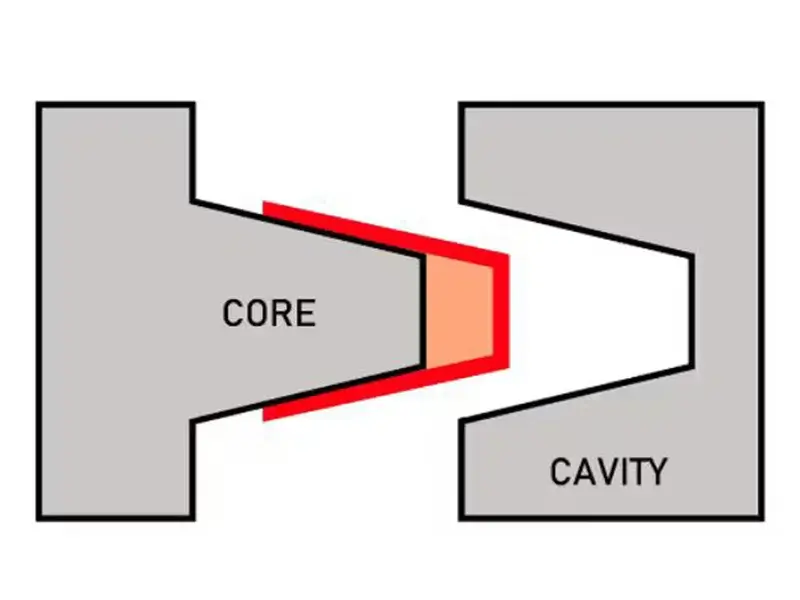
In plastic manufacturing, choosing between rotational molding and injection molding is often a key decision that affects cost, product design, and production efficiency.
Both processes are widely used for producing plastic parts, but they are suitable for very different applications. Understanding the differences helps engineers and buyers select the right manufacturing method for their project — especially when considering part size, structure, and production volume.
What Is Rotational Molding?
Rotational molding is a low-pressure manufacturing process used to produce large, hollow, and seamless plastic parts.
It is especially suitable for products that require uniform wall thickness and structural strength without internal stress. Common applications include water tanks, kayaks, storage containers, and outdoor furniture.
A measured amount of plastic powder is placed into a metal mold, which is then heated and rotated on two axes. The material melts and gradually coats the inner surface of the mold. After cooling, a hollow part with consistent wall thickness is formed.
What Is Injection Molding?
Injection molding is a high-pressure manufacturing process designed for producing precise, high-volume plastic parts.
It is widely used for components that require tight tolerances and complex geometries, such as electronic housings, automotive parts, medical devices, and consumer product components.
In this process, plastic pellets are melted and injected into a steel mold under high pressure. The material fills the cavity rapidly, cools through internal channels, and is then ejected as a finished part.
Key Differences Between Rotational Molding and Injection Molding
When comparing rotational molding and injection molding, the most important differences come down to part size, design complexity, tooling cost, production speed, and overall manufacturing efficiency. These factors directly determine which process is more suitable for a specific application.
Design Complexity & Part Size
Rotational molding is best suited for large, hollow, and seamless parts. Because the process does not rely on high pressure, it can easily produce oversized components such as tanks, containers, and industrial housings. Wall thickness is naturally uniform, and part sizes can exceed 3 meters.
Injection molding, on the other hand, is designed for smaller and more precise components. It supports highly complex geometries, including thin walls, threads, snap-fits, and detailed surface features. However, as part size increases, tooling complexity and cost rise significantly, making very large parts less practical for injection molding.
Tooling Cost & Mold Structure
Injection molding requires high-precision hardened steel molds capable of withstanding high injection pressure. These molds are expensive to design and manufacture, but they offer long service life and are ideal for high-volume production. However, design modifications after tooling is made can be costly and time-consuming.
Rotational molding uses simpler aluminum or steel molds that operate under low pressure. This significantly reduces upfront tooling costs and shortens development time. Mold changes and adjustments are also easier compared to injection molding, making it more flexible for early-stage product development or small production runs.
Material Compatibility
Injection molding supports a wide range of thermoplastics and engineering-grade materials, allowing manufacturers to optimize strength, rigidity, heat resistance, and surface finish according to application requirements.
Rotational molding is generally limited to polyethylenes and similar low-melt-flow materials, although material options are gradually expanding. This limitation makes it less suitable for high-performance engineering applications but ideal for durable hollow structures.
Production Speed & Efficiency
Injection molding is highly efficient for mass production, with cycle times typically measured in seconds. Once the mold is built, thousands or even millions of identical parts can be produced with consistent quality and minimal variation.
Rotational molding has much longer cycle times, often ranging from 20 to 60 minutes per part depending on size and wall thickness. This makes it more suitable for low to medium production volumes where speed is less critical than structural requirements.
Cost Efficiency
Injection molding has high initial tooling costs, but the per-part cost becomes extremely low at large production volumes. It is therefore the most cost-effective solution for mass manufacturing.
Rotational molding has much lower upfront investment, but higher per-unit production costs due to longer cycle times and lower automation levels. It is more economical for smaller production runs or large, low-volume products.
Advantages of Rotational Molding
Rotational molding offers several distinct benefits, particularly for specific product types:
- Uniform wall thickness: Ideal for large hollow structures that require consistent strength and durability.
- Lower mold cost: Initial tooling expenses are significantly less than injection molding, making it attractive for prototypes and small production runs.
- Durable and impact-resistant parts: The process produces stress-free parts with fewer internal weaknesses.
- Ability to produce large items: Tanks, kayaks, furniture, and storage containers can be manufactured more easily than with injection molding.
- Simplified design modifications: Adjustments to mold design are easier and more cost-effective compared to high-precision injection molds.
Advantages of Injection Molding
Injection molding provides distinct advantages that make it the process of choice for high-volume, precision parts:
- High production speed: Parts are produced quickly with minimal labor per unit.
- Complex geometries and tight tolerances: Features such as threads, snap-fits, and intricate surface details can be accurately produced.
- Wide material selection: Thermoplastics, thermosets, and high-performance polymers can be utilized, allowing for customized mechanical and aesthetic properties.
- Repeatable quality: Each part meets strict dimensional specifications, essential for assembly line production.
- Lower per-unit cost at scale: High initial mold costs are offset by efficiency in large-volume production.
How to Decide Between Rotational Molding and Injection Molding?
Use rotational molding when:
- The part is large and hollow (>1m)
- Design is simple without fine details
- Low to medium production volume is required
- Wall thickness consistency is more important than precision
Use injection molding when:
- High precision and tight tolerances are required
- Complex features like threads, ribs, or snap-fits are needed
- Medium to high-volume production is expected
- Surface finish and dimensional accuracy are critical
Conclusion
Choosing the right manufacturing process directly affects product performance, cost efficiency, and production scalability.
If you are unsure which process is best for your project, working with an experienced manufacturer can help you evaluate design requirements and production goals more effectively.
Jiangzhi provides injection molding solutions for a wide range of industrial applications, from prototype development to mass production.