Achieving a flawless cosmetic surface on an injection-molded part while controlling manufacturing efficiency is a common balancing act in product development. Traditional edge or side gates often leave visible gate vestiges that require manual degating and secondary polishing, increasing labor costs and potentially leading to inconsistent part quality.
What Is a Submarine Gate?
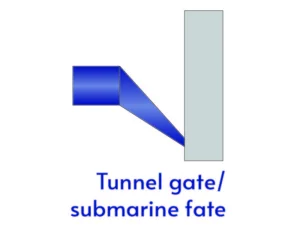
Submarine gate, also called tunnel gate or sub gate, is a type of injection molding gate used in cold runner mold systems. It is positioned below the parting line, and the gate channel passes through the mold steel into the cavity at a specific angle. This inclined tunnel structure is the key feature that enables automatic shearing of the gate during ejection.
Common structural types of submarine gate include:
- Standard Subgate: A straight tunnel gate that enters from the side or backside of the part. The gate mark is typically located on a non-visible surface, making it suitable for parts where appearance is partially important.
- Banana Gate (Curved Submarine Gate): The gate follows a curved path and is often guided toward an ejector pin area. This structure allows the gate location to be placed on an internal wall surface, making it suitable for housings or enclosures where all external surfaces require good appearance quality.
- Cashew Gate: A more highly curved variation of the banana gate. It is used in cases where neither straight nor standard curved gate paths can be arranged due to geometric constraints in the part or mold design.
Typical gate diameter ranges from 0.8 mm to 2.0 mm, while the tunnel angle is generally 30° to 45°, adjusted according to material flexibility and part geometry.
How a Submarine Gate Works?
The working process of a submarine gate follows a controlled flow path inside the mold system:
First, molten plastic flows from the sprue into the runner system. It then enters the submarine gate channel, which directs the material into the cavity at an angled entry point.
During injection, the cavity is fully filled under pressure, and the gate remains connected to the molded part. When the mold opens, the design of the tunnel gate forces the gate to shear off automatically due to the relative movement between the fixed and moving halves of the mold.
Advantages of Submarine Gate
- Automatic Degating Efficiency: The primary advantage of a submarine gate is automatic degating during ejection, eliminating secondary trimming and improving production efficiency.
- Improved Surface Finish Quality: Another advantage is improved surface quality. Because the gate is located in a hidden position, it leaves only a small mark that is less visible on the final product. This is particularly useful for consumer-facing components where appearance matters.
- High-Volume Production: In addition, submarine gates help maintain consistent cycle times and support fully automated production, making them well suited for high-volume manufacturing.
Disadvantages of Submarine Gate
Despite its benefits, submarine gate design also has limitations that must be considered.
- Complex Mold Design and Higher Cost: Submarine gates require more complex mold designs because the angled tunnel channel needs precise machining and alignment. This additional processing increases mold fabrication difficulty and may lead to higher tooling costs compared with simpler gate types.
- Material Limitations: Material selection is also important. Brittle materials such as PMMA or highly glass-filled engineering plastics may experience inconsistent gate breakage or surface defects during ejection. This may limit the use of submarine gates with certain engineering plastics.
- Maintenance Needs: Long-term production may require maintenance attention. Wear in the gate area can affect stability if the mold is not properly maintained.
When Should You Use a Submarine Gate?
Submarine gates are typically recommended for production scenarios where automation and efficiency are priorities.
- They are suitable for medium to high-volume production runs, especially when cycle time consistency is required.
- Products with high cosmetic requirements benefit from submarine gates because the gate vestige can be hidden on a non-visible surface.
- It is also appropriate for relatively small or medium-sized parts where material flow can be controlled effectively through a tunnel gate structure.
When Should You Avoid a Submarine Gate?
Although widely used, submarine gates are not suitable for every application.
- They should be avoided when using materials that are highly brittle or sensitive to shear stress, as the automatic gate breakage may cause defects or inconsistent separation.
- Complex geometries with thick sections or uneven flow paths may also lead to filling issues because long flow paths can result in pressure loss and unbalanced cavity filling.
- When extremely high gate strength or specialized maintenance access is required, alternative gating systems may be more appropriate.
Optimize Your Part Design for Submarine Gating
Submarine gates are a practical solution in many injection molding projects by combining automatic operation with improved surface quality. However, successful implementation depends on a thorough analysis of part requirements, material properties, and production goals. Selecting the right gate type and location requires a balance of cosmetics, cycle time, and material behavior. Factors such as resin type, wall thickness, part geometry, and mold layout should all be evaluated during DFM (Design for Manufacturability). At Jiangzhi, we don’t just mold parts — we optimize your design for manufacturing.
Upload your 3D CAD files today for a free, comprehensive DFM analysis and a professional tooling quote within 24 hours.
FAQs About Submarine Gates