
Brass CNC machining is a subtractive manufacturing process that uses CNC (Computer Numerical Control) machines to remove material from brass stock and create customized components according to CAD designs. Through processes such as milling and turning, complex geometries and customized part requirements can be achieved without the need for dedicated tooling.
Brass, as a copper-zinc alloy, offers excellent machinability, corrosion resistance, and an attractive surface appearance. These properties make it a suitable material for producing functional and decorative components across various industries.
Although brass CNC machining uses the same basic CNC principles as other machining processes, the characteristics of brass make it a unique option for producing customized components.
Understanding how brass CNC machining works, which brass alloys are commonly used, and the advantages and challenges involved can help you make better decisions when selecting a manufacturing solution for custom components.
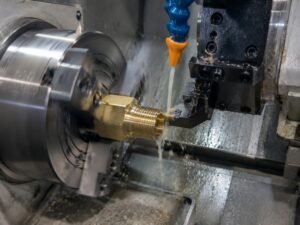
Brass CNC Machining Process
The brass CNC machining process typically includes several key stages:
1. CAD Design and CNC Programming
A CAD model or technical drawing is converted into CNC instructions to define the machining process.
2. Material Selection and Preparation:
The appropriate brass alloy is selected based on part requirements, and the material is prepared for machining.
3. CNC Machining Operations
Depending on the part design, different machining methods may be applied:
- CNC Milling: Use rotating cutting tools to create flat surfaces, slots, holes, and complex features.
- CNC Turning: Rotate the workpiece to create cylindrical brass parts.
- Drilling and Threading: Create accurate holes and threaded features for assembly.
- Surface Finishing: Improve appearance and performance through polishing, plating, or other finishing methods.
4. Inspection and Quality Control
After machining, finished brass components are inspected to verify dimensional accuracy, surface quality, and compliance with project requirements.
Common Brass Alloys for CNC Machining
Different brass alloys provide different combinations of machinability, strength, and corrosion resistance. Selecting the right alloy helps ensure the final parts meet specific performance requirements.
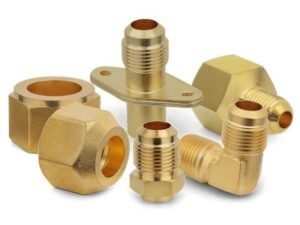
- C360 Brass (Free-Cutting Brass): Known for excellent machinability and surface finish. It is commonly used for precision fittings, connectors, fasteners, and valve components.
- C260 Brass (Cartridge Brass): Offers good ductility, corrosion resistance, and formability. It is suitable for electrical components, decorative parts, and automotive components.
- C464 Brass (Naval Brass): Provides excellent corrosion resistance in marine and harsh environments. It is often used for marine fittings, pump components, and valve parts.
For more information about choosing suitable materials for CNC machining projects, you can check out our CNC machining materials guide.
Advantages of Brass CNC Machining
Brass CNC machining combines the benefits of CNC precision with the favorable characteristics of brass material, making it a reliable choice for custom components.
Excellent Machinability
Brass is known for its excellent machinability compared with many other metals. It can be cut efficiently with CNC tools while maintaining high surface quality. This characteristic helps reduce machining time, improve production efficiency, and support cost-effective manufacturing for customized parts.
High Precision and Repeatability
CNC machining uses computer-controlled operations to achieve consistent results across multiple parts. This makes it possible to produce brass components with tight tolerances and reliable dimensional accuracy. This is especially important for parts used in assemblies where precise fitting is required.
Good Corrosion Resistance
Brass naturally provides good resistance to corrosion and oxidation. This allows machined brass components to maintain stable performance in applications exposed to moisture, chemicals, or changing environmental conditions.
Excellent Surface Finish
Brass can achieve a smooth and attractive surface finish after CNC machining. Additional processes such as polishing or plating can further improve appearance and surface protection. This makes brass suitable for both functional components and products where appearance is important.
Flexible for Custom Production
Unlike injection molding or casting processes that require molds, CNC machining can directly produce parts from raw brass material. Because of this characteristic, it provides greater flexibility for customized designs, prototypes, and small-to-medium production runs.
Challenges of Brass CNC Machining
Although brass is considered one of the easier metals to machine, several factors should still be considered during production.
Material Cost
Brass generally has a higher material cost compared with common metals such as aluminum. Material selection should balance performance requirements and overall project budget.
Tool Selection and Machining Parameters
Proper cutting tools and machining settings are required to maintain surface quality and production efficiency. Incorrect parameters may affect tool life and final part quality.
Design Complexity
Complex geometries, tight tolerances, or additional finishing requirements may increase machining time and manufacturing costs. Early communication between designers and manufacturers helps optimize part design.
Applications of CNC Machined Brass Parts
Due to its combination of machinability, durability, corrosion resistance, and appearance, brass CNC machining is widely used across multiple industries.
In the automotive industry, brass machined parts are commonly used for connectors, fittings, bushings, and other precision components that need reliable performance under demanding conditions. The aerospace industry also uses brass components for specialized fittings, connectors, and mechanical parts where accurate dimensions and corrosion resistance are important.
In the consumer electronics industry, brass CNC machined parts are frequently found in connectors, terminals, contact pins, and switch components due to brass’s good conductivity and stable performance. As for medical components, brass machining can be used for customized fittings, instrument components, and equipment parts that require precision and consistent quality.
Conclusion
Brass CNC machining is a flexible option for businesses looking to source customized metal components with specific design and performance requirements. To achieve the best results, factors such as material selection, part complexity, tolerance requirements, surface finish, and production volume should be considered during the sourcing process.
With experience in precision manufacturing and custom part production, Jiangzhi provides brass CNC machining services to support projects from material selection and prototyping to final production. If you have a brass CNC machining project, contact Jiangzhi for a customized solution.


