Injection Molding Electronics: Parts, Materials and Processes

Modern electronics keep getting smaller, more complex, and more tightly integrated, yet flawless fit, feel, and reliability are still expected from every device. From the housing of a wireless earbud to the connector inside a smart meter, injection molding quietly makes the scale and precision of modern electronics possible. This guide explains what injection molding electronics actually involves, the materials and processes behind it, and the design considerations that determine whether a part performs reliably.

What Is Injection Molding Electronics?

Injection molding electronics is the application of injection molding, a process that shapes molten thermoplastic inside custom molds, to components used in and around electronic products. Plastic resin is heated until molten, injected under pressure into a precision mold cavity, cooled, and ejected as a finished part. This produces thousands of identical, tight-tolerance parts per run, which matters for electronics since dimensional accuracy affects assembly and function.

Common Electronic Parts in Injection Molding

Injection molding shows up across nearly every category of electronic component:

  • Housings and Enclosures: outer shells for smartphones, laptops, wearables, and remote controls, which protect internal components while shaping the product’s appearance
  • Connectors and Ports: USB, HDMI, and audio connectors, which depend on tight dimensional accuracy for a reliable electrical connection
  • Buttons and Keypads: power buttons, volume controls, and function keys, molded to deliver consistent tactile feedback over repeated use
  • Internal Structural Parts: brackets, mounts, and holders that position circuit boards and batteries inside the enclosure
  • Insulating Components: non-conductive housings and separators that provide electrical insulation and structural support
  • Heat Management and Shielding Parts: plastic heat sinks and housings with embedded shielding layers that help manage heat buildup and electromagnetic interference
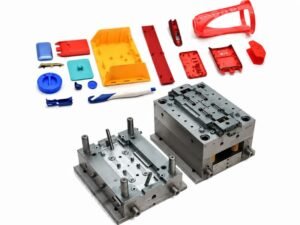
Injection Molding Parts for Electronics

Materials Behind the Injection Molding Electronics

Material choice has a direct effect on how an electronic component performs and how long it lasts, so resins are typically selected for the specific property a part needs. The following are some commonly used plastic materials.

MaterialChosen ForTypical Use
ABSStrength, moldability, surface finishHousings, keypads
Polycarbonate (PC)Impact resistance, heat resistance, clarityScreens, light covers, protective shells
PC/ABS blendBalance of toughness and appearanceEnclosures
Nylon (PA)Abrasion resistance, chemical resistanceConnectors, gears, internal parts
PBTDimensional stability, electrical insulationConnectors, switches
TPUFlexibility, scratch resistanceCable protection, wearable components
Acrylic (PMMA)Optical clarity, UV resistanceDisplays, light guides

Some applications call for flame-retardant grade plastics to meet safety requirements, and others require materials with predictable shrinkage rates so that final dimensions stay within tolerance after cooling. Resin, part geometry, and process settings interact with each other.

Key Processes and Technologies Used During Injection Molding Electronics

Beyond standard single-material molding, several specialized processes are widely used in electronics manufacturing.

Insert Molding

Insert molding places a pre-formed part, most often a metal terminal, pin, or threaded fastener, into the mold cavity before plastic is injected around it. In electronics, this is what allows connectors and battery contacts to combine a conductive metal element with an insulating plastic body in one step, eliminating separate soldering or fastening operations while keeping the metal contact precisely positioned.

Overmolding

Overmolding molds one material over another, typically a soft material such as TPU over a rigid plastic base. For electronics, this adds grip to handheld devices, seals seams against moisture and dust, and cushions internal precision components against impact.

Multi-shot Molding

Multi-shot or two-shot molding injects two or more materials into a single mold in stages to produce one finished part with multiple colors, textures, or material properties, reducing the number of separate parts that need to be assembled afterward. In electronics, this is how a remote control or game controller shell combines a rigid structural body with soft-touch buttons in the same molding cycle, or how a connector housing pairs a rigid outer shell with a soft gasket section for water and dust sealing.

Automation

Automation, including robotics and real-time process monitoring, supports the high-volume, high-consistency runs electronics production depends on, handling part removal and reducing the unit-to-unit variation that tight-tolerance components can’t tolerate.

Why Choose Injection Molding for Electronics

Several factors explain why injection molding remains the dominant process for electronic component manufacturing:

  • Production Efficiency at Scale: once a mold is built, thousands of identical parts can be produced quickly and consistently, lowering the per-unit cost as volume increases
  • Design Freedom: intricate shapes, thin walls, and complex geometries can be produced to fit compact or unusually shaped devices
  • Precision and Consistency: tight tolerances can be held reliably across an entire production run, which matters for components that must fit precisely with other parts
  • Material Versatility: resins can be selected for specific functional needs, including electrical insulation, flame resistance, or chemical resistance
  • Reduced Assembly Steps: features such as snap-fits, threads, and molded-in inserts can be built directly into the part, cutting down on secondary assembly operations

Design Requirements for Electronic Components

Unlike a standalone plastic item, an electronic component usually has to fit with other elements of the assembly. Its design is therefore evaluated as part of the complete product. A few design principles affect whether a part molds cleanly and assembles correctly:

  • Consistent wall thickness, to reduce the risk of sink marks and warpage as the part cools
  • Adequate draft angles, especially on textured surfaces, to allow the part to release cleanly from the mold
  • Careful gate and weld-line placement, particularly around cosmetic surfaces or functional openings, since these areas can affect both appearance and structural integrity
  • Defined critical dimensions, focused on the features that actually matter for assembly rather than applying the same tight tolerance everywhere
  • Tolerance stack-up review between mating components, since parts that are each individually within spec can still fail to assemble correctly together

Common Injection Molding Challenges for Electronics

Electronic components face two distinct categories of challenges during molding.

Process-related injection molding defects can appear even on a well-designed part if process conditions are not controlled:

  • Warping: Uneven cooling or shrinkage can cause warping, which can be reduced through balanced mold design and controlled cooling rates.
  • Sink Marks: Overly thick ribs or bosses can lead to sink marks, so adjusting wall and rib thickness can help prevent them.
  • Weld Lines: Weld lines form where two flow fronts meet and can be minimized through proper gate placement and mold flow analysis.
  • Short Shots or Flash: Incorrect fill pressure or speed can cause short shots or flash, particularly in thin-walled electronic parts, addressed with high-speed injection and precise process tuning.

Material limitations are a separate concern, rooted in the nature of plastic itself:

  • Plastic is naturally non-conductive, which is a limitation for components that need to manage electrical or thermal loads. Conductive fillers, metal inserts, or added shielding layers are commonly used to address this.
  • Dimensional stability can shift with temperature and humidity, which matters for parts held to tight tolerances. Material selection and design allowances help compensate for this behavior.
  • Heat dissipation is weaker than in metal components, which becomes relevant for parts positioned near heat-generating elements such as power supplies or processors. Embedded metal elements or dedicated shielding structures are typical solutions.

Conclusion

Injection molding remains central to how electronic products are manufactured at scale, balancing precision, design flexibility, and cost efficiency in a way few other processes can match. Getting reliable results depends on treating material selection, mold design, and process control as connected decisions rather than separate steps. Companies with experience in plastic injection molding services, such as Jiangzhi, are well positioned to support your projects. Work together and start your project.

FAQs About Injection Molding Electronics

Lead time depends mainly on order volume and part complexity. Mold design and tooling typically represent the longest phase, after which production runs can proceed at a predictable rate based on cycle time and cavity count. Requesting an estimate based on specific part requirements is the most reliable way to get an accurate timeline.

The two are related but distinct. Conventional injection molding for electronics produces plastic structural components, such as housings, connectors, and brackets, that are assembled around separately manufactured electronic parts like PCBs and sensors. In-mold electronics is a different process in which a conductive circuit is printed onto a film, thermoformed into shape, and then encapsulated with injected plastic, so the circuit itself becomes part of the molded structure rather than a separate component installed afterward.

In some applications, yes, provided the recycled material still meets the required mechanical, electrical, and cosmetic specifications for the part. Consistency between material batches and color variation are the main factors that need to be validated before recycled resin is approved for a given application.

Common methods include molded-in cavity numbers, date codes, laser-etched markings, and printed labels, often linked to production and inspection records for the material batch used. The right method usually depends on the level of traceability required for the specific product and industry.

Scroll to Top

Contact Us

Great! We’ve received your information.