If you are planning a CNC machining project, one of the first questions you will ask is simple: how much will this cost? The answer is rarely straightforward. CNC machining prices depend on a combination of material, design complexity, machine type, labor, and order volume. Without understanding these variables, it is easy to overpay for a part that could have been designed more efficiently. This guide breaks down exactly what goes into a CNC machining quote and offers practical strategies to reduce your costs without sacrificing quality.
What Is CNC Machining?
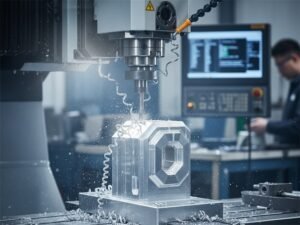
CNC, or computer numerical control, machining is an automated subtractive manufacturing process. A cutting tool removes material from a solid block, known as a workpiece, to create a finished part based on a CAD model. Common CNC processes include:
- CNC milling, which uses rotary cutting tools to remove material and can operate on 3, 4, or 5 axes depending on part complexity
- CNC turning, which rotates the workpiece against a fixed cutting tool, ideal for cylindrical parts
- CNC routing and waterjet or laser cutting, used for specific material types and geometries
CNC machining is valued for its precision, repeatability, and ability to work with a wide range of metals and plastics. It is used across industries including aerospace, medical devices, electronics, and automotive manufacturing, especially where tight tolerances and consistent quality matter.
While CNC machining offers reliable performance and flexibility, these capabilities also influence the overall manufacturing cost. Understanding how different factors affect pricing can help you make better design and production decisions.
CNC Machining Cost Breakdown
CNC machining costs generally fall into two categories: fixed costs, which stay the same regardless of order size, and scaled costs, which grow with the number of parts you order. These costs can be further broken down into several key components.
Material Costs
Material selection is often the single biggest driver of part cost. Aluminum is widely used because it is affordable, lightweight, and easy to machine. Stainless steel costs more and machines more slowly. Titanium is significantly more expensive due to both raw material price and the difficulty of cutting it.
Machinability matters as much as raw material price. Harder materials wear down cutting tools faster, require slower feed rates, and increase machine time, all of which add cost. As a rough guide:
- Aluminum: roughly $2 to $5 per kilogram depending on alloy
- Carbon Steel: generally the most economical metal option
- Stainless Steel: moderately more expensive, with slower cycle times
- Titanium: significantly higher raw material and tooling cost
Setup and Programming Costs
Before any cutting begins, a programmer must analyze the part design, determine tool paths, and set up fixtures. This is a fixed, one-time cost per job. Simple parts might only need $50 to $150 in setup, while complex parts with multiple operations can run $500 to over $1,000.
Because setup costs do not change with order size, they represent a smaller percentage of the total price as your batch size increases. This is one of the main reasons larger orders cost less per unit.
Hourly Machine Rates
Machine time is charged per hour and varies by equipment type:
- 3-Axis CNC Mills: approximately $30 to $60 per hour, suitable for simpler geometries
- 4-Axis CNC Mills: approximately $50 to $100 per hour
- 5-Axis CNC Mills: approximately $75 to $150 or more per hour, used for complex geometries requiring fewer setups
- Additionally, CNC turning is often faster and less expensive than milling for cylindrical parts due to simpler setup requirements.
If you want to learn more about the key differences between 3-axis, 4-axis, and 5-axis CNC machining, you can explore our guide about it.
Labor and Overhead Costs
Skilled machinists who program, operate, and inspect parts typically earn between $20 and $50 per hour depending on region and experience. Facility overhead, including equipment maintenance, utilities, and rent, is factored into hourly shop rates. Labor costs also vary significantly by geographic region, so some manufacturers offer both domestic and offshore production options.
Post Processing Costs
Many parts require finishing after machining, including deburring, anodizing, powder coating, passivation, or heat treatment. These steps add labor, materials, and processing time. Basic deburring might add $50 to $150 to a project, while more involved finishes like anodizing or powder coating can add $100 to $500 or more depending on part size and complexity.
Ways to Reduce CNC Machining Costs
Understanding cost drivers is the first step. Applying that knowledge to design and ordering strategy is where real savings happen.
Optimize the Design for Manufacturing
Design choices have the greatest impact on final cost. A few proven guidelines:
- Avoid sharp internal corners. Use rounded internal radii so the machine can move continuously instead of stopping to reposition the tool.
- Avoid deep pockets. Keep pocket depth to no more than four times the pocket width to reduce tool wear and machining time.
- Avoid unnecessarily long threads. Threads longer than three times the hole diameter rarely add strength but do add machining time.
- Use standard hole sizes. Non standard diameters often require specialty tooling instead of standard drill bits.
- Maintain adequate wall thickness. Thin walls are prone to distortion and require slower, more careful machining. A minimum of 0.8mm for metal parts and 1.5mm for plastic parts is a reasonable starting point.
- Minimize the number of setups required. Parts that can be completed in a single fixture position are significantly cheaper than parts requiring multiple repositioning steps.
Apply Tolerances Strategically
Specify tight tolerances only for critical features that directly affect part performance, such as mating surfaces or bearing fits. Use standard tolerances for non-critical dimensions to avoid unnecessary machining precision, longer inspection time, and higher production costs. By applying tolerances based on functional requirements rather than across the entire part, it can reduce machining time, simplify quality control, and lower overall manufacturing costs.
Choose Cost Effective Materials
Select the least expensive material that still meets your functional requirements. For example, if corrosion resistance is not critical, carbon steel with a protective coating may perform similarly to stainless steel at a lower cost. If high strength is not required, aluminum is usually a better choice than titanium. Standardizing on common alloys like 6061 aluminum or 304 stainless steel also reduces lead times and avoids premiums associated with exotic materials. For more details, you can see our article about material selection in CNC machining.
Take Advantage of Batch Ordering
Because setup and programming costs are fixed per job, ordering larger quantities spreads that cost across more parts. In many cases, increasing an order from a handful of units to several dozen can cut the per unit price dramatically, and orders in the thousands can reduce unit cost by five to ten times compared to a single prototype. If you anticipate needing more parts in the future, ordering prototypes and production parts together can be more economical than ordering multiple small batches separately.
Consider Off the Shelf Alternatives
Not every feature needs to be machined from a solid block. Standard extruded aluminum framing, off the shelf fasteners, and purchased components can sometimes replace custom machined parts entirely. Reducing the number of features that require machining reduces both material waste and shop time.
Partner with an Experienced Manufacturer
The right machining partner can identify cost saving opportunities you might not see on your own. Look for a supplier who offers design for manufacturability feedback early in the process, provides transparent, itemized quotes, and asks detailed questions about your tolerance and finish requirements. A supplier who does not discuss these details may not be equipped to deliver the precision your project needs, and an unusually low quote can sometimes signal missing quality controls rather than genuine savings.
Conclusion
Manufacturing technology continues to evolve, and automation and AI-assisted programming are gradually helping shops run more efficiently, which may bring machining costs down further in the years ahead. For now, applying the strategies above remains the most reliable way to keep your project on budget.
If you need a professional CNC machining service and are ready to see what your project will cost, reach out to Jiangzhi’s team for a detailed, transparent quote and expert feedback on how to optimize your design for the best possible price without compromising quality.