
A thread is one of the smallest features on a machined part, yet it often determines whether an assembly holds up under load. The choice between coarse and fine threading affects how well a part performs in its working environment. Understanding the difference between coarse and fine threads, and knowing when each one makes sense, is an essential part of designing reliable threaded parts.
Coarse Thread vs Fine Thread: Key Differences Explained
Thread pitch describes the distance between one thread peak and the next. Coarse threads have wider spacing between peaks, so fewer threads fit into a given length. Fine threads sit closer together, packing more threads into the same length.
In the imperial system, this is expressed as threads per inch (TPI). A bolt with a higher TPI has finer threading, while a lower TPI indicates a coarser thread. There is no fixed number that separates the two categories. It depends on the diameter of the fastener and the standard being used.
In the metric system, pitch is measured as the distance in millimeters that a fastener advances with one full rotation. A larger pitch value means the thread is coarser, since the fastener travels farther with each turn. A smaller pitch value means the thread is finer.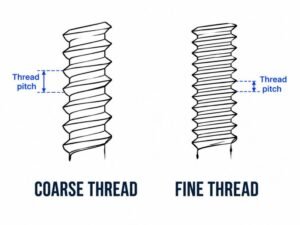
Advantages of Coarse Threads
- Strong Grip in Soft Materials: Coarse threads cut deeper and grip more effectively in materials like wood, plastic, rubber, and sheet metal.
- Resistant to Cross-threading: The wider spacing makes coarse threads more forgiving during assembly, since they are less likely to jam or strip when aligned slightly off-angle.
- Faster Assembly: Fewer turns are needed to fully engage a coarse thread, which speeds up assembly on production lines.
- General Industrial Applications: Offer faster installation, better durability, and easier maintenance, making them suitable for automotive assembly, construction equipment, plastic components, and general machinery.
Disadvantages of Coarse Threads
- Lower Clamping Force: When threading into a component with a corresponding internal thread, such as a nut, coarse threads generally provide less clamping force than an equivalent fine thread.
- Weaker Vibration Resistance: The larger pitch means less thread engagement per unit length, which can allow the connection to work loose over time in high-vibration applications.
Advantages of Fine Threads
- Higher Clamping Strength: More threads per inch increase the contact area between mating threads, giving fine threads a stronger hold once assembled.
- Precise Adjustment: The smaller pitch allows for more precise positioning, which matters in applications like adjustment screws or instruments.
- Better Vibration Resistance: Closer thread engagement helps fine threads stay seated under vibration and cyclic loading.
- Preserves Core Material: Because less material is removed to cut the thread, fine threads leave more core material intact, which helps in thin-walled or smaller-diameter parts.
- Precision Mechanical Applications: Provide higher precision, stronger clamping force, and better adjustment control, making them ideal for aerospace components, medical devices, precision equipment, and hydraulic systems.
Disadvantages of Fine Threads
- Higher Cross-threading Risk: The tight spacing makes fine threads more sensitive to misalignment during assembly, increasing the chance of stripped or galled threads.
- Sensitive to Coatings and Debris: Plating, paint, or debris can interfere with fine threads, sometimes preventing proper engagement.
Coarse Thread vs Fine Thread: A Quick Comparison
| Aspect | Coarse Thread | Fine Thread |
|---|---|---|
| Thread pitch | Larger, fewer threads per inch | Smaller, more threads per inch |
| Assembly speed | Faster, fewer turns needed | Slower, more turns needed |
| Cross-threading risk | Lower | Higher |
| Grip in soft materials | Stronger | Weaker |
| Clamping force (mated threads) | Lower | Higher |
| Vibration resistance | Lower | Higher |
| Tolerance to coatings/debris | Higher | Lower |
| Best suited for | Wood, plastics, rubber, general fasteners | Precision assemblies, thin walls, high-vibration environments |
| Applications | Automotive assembly, construction equipment, and general machinery | Aerospace components, medical devices, and hydraulic systems |
When to Use Coarse vs Fine Threads
Based on the comparison above, choosing between coarse and fine threads depends heavily on the material being threaded, the loads the part will see, and the environment it operates in, including vibration, temperature, and how often the connection will be assembled and disassembled.
If the part is going into a soft material, needs fast assembly, or will be handled and reassembled often, coarse threads are usually the safer choice. If the part demands strong clamping force, must resist loosening under vibration, or requires fine positional control, fine threads are typically the better fit. Wall thickness matters as well. Thin-walled or small-diameter parts often favor fine threads.
How Threads Are Made
Threads are commonly produced through three main methods: CNC milling, thread rolling, and Swiss screw machining. Each method has different advantages in terms of strength, precision, production volume, and design flexibility.
CNC milling creates threads by using a rotating cutting tool to follow a helical path. It provides excellent control over thread dimensions and surface finish, making it suitable for both internal and external threads, including custom pitches, left-hand threads, and complex designs.
Thread rolling forms threads by pressing a blank between hardened dies to reshape the material. This process improves thread strength and fatigue resistance through work hardening and is ideal for high-volume production. It is mainly used for external threads with standard profiles.
Swiss screw machining produces threads using single-point cutting tools on a sliding headstock lathe. It offers high precision and is commonly used for small, complex components that require tight tolerances across multiple features.
Compared with thread rolling, machined threading methods such as CNC milling and Swiss machining generally have higher costs and longer processing times. However, they provide greater flexibility for custom thread designs and precision applications.
Conclusion
Coarse threads and fine threads each offer unique advantages depending on application requirements. Coarse threads provide faster installation, better resistance to damage, and improved performance in softer materials or harsh environments, while fine threads deliver higher strength, better adjustment accuracy, and greater resistance to loosening under vibration.
Proper thread selection helps create more reliable and cost-effective designs. If your project needs custom threaded components, Jiangzhi provides professional CNC machining services with precise thread machining capabilities to meet various design and application requirements.


