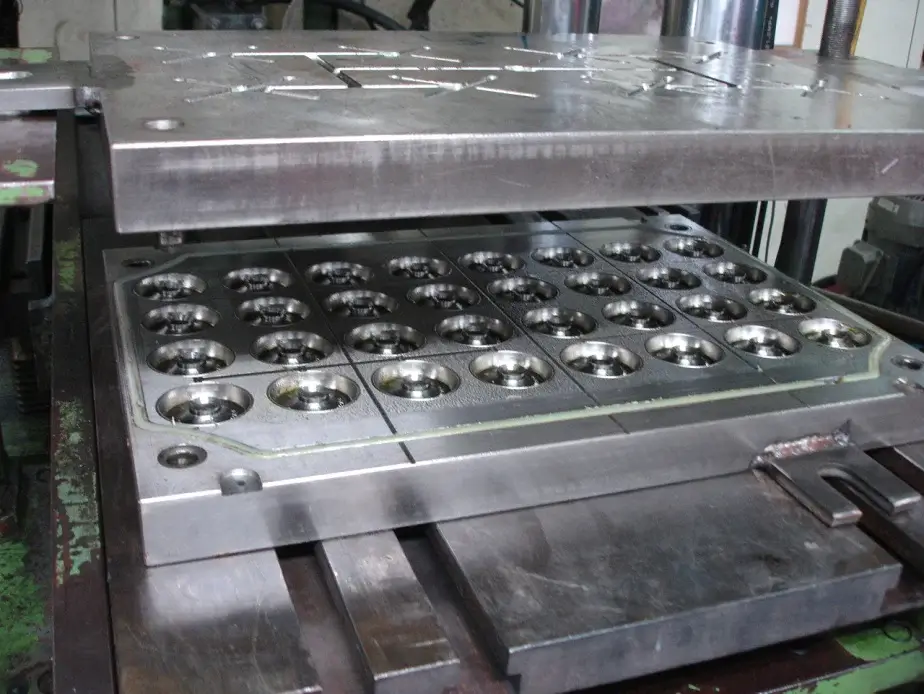
Two injection mold suppliers receive the same product drawing from a customer. One quotation is significantly lower than the other. At first glance, it may appear that one supplier simply offers a better price. However, in many cases, the difference comes from different interpretations of the mold requirements.
One supplier may quote a basic production mold designed for tens of thousands of cycles, while another may calculate the tooling cost based on a high-volume production mold using hardened steel components and a longer service life requirement. Although both quotations are based on the same part design, they are not necessarily describing the same tooling standard. This is where SPI Mold Classification becomes important.
What Is SPI Mold Classification?
SPI Mold Classification refers to a set of guidelines originally developed by the Society of the Plastics Industry, now part of the Plastics Industry Association. It provides a common reference for defining injection mold construction requirements, expected production cycles, and general tooling quality levels. Instead of relying only on general descriptions such as “production mold” or “high-quality mold,” manufacturers and buyers can use mold classes to establish clearer expectations before tooling begins.
The system divides injection molds into five classes: Class 101, Class 102, Class 103, Class 104, and Class 105. Each class is defined primarily by the expected number of production cycles the mold should support under normal operating conditions.
The five main SPI mold classes are:
- Class 101: Designed for extremely high production volumes, typically exceeding one million cycles.
- Class 102: Designed for medium to high production applications with higher durability requirements.
- Class 103: General production tooling for medium-volume applications.
- Class 104: Low-volume production molds with limited service requirements.
- Class 105: Prototype molds intended for very limited quantities.
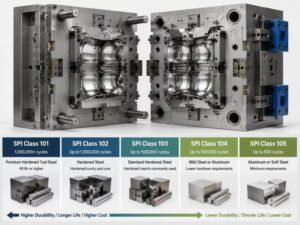
SPI Mold Classification Chart: Class 101–105 Comparison
The following table summarizes the general differences between each SPI mold class.
| Mold Class | Expected Cycles | Typical Application | Mold Steel Requirement | Hardness Requirement |
|---|---|---|---|---|
| Class 101 | 1,000,000+ cycles | High-volume production, long-term manufacturing programs | Premium hardened tool steel | Core and cavity typically hardened around 48 Rc or higher |
| Class 102 | Up to 1,000,000 cycles | Medium to high production, abrasive materials, tighter tolerances | Hardened steel components | Hardened cavity and core materials |
| Class 103 | Up to 500,000 cycles | General production molds and medium-volume projects | Standard hardened steel | Hardened inserts commonly used |
| Class 104 | Up to 100,000 cycles | Low-volume production and limited manufacturing runs | Mild steel or aluminum options | Lower hardness requirements |
| Class 105 | Up to 500 cycles | Prototype tooling and sample production | Low-cost materials such as aluminum or soft steel | Minimum requirements |
Why Do Different Sources Show Different SPI Mold Classification Cycle Numbers?
When researching SPI Mold Classification, buyers may notice that different websites, suppliers, or technical documents sometimes show slightly different cycle numbers for the same mold class. This often creates confusion during the quotation process.
For example, some charts may describe Class 102 as a mold for up to one million cycles, while other references may show different ranges for Class 102 or Class 103. These differences do not necessarily indicate that multiple SPI standards exist. In most cases, the variation comes from simplified industry charts, older reference materials, or different ways of interpreting the original classification guidelines.
The practical response is simple. Do not rely solely on the class number. When reviewing a quote, ask the mold maker to confirm the expected cycle life, the steel grades planned for cavities and cores, and any specific hardness or surface treatment targets. Clear confirmation removes ambiguity that outdated charts can introduce.
How to Choose the Right SPI Mold Classification for Your Project?
Selecting the correct mold grade requires more than estimating the expected production quantity. A lower-class mold may reduce initial tooling costs, but it may create additional maintenance or replacement costs if the production requirements increase. On the other hand, selecting the highest mold class for every project can create unnecessary investment. The right choice depends on several practical questions.
First, what is the expected total production volume? A part that will run for several years at high volume generally needs Class 101 or Class 102. A limited run of a few thousand parts may only require Class 104 or even Class 105 for initial validation.
Second, how abrasive is the material? Glass-filled resins or other filled compounds increase wear. These materials often push a project toward a higher class even if the absolute volume is moderate.
Third, how tight are the dimensional tolerances? Parts that must hold close tolerances over many cycles benefit from the higher hardness and better component quality found in Class 101 and Class 102 molds.
Fourth, is the current need for prototypes, bridge tooling, or full production? Using a Class 101 specification for early design validation is a frequent source of unnecessary cost. A Class 105 or Class 104 tool can often supply enough parts for testing and market trials at a lower investment.
Factors That Really Affect Mold Lifespan Beyond SPI Classification
Although SPI Mold Classification provides a useful reference for expected mold life, the actual service life of an injection mold depends on many engineering factors.
Number of Cavities
Cavity quantity affects both productivity and mold complexity. A multi-cavity mold produces more parts per molding cycle, but it also introduces additional design requirements. More cavities mean more inserts, more cooling channels, more alignment requirements, and greater maintenance complexity. The cavity design must balance production efficiency with long-term mold stability.
Hot Runner vs Cold Runner System
The runner system is another factor that affects mold performance. Hot runner systems reduce material waste and improve production efficiency because the plastic material remains inside the heated runner system. However, they require more complex design, temperature control, and maintenance.
Cold runner systems are simpler and generally easier to maintain, but they may produce more material waste and require additional trimming operations.
Surface Treatment and Mold Steel Protection
Surface treatment can improve mold durability, especially when the selected steel or production conditions create additional wear risks.
Common surface treatments include nitriding, hard chrome plating, and corrosion-resistant coatings. These treatments can improve surface hardness, reduce friction, and increase resistance against wear or corrosion.
Mold Maintenance Frequency
Maintenance is another factor that directly affects actual mold lifespan. Regular cleaning of cooling channels, inspection of wear surfaces, and timely replacement of high-wear components keep a mold performing closer to its rated life. Neglect shortens that life regardless of the original class.
SPI Mold Classification vs Other International Standards
SPI mold classification is widely recognized in the injection molding industry, especially for North American tooling projects. However, it is not the only system used globally. Different regions and companies may use additional standards or internal specifications to define mold requirements.
SPI Standards
The SPI system classifies molds from Class 101 to Class 105 based mainly on expected production volume, mold construction level, and durability requirements. The main advantage of SPI classification is that it provides a common reference between buyers and mold manufacturers.
Euromap Standards
Euromap is commonly referenced by European plastics machinery and manufacturing companies. Unlike SPI mold classification, which focuses mainly on mold categories and expected tooling requirements, Euromap standards cover broader aspects of plastics processing equipment and industry practices.
ISO and VDI Internal Standards
Many mold manufacturers in Asia and Europe also use internal standards based on customer requirements, ISO quality systems, and engineering practices. These systems may provide detailed technical requirements, but they are not always directly equivalent to SPI mold classifications.
How to Communicate Mold Class Requirements?
Providing only a class number leaves room for assumption. A more complete request includes the following information:
- Expected total production volume or target cycle life
- Resin type and any fillers (for example, glass fiber percentage)
- Critical dimensional tolerances
- Number of cavities
- Current project stage (prototype, bridge, or full production)
- Any specified steel grades or hardness requirements
- Preferred surface treatments or cooling channel materials
Conclusion
SPI Mold Classification provides an effective way for buyers and injection mold manufacturers to communicate tooling expectations. The five classifications, from Class 101 to Class 105, help define different production requirements and mold construction levels. A professional mold manufacturer can help evaluate these requirements, select a suitable mold grade, and provide tooling that matches the actual application rather than simply meeting a classification number. Jiangzhi provides mold tooling services covering mold design, tooling development, and production-ready solutions for different injection molding applications.