Additional considerations for rubber/silicone molds: When core pins are used in rubber vulcanization or silicone injection molds, material selection depends not only on wear resistance but also on the ability to withstand repeated exposure to vulcanization temperatures over the long term and resistance to corrosion from mold release agents or vulcanizing agents in the rubber compound. This differs from the selection logic for plastic injection molds; therefore, the specific rubber formulation and vulcanization process conditions must be verified before material selection.
How to Choose the Right Core Pin Material?
Choosing the correct core pin material requires evaluating the molding conditions, production requirements, and expected service life.
High-Volume Injection Molding Applications
For high-volume production, core pins need to maintain stable dimensions after repeated molding cycles. Hardened tool steels such as H13 are commonly selected because they provide good wear resistance, thermal fatigue resistance, and mechanical strength.
High-Precision and Appearance-Critical Parts
For parts requiring tight tolerances and high surface quality, materials such as NAK80 and S136 stainless steel are suitable choices. They provide good polishing performance and dimensional stability for optical, medical, and appearance-focused components.
Glass-Filled Engineering Plastics
Glass-filled plastics can accelerate core pin wear due to their abrasive properties. For these applications, materials with higher hardness and wear resistance, such as M2 high-speed steel, are recommended to maintain dimensional accuracy during extended production.
Rubber and Silicone Molding Applications
For rubber vulcanization molds and silicone injection molding, core pin materials must withstand repeated thermal cycles and chemical exposure. Selection should consider the rubber formulation, curing temperature, release agents, and surface requirements.
Corrosion-Sensitive Environments
For molds exposed to moisture or corrosive materials, stainless steel such as S136 provides better corrosion resistance. It helps maintain the core pin surface quality and reduces maintenance caused by rust or degradation.
Core Pin Manufacturing and Tolerance Control
Precision machining ensures that each core pin meets the requirements of core pins injection molding. CNC Swiss lathes, grinding, and milling operations achieve tight tolerances, often in the range of ±0.002 mm on critical diameters.
Surface finish quality affects ejection and long-term performance. Smoother finishes, such as Ra 0.2 μm, reduce friction and plastic adhesion. Post-machining treatments like nitriding or specialized coatings can further enhance wear properties.
Quality control steps include dimensional inspection and verification of concentricity. Any deviation in machining can result in fit issues within the mold or dimensional variation in molded parts.
Core Pin Design Considerations
Core pin design is not only about selecting the correct material. Mechanical support and installation accuracy are equally important.
Core Pin Support Length
The support length of a core pin determines its ability to withstand injection pressure during molding. A pin with a long unsupported section is more likely to bend or deflect when exposed to high pressure from molten plastic. This can cause problems such as hole position deviation, uneven wall thickness, flash formation, and reduced part accuracy. To improve stability, designers should optimize the support structure, reduce unsupported length, or increase the pin diameter when necessary.
Core Pin Fit and Alignment
The fit between the core pin and the mold plate must be accurately controlled to ensure stable positioning during injection molding. Excessive clearance may allow the pin to move under injection pressure, leading to flash, dimensional variation, or uneven wear. A proper fit maintains alignment, improves mold durability, and helps produce consistent molded parts over repeated production cycles.
Common Core Pin Failure Modes and Their Impact on Molded Parts
Core pins are exposed to repeated mechanical stress, injection pressure, thermal cycling, and material friction during production. Improper material selection, insufficient support, or inaccurate manufacturing can lead to core pin failures that affect mold performance and molded part quality.
Core Pin Bending
Core pin bending usually occurs when the pin has an excessive unsupported length, insufficient support, or is exposed to high injection pressure. During molding, the pressure from molten plastic can create lateral forces that cause the pin to deflect. A bent core pin may result in inaccurate hole positions, uneven wall thickness, flash around the feature, and dimensional issues in the finished part.
Core Pin Wear
Core pin wear is commonly caused by high production cycles, abrasive plastic materials, or insufficient material hardness. During repeated molding operations, friction between the molten plastic and the core pin surface gradually removes material from the pin. This wear can increase the size of molded features, reduce dimensional consistency, affect part assembly, and shorten mold service life.
Core Pin Breakage
Core pin breakage is often related to improper design, excessive stress concentration, small pin diameter, or incorrect heat treatment. When a core pin repeatedly experiences injection pressure and mechanical stress, fatigue can develop over time and eventually cause the pin to fail. A broken core pin may damage other mold components, interrupt production, and require mold repair or replacement.
Core Pin Corrosion and Surface Damage
Corrosion and surface damage can occur when the core pin material is not compatible with the molding environment or when the mold is exposed to moisture and chemical agents. Surface degradation can affect the finish of molded parts and increase friction during demolding. In rubber and silicone molding applications, chemical exposure from curing agents and additives should also be considered when selecting core pin materials.
Core Pin Misalignment
Core pin misalignment may result from poor installation accuracy, improper fit, or wear between the pin and mold components. When the core pin position shifts during molding, internal features may not meet design requirements. This can lead to incorrect hole locations, uneven part geometry, assembly problems, and inconsistent product quality.
Core Pin vs Ejector Pin vs Guide Pin
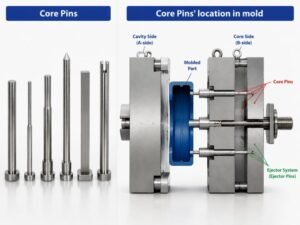
Although these components have similar shapes, their functions are different. A core pin in injection molding creates part geometry, while an ejector pin supports demolding and a guide pin maintains mold alignment. There is a comparison table to show the differences.
| Component | Main Function | Location | Effect on Molded Part |
|---|
| Core Pin | Creates internal features | Core side of mold | Determines holes and internal geometry |
| Ejector Pin | Removes molded parts | Ejection system | Assists part removal |
| Guide Pin | Aligns mold halves | Mold base | Maintains mold positioning accuracy |