Selecting the right plastic manufacturing process is essential for achieving the required balance of quality, cost, and production efficiency. For continuous plastic components such as pipes, tubes, profiles, and sheets, extrusion molding is widely used across multiple industries.
This guide explains how extrusion molding works, commonly used materials, applications, advantages, and key considerations when selecting this manufacturing method.
What Is Extrusion Molding?
Extrusion molding is a plastic manufacturing process that shapes molten thermoplastic materials by forcing them through a customized die. As the material exits the die, it takes the shape of the die opening and forms a continuous product with a consistent cross-section.
This continuous production capability is what distinguishes extrusion molding from other manufacturing processes. A single die can produce long lengths of consistent products, making extrusion an efficient and cost-effective solution for applications such as pipes, tubing, hoses, sheets, and profiles. Although the process may sometimes be referred to as “plastification extruding,” the term “extrusion” is more commonly used in the industry.
How Does the Extrusion Molding Process Work?
The extrusion molding process consists of several key steps that transform raw plastic materials into finished products.
Step 1. Material Feeding: Plastic resin pellets are first added into the hopper of the extrusion machine. Depending on product requirements, manufacturers may add colorants, stabilizers, fillers, or other additives to modify material performance.
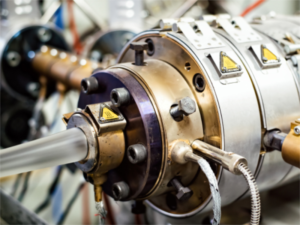
Step 2. Melting and Plasticizing: The resin enters a heated barrel where rotating screws generate heat and pressure. The combined effects of temperature and mechanical movement melt and mix the plastic into a uniform molten material. Proper melting and mixing help maintain consistent product quality throughout production.
Step 3. Shaping Through the Die: The molten plastic is pushed through a customized die, which determines the cross-sectional shape of the final product. Different die designs allow manufacturers to produce round tubes, flat sheets, hollow profiles, and custom-shaped plastic sections.
Step 4. Cooling and Cutting: After exiting the die, the extruded material is cooled using air or water cooling systems to maintain its shape and dimensional stability. Depending on the product requirements, additional operations may include cutting, surface treatment, or assembly.
Common Materials Used in Extrusion Molding
Not every plastic extrudes well. Extrusion depends on a material that melts into a stable, evenly flowing stream in the barrel, holds its shape as it exits the die, and sets quickly during cooling without warping that combination of melt behavior and post-die stability is what makes the following materials extrusion staples:c’c
- Polyethylene (PE) has a low melt viscosity that lets it flow through a die under relatively low pressure, keeping production fast and efficient — well suited to high-volume runs of film, pipe, and packaging.
- PVC is rigid once cooled but needs heat stabilizers to process safely through the barrel without degrading — a trade-off manufacturers accept because rigid PVC holds its shape well over long extrusion runs, making it a frequent choice for pipe and siding.
- Nylon (polyamide) flows cleanly at high barrel temperatures and solidifies quickly once it exits the die, so it keeps tight dimensional tolerances along the length of a profile. This property matters in automotive tubing, where fit and heat resistance both count.
- Acrylic maintains a very even melt viscosity through the die, which is what gives extruded acrylic sheet its clarity and light transmission, and it’s more cost-effective to extrude this way than to cast it.
- ABS flows consistently at moderate processing temperatures and comes off the die with a smooth, glossy surface, which is why it’s used for housings and wire protection where appearance matters.
Choosing the right one comes down to matching the material’s properties to the part’s real-world demands. For a deeper look at how flexibility, chemical exposure, temperature range, and impact resistance factor into that decision, see our guide on plastic materials selection factors.
Applications of Extrusion Molding
Extrusion suits products that are long, uniform, and cut to length rather than molded as one discrete piece:
- Pipe and Tubing: water or sewage pipe, medical tubing, flexible or rigid hose
- Sheets and Films: glazing panels, protective covers, food wrap, agricultural film
- Coatings and Laminations: polymer layers on paper, foil, or fabric
- Wire and Cable Coating: insulation using PE, PVC, or thermoplastic elastomers
- Profiles and Trim: window frames, vinyl siding, edge trim, decking and fencing
- Other Products: drinking straws, blister packaging, gaskets and seals anywhere a consistent cross-section produced in bulk matters more than a complex 3D shape.
Advantages of Extrusion Molding
High Production Efficiency
Extrusion molding is a continuous manufacturing process, allowing manufacturers to produce large quantities of products with consistent quality.
Lower Tooling Cost
Extrusion tooling is generally simpler than injection molds because it mainly consists of a die that shapes the product profile. This helps reduce initial tooling costs and makes extrusion molding a cost-effective choice for continuous and high-volume production.
Consistent Product Dimensions
Because extrusion continuously forms products through a fixed die, it can maintain consistent cross-sectional shapes and dimensions.
Material Versatility
With different die designs and material options, extrusion molding can produce a variety of profiles ranging from simple shapes to moderately complex geometries.
Reduced Material Waste
Excess material generated during extrusion production can often be recycled and reused, helping improve material efficiency and reduce overall manufacturing costs.
Disadvantages of Extrusion Molding
Although extrusion molding offers many advantages, it also has some limitations.
Limited Design Flexibility
Since the die determines the product profile, extrusion molding is not ideal for parts with highly complex three-dimensional geometries.
Limited Feature Complexity
Compared with injection molding, extrusion molding is less suitable for products requiring intricate details, undercuts, or complex internal structures.
High Initial Equipment Investment
Extrusion molding requires a significant upfront investment in the extruder itself. Although the tooling cost is relatively low, the equipment, screws, and production line setup still represent a considerable capital expense, which can make extrusion less economical for small-scale or one-off projects.
Extrusion Molding vs Injection Molding
Both processes heat plastic and force it into shape, but they solve different problems. Injection molding pushes molten plastic under high pressure into a closed cavity to form a discrete 3D part. Extrusion pushes material at lower pressure through an open die to form a continuous, uniform profile that’s cut to length. The table below highlights the key differences between them.
| Comparison Factors | Extrusion Molding | Injection Molding |
|---|---|---|
| Manufacturing method | Plastic pushed through a die | Plastic injected into a mold |
| Product type | Continuous profiles | Individual molded parts |
| Best suited for | Pipes, tubes, sheets, profiles | Complex plastic components |
| Production style | Continuous process | Repeated molding cycles |
For a more detailed comparison, see our guide on extrusion molding vs injection molding.
Conclusion
Extrusion molding is an efficient manufacturing process for producing continuous plastic products with consistent shapes and dimensions. With proper material selection and process control, it provides a reliable solution for many industrial applications.
Jiangzhi provides custom plastic molding solutions to help customers develop high-quality plastic components. Contact our team to discuss your extrusion molding requirements and find the right manufacturing solution for your project.