Injection molding can produce complex parts efficiently, but some designs require two molded pieces to be joined after molding. Screws add weight and loosen over time. Glue adds a curing step and a second material to source. For a lot of injection-molded components, neither is the right answer, and that is where plastic welding comes in.
What Is Plastic Welding?
Plastic welding is the process of joining two compatible thermoplastic components by heating their contact surfaces to a softened or molten state and then applying pressure to fuse them as they cool. Once the joint solidifies, the bonded area has mechanical properties close to those of the base material, particularly when the two parts are made of the same or a chemically compatible resin.
Plastic welding relies on molecular entanglement between polymer chains at the interface, which only happens if the two materials are thermally and chemically compatible. Because the joint is chemically continuous with the parent material, it is also permanent.
Why Manufacturing Needs Plastic Welding?
Screws, rivets, and adhesives all have a place in plastic assembly, but plastic welding solves problems that those methods handle poorly.
First, it removes the need for additional consumables. No fasteners to source, no adhesive to mix or cure, and no hardware to track through inventory. This simplifies the bill of materials and reduces the number of failure points in an assembly.
Second, it produces a joint that does not rely on a separate bonding agent, which makes it a practical option for parts that need to hold a seal against water, dust, or chemical exposure. A welded seam behaves like a continuous wall of the same material, rather than a boundary where two different substances meet.
Third, assemblies built with welded joints tend to be lighter than the same assembly built with mechanical fasteners, since there is no added mass from bolts, brackets, or rivets. For components going into weight-sensitive applications, that difference adds up.
Fourth, welding is often the only practical way to assemble a component that was deliberately split into two or more mold halves during design. Complex geometries with internal channels, undercuts, or enclosed cavities frequently cannot be molded as one piece. Designing the part as two halves that get welded together after molding is a common workaround.
Three Core Steps of Plastic Welding
Regardless of which specific method is used, nearly all plastic welding processes follow the same three-step sequence.
Step1. Pressing
The two parts are clamped or held together at the joint location before any heat is applied. This step matters because gaps or misalignment at this stage carry through to the finished weld. A part that is not held firmly in place will produce an inconsistent bond line, even if the heating and cooling steps are executed correctly.
Step2. Heating
Heat is applied to the joint interface using one of several methods, ranging from direct hot air to non-contact methods like ultrasonic vibration or laser energy. The goal is to bring the polymer at the interface to a workable, softened state without pushing it past its degradation temperature. Underheating leaves the chains too rigid to interdiffuse; overheating can degrade the polymer and weaken the resulting joint rather than strengthen it.
Step3. Cooling
Once the interface has fused under pressure, the joint is held in place while it cools and solidifies. This step locks the molecular structure into place. Cooling times vary by material thickness and welding method, but rushing this step, or releasing pressure too early, is a common cause of weak or inconsistent joints in practice.
Main Plastic Welding Process Types
Several welding methods are used in production settings, each suited to different part sizes, geometries, and volumes.
Ultrasonic Welding
Ultrasonic welding uses high-frequency mechanical vibration, typically between 15 and 40 kHz, to generate localized heat at the interface between two thermoplastic components and melt the plastic in well under a second.
The short cycle time and ease of automation make it the default choice for high-volume production of small precision parts, including electronic housings and connectors.
Vibration Welding
The two parts are rubbed against each other at a set frequency and amplitude, generating heat through friction across the entire joint surface. This works well on larger parts and irregular or uneven joint surfaces that ultrasonic welding cannot handle consistently. Cycle times generally run one to five seconds. It is commonly considered for automotive components, housings, ducts, reservoirs, and other relatively large assemblies.
Hot Plate Welding
A heated plate contacts both surfaces to melt them before they are pressed together and held until they cool. It takes longer than the friction-based methods, usually ten to twenty seconds. Hot plate welding can be useful for larger thermoplastic components and assemblies with relatively broad joining surfaces. It can also accommodate certain geometries that are difficult to process with smaller localized welding technologies.
Laser Welding
Laser welding uses a focused laser beam to generate heat at the joining interface. One common approach uses two plastic components with suitable optical characteristics. Laser energy passes through one component and is absorbed at the joining area of the other component, generating localized heat.
It has more positional accuracy than the other methods. Weld times run three to five seconds. The setup cost is higher, but the result is a cleaner, lower-flash appearance, which matters for parts where the seam is visible or where a consistent seal is critical.
Hot Air Welding
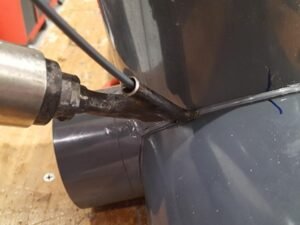
A heated air stream, often paired with a filler rod, melts the joint manually or with semi-automated equipment. Weld time depends on part size and operator technique rather than a fixed cycle. This method fits lower-volume production, repair work, and joint geometries too irregular for standard tooling.
Spin Welding
One part rotates against a stationary part to generate friction at the joint. It works only on rotationally symmetric joints, such as round caps or containers, and typically completes in under five seconds.
How to Choose the Right Plastic Welding Process?
Selecting a method comes down to a handful of practical factors, and they typically need to be weighed together rather than in isolation.
Material Type: Check the Plastic Materials
Not every resin responds to every welding method the same way. High-frequency welding, for instance, works well on polar materials like PVC but performs poorly on non-polar resins such as polyethylene. If two different materials need to be joined, their compatibility should be evaluated before selecting the welding technology.
Part Size and Geometry
Rotationally symmetric parts are natural candidates for spin welding. Large, irregularly shaped joint surfaces are better suited to vibration welding, which does not require the part to be perfectly round or flat. Small, precise components with limited joint area are a good match for ultrasonic welding.
Production Volume
High-volume manufacturing generally favors methods with short cycle times and a high degree of automation, such as ultrasonic or vibration welding. Lower-volume runs, or repair work, can justify the lower equipment cost and slower pace of hot air welding.
Appearance and Sealing Requirements
Parts that need a clean, low-flash appearance, or a consistent hermetic seal, often point toward laser welding or a well-controlled hot plate process. Applications with looser cosmetic requirements have more flexibility in method selection.
Plastic Welding vs Other Joining Methods
Plastic welding is one of several ways to join plastic components, and it is not always the right choice. The table below compares welding against adhesive bonding, mechanical fastening, and snap-fit designs across a few practical dimensions.
| Joining Method | Main Principle | Permanent | Sealing Potential | Production Speed | Typical Application |
|---|---|---|---|---|---|
| Plastic Welding | Heat or other energy fuses thermoplastics | Yes | High with suitable joint design | Medium–High | Thermoplastic assemblies |
| Adhesive Bonding | Adhesive joins two surfaces | Usually | Good with suitable adhesive | Medium | Mixed materials and complex surfaces |
| Screws/Fasteners | Mechanical fixation | Yes, but serviceable | Depends on design | Medium | Assemblies requiring disassembly |
| Riveting | Mechanical deformation | Yes | Limited unless separately sealed | High | Plastic and sheet assemblies |
| Heat Staking | Local plastic melting and deformation | Yes | Limited | High | Plastic-to-plastic or plastic-to-metal assembly |
Plastic Welding Applications for Injection Molded Parts
A significant number of plastic welding applications involve components that were first produced through injection molding. Injection molding provides the individual parts, while welding provides the secondary assembly process.
Split-Mold Enclosures
Housings with internal ribs, undercuts, or enclosed cavities are frequently molded as two separate halves and welded together afterward.
Common examples include:
- Electronic housings
- Sensor housings
- Automotive housings
- Control units
- Consumer electronic enclosures
Fluid Containers and Tanks
Reservoirs, tanks, and connectors that need to hold liquid or gas under pressure rely on a welded seam to maintain a leak-tight boundary, which an adhesive or mechanical joint cannot reliably guarantee over time.
Examples include:
- Fluid reservoirs
- Plastic tanks
- Pump housings
- Ducts
- Containers
Electronic and Electrical Components
Parts requiring an IP rating for dust or water resistance often use welding to close the enclosure without introducing a seam that could compromise the seal.
Typical applications include:
- Connector housings
- Sensor housings
- Protective covers
- Small enclosures
- Electronic modules
Automotive Plastic Components
Automotive parts can have demanding requirements for temperature resistance, vibration resistance, dimensional stability, and long-term durability. Automotive parts use a wide range of welded plastic assemblies.
Potential applications include:
- Air ducts
- Fluid-related components
- Sensor housings
- Lighting components
- Electronic housings
- Battery-related plastic components
Conclusion
Plastic welding is an effective way to join compatible thermoplastic parts, especially when a permanent, sealed, and repeatable joint is required. If you are planning an injection-molded part that will need welded assembly, send over your design and target application, and we can provide injection molding services and review material compatibility, joint design, and welding method together before tooling begins.