
When a plastic part needs to meet a flame-retardancy requirement, specifying “UL94 V-0” on a drawing may seem straightforward. In practice, however, selecting a compliant material is rarely just a matter of choosing a resin with the right rating.
For injection molded parts, the material, part design, production requirements, and end-use conditions all need to be considered together. A material that looks suitable on paper may not deliver the expected result once it is molded into the actual component.
This guide explains how UL94 classifications should be understood when selecting flame-retardant plastics for injection molding. It also covers the factors that can affect the achievable rating, commonly used flame-retardant materials, and how to approach material selection for different applications.
What Is UL94, and What Do the Six Ratings Mean?
UL94 is a flammability test standard published by Underwriters Laboratories. It measures how a plastic material behaves when exposed to a small open flame: how quickly it ignites, whether it self-extinguishes, and whether burning drips fall and ignite anything below. There are two basic test orientations. The HB test holds the specimen horizontally and measures burn rate. The V and 5V tests hold the specimen vertically and measure how quickly the flame self-extinguishes after the ignition source is removed.
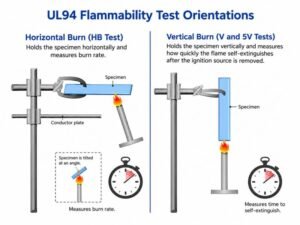
The six commonly referenced UL 94 classifications are HB, V-2, V-1, V-0, 5VB, and 5VA.
| UL 94 Rating | Test Orientation | General Performance | Key Consideration |
|---|---|---|---|
| HB | Horizontal | Basic horizontal burning classification | Lower flame resistance than vertical ratings |
| V-2 | Vertical | Self-extinguishing within specified limits | Flaming drips may occur |
| V-1 | Vertical | Better vertical flame resistance | Flaming drips that ignite the specified cotton indicator are not permitted |
| V-0 | Vertical | Higher vertical flame resistance | Faster extinguishing and no qualifying flaming drips |
| 5VB | Vertical | More demanding flame exposure | Burn-through of the specimen is permitted |
| 5VA | Vertical | Higher 5V performance | Burn-through is not permitted |
HB: HB is a horizontal burning classification. The specimen is positioned horizontally and exposed to a flame under specified test conditions. It is generally considered a basic flammability classification and is not equivalent to the vertical V ratings.
V-2: V-2 is tested with the specimen in a vertical orientation. The material must meet specified afterflame and afterglow requirements, but flaming drips can ignite the cotton indicator beneath the specimen.
V-1: V-1 has more demanding requirements than V-2. The material must extinguish within the specified limits, and flaming drips that ignite the cotton indicator are not permitted.
V-0: UL 94 V-0 is one of the most commonly specified ratings for flame-retardant plastic components. Compared with V-1 and V-2, it requires shorter allowable burning times and does not permit qualifying flaming drips that ignite the cotton indicator.
5VB and 5VA: The 5V classifications use a different and more demanding test configuration than the V-0, V-1, and V-2 classifications. The test involves both a vertical specimen and a larger plaque. The distinction between 5VB and 5VA is mainly related to whether burn-through of the plaque is permitted. 5VA has the more restrictive requirement.
Two Key Variables That Affect UL 94 Ratings
A UL94 rating on a datasheet is not a fixed property of the resin. It applies to one specific formulation, at one specific thickness. Two variables cause most of the certification issues we see in practice.
Wall Thickness
Wall thickness has a direct effect on the flammability behavior of a plastic specimen. A material that achieves V-0 at one thickness may not achieve the same rating at a significantly thinner section.
For example, a flame-retardant PC grade may be listed as V-0 at 1.5 mm. This does not automatically mean that a 0.8 mm injection-molded wall made from the same material will achieve V-0.
This distinction is particularly important for lightweight product designs. Reducing wall thickness can lower material consumption and part weight, but thinner sections are generally more difficult to qualify for demanding flame-retardant ratings.
A practical material selection process should therefore check the manufacturer’s UL documentation for the exact thickness associated with the rating.
There is a reference for wall thickness and UL94 rating.
| Wall Thickness Range | Typically Achievable Rating | Design Note |
|---|---|---|
| Below 0.8 mm | HB in most standard FR grades | Consider redesigning with ribs or a thicker section |
| 0.8–1.5 mm | V-2 or V-1 | Acceptable for non-critical housings |
| 1.5–3.0 mm | V-0 | Most common range for electronics enclosures |
| 3.0–6.0 mm | V-0 or 5VB | High-performance resins may reach 5VB here |
| Above 6.0 mm | 5VA | Structural or high-voltage enclosures |
Formulation and Color
A commercial plastic resin is not always a single fixed chemical formulation. Flame-retardant grades may contain specific additives, fillers, stabilizers, impact modifiers, and other components designed to achieve the required performance.
A black, white, natural, or custom-colored version of the same base resin may use different colorants or additive packages. These changes can affect the material’s flammability behavior and, in some cases, its UL recognition.
For this reason, it is not sufficient to specify only: PC, UL 94 V-0. A more complete specification should identify the exact material grade, required color, minimum wall thickness, and applicable certification.
For custom injection molding, the safest approach is to confirm the UL documentation for the actual grade and color before production.
Common Flame-Retardant Plastics for Injection Molding
Flame-retardant injection molding materials are available in many resin families. The following resins represent the flame-retardant grades most frequently used in the injection molded parts we produce. Availability and exact grade recommendations depend on part geometry and the target thickness, but this table is a starting reference point.
| Material | Typical Flame-Retardant Grade | Common UL 94 Target | Typical Applications |
|---|---|---|---|
| ABS | FR-ABS | V-0 | Electronic housings, control panels |
| PC | FR-PC | V-0 | Electrical enclosures, equipment housings |
| PC/ABS | FR PC/ABS | V-0 | Electronics and electrical housings |
| PA6 / PA66 | FR-PA | V-0 | Automotive and electrical components |
| PBT | FR-PBT | V-0 | Connectors, terminal blocks, electrical parts |
| PP | FR-PP | V-0 in selected grades | Automotive and industrial components |
| PPS | FR-PPS | V-0 in selected grades | High-temperature electrical components |
| PEEK | Selected FR grades | V-0 in selected grades | High-performance industrial components |
Choosing UL 94 Ratings by Industry and Application
The required UL94 rating is not a fixed number across all applications. It depends on how close the part sits to a live electrical connection, how it will be used, and which regulatory standard governs the end product.
Electronics and Electrical Enclosures
Electronic products commonly use flame-retardant plastic for:
- Electrical housings
- Power supply enclosures
- Connector housings
- Terminal blocks
- Switch housings
- PCB-related components
UL 94 V-0 is a common target for plastic parts located close to electrical components or potential ignition sources. However, the exact requirement depends on the product standard and the location of the component within the product. Standards such as IEC 62368-1 and IEC 60335 may introduce additional requirements that cannot be determined from UL 94 alone.
Automotive Plastic Components
Flame-retardant plastics are used in automotive connectors, fuse boxes, sensor housings, electrical modules, and other components.
The required flame performance varies significantly according to the component and vehicle application. Automotive manufacturers may also use their own material specifications and flammability requirements.
Therefore, automotive plastic material selection should consider UL 94 where applicable, but it should not assume that a UL 94 V-0 rating automatically satisfies every automotive flammability requirement.
Temperature resistance, chemical exposure, vibration, dimensional stability, electrical insulation, and mechanical strength may be equally important.
Industrial Control Cabinets and Electrical Equipment
Industrial control equipment can contain numerous plastic components, including housings, terminal blocks, circuit protection components, control panels, and internal supports.
V-0 is often considered for plastic components located near electrical sources, but the final requirement depends on the applicable equipment standard and component function.
For industrial equipment, standards such as UL 508A or relevant IEC standards may need to be considered together with the material’s UL 94 classification.
Quick Application Reference
| Application | Common UL 94 Consideration | Other Factors to Check |
|---|---|---|
| Electronic housings | V-0 often specified | Product safety standard, wall thickness |
| Electrical connectors | V-0 commonly considered | CTI, electrical insulation, temperature |
| Automotive electrical parts | Depends on component | OEM specification, temperature, chemicals |
| Automotive interior and under-hood parts | V-0 | Varies by subsystem |
| Industrial control equipment | V-0 often considered | Applicable UL/IEC product standard |
| Household electrical products | V-0 may be required in relevant areas | Product-specific safety requirements |
| High-temperature industrial parts | Selected V-0 grades | Continuous-use temperature, chemical resistance |
Beyond flame resistance, material selection should also account for mechanical performance, temperature resistance, chemical exposure, and electrical requirements. These considerations are part of the plastic material selection factors that help ensure the chosen material meets the needs of the final application.
Conclusion
Selecting a flame-retardant plastic comes down to a sequence, not a single lookup. Start with the rating your industry and application require, confirm that the material can still hit that rating at your actual wall thickness, and verify that the color or formulation you need is covered by the same certification. Skipping any one of these steps is what typically causes a part to fail testing after the mold has already been built.
If you are specifying a flame-retardant part for injection molding, we can review your drawings, confirm material and thickness combinations, and quote production before tooling begins. Send over your part design and target rating, and we will walk through the material options with you.


