
Your part design is finalized. Orders are increasing. Production is running. However, there is a question that many buyers only confront after costs begin to accumulate: Is your current injection molding approach still appropriate for your production volume?
Once demand moves into the tens of thousands of units, the gap between standard injection molding and high-volume injection molding becomes significant. It is no longer just about cycle time. It involves tooling strategy, mold durability, automation level, and quality consistency. For a broader comparison of production scale, see our guide to high-volume vs. low-volume manufacturing.
As a custom plastic parts manufacturer, we have supported buyers across automotive, industrial, and consumer electronics sectors in transitioning to high-volume production. This guide outlines what high-volume injection molding involves, how to evaluate whether your part is suitable, and what to look for in a manufacturing partner.
What Is High Volume Injection Molding?
High-volume injection molding refers to the production of large quantities of plastic parts using optimized tooling and automated systems designed for long production runs.
The distinction from standard injection molding is not purely quantitative. It is structural. In standard injection molding, tooling may prioritize flexibility and lower upfront investment. In high-volume injection molding, the emphasis shifts toward durability, multi-cavity output, repeatability, and long-term cost reduction.
How Many Parts Count as “High Volume”?
The manufacturing sector has no single universally recognized numerical threshold for defining production volume tiers. Most manufacturers segment production volumes as follows:
| Production Tier | Typical Unit Range | Tooling Type |
|---|---|---|
| Prototyping | 1–500 | Aluminum or soft steel |
| Low Volume | 500–10,000 | Aluminum or P20 steel |
| Medium Volume | 10,000–100,000 | P20 hardened steel |
| High Volume | 100,000–1M+ | H13 hardened steel, multi-cavity |
Industry expectations vary. Automotive suppliers often consider 50,000+ parts annually as high volume. Consumer goods and packaging applications may qualify at lower thresholds, typically starting around 25,000 units per run. In medical applications, even 10,000 precision components may be treated as high volume if quality validation requirements are strict.
How Does High-Volume Injection Molding Work?
High-volume injection molding achieves high output by increasing the number of parts produced in each cycle, reducing cycle time, and maintaining stable production over long manufacturing runs. Rather than relying on a single technology, manufacturers combine specialized tooling, efficient runner systems, and automated production to maximize throughput while keeping part quality consistent.
Multi-Cavity Molds: Produce More Parts per Cycle
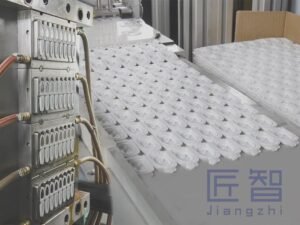
The most direct way to increase production is to mold multiple parts in every cycle. Instead of producing one component at a time, multi-cavity molds create several identical parts simultaneously. An eight-cavity mold, for example, can produce eight parts in the same cycle required for a single-cavity mold, significantly increasing hourly output.
Because every cavity must fill and cool uniformly, the mold requires balanced runner design, optimized cooling channels, and precise manufacturing. These factors ensure consistent dimensions across all parts during continuous production.
Hot Runner Systems: Reduce Cycle Time and Material Waste
High-volume production also depends on minimizing time and waste between cycles. Hot runner systems keep the plastic molten inside the mold, eliminating the need to cool and remove solid runners after each shot.
This shortens cooling time, reduces material waste, and allows the molding process to operate more efficiently over long production runs. While the time saved in a single cycle may be small, the cumulative improvement becomes significant when producing hundreds of thousands of parts.
Automation and Process Control: Keep Production Running Continuously
High-volume injection molding is designed for continuous production with minimal interruptions. Automation in injection molding enables robotic part removal, runner separation, inspection, and packaging without slowing the molding cycle. This reduces manual intervention and keeps production running efficiently over long manufacturing runs.
At the same time, process monitoring continuously controls melt temperature, injection pressure, holding pressure, and cooling time. Stable process parameters reduce variation, minimize defects, and maintain consistent quality throughout long production runs.
Is Your Part Suitable for High-Volume Injection Molding?
Not every part benefits from transitioning to high-volume injection molding. Before designing hard steel multi-cavity tooling, a complete evaluation is needed. It includes production requirements, design stability, and cost targets. High-volume technical feasibility usually improves when:
- The annual production volume exceeds 20,000 to 50,000 units.
- Your part design is stable, with minimal expected revisions.
- Draft angles are suitable for automated mechanical ejection.
- Wall thickness is consistent throughout the part.
- The part design has passed a design for manufacturability (DFM) review.
How Does High-Volume Injection Molding Reduce Unit Cost?
High-volume injection molding lowers the cost per part by optimizing both tooling and production costs. While tooling represents a fixed upfront investment, production costs are reduced through higher manufacturing efficiency. As production volume increases, the combined effect significantly lowers the overall unit cost.
Tooling Cost: Spreading the Investment Across More Parts
Tooling is the highest upfront cost in injection molding. High-volume molds are built for long production runs using durable tool steel, optimized cooling systems, and other features that ensure reliable performance over hundreds of thousands or even millions of cycles.
Although the initial tooling investment is higher than that of low-volume production, it is distributed across a much larger number of parts. As production volume increases, the tooling cost allocated to each part becomes progressively lower, reducing its impact on the overall unit cost.
Production Cost: Improving Manufacturing Efficiency
Once production begins, manufacturing efficiency becomes the primary source of cost savings. Multi-cavity molds increase the number of parts produced in each cycle, hot runner systems improve material utilization by reducing runner waste, and automation minimizes manual handling and labor requirements. Stable process control also helps reduce defects and unplanned downtime while maintaining consistent quality.
These improvements reduce labor, material, and machine costs throughout the production run, further lowering the manufacturing cost of each part.
Lower Total Cost Per Part
High-volume injection molding does not reduce the initial investment—it reduces the cost of each finished part. By spreading tooling costs over a large production volume and improving production efficiency, manufacturers achieve a significantly lower unit cost, making high-volume injection molding one of the most cost-effective manufacturing methods for large-scale production. If you’re estimating project costs, our guide to injection molding costs explains how tooling, materials, cycle time, and production volume affect pricing.
Contact our engineers for a practical high-volume manufacturing plan.
Common Materials Used in High-Volume Injection Molding
Material selection determines how smoothly a resin fills a complex multi-cavity mold and how reliably the finished component performs under actual service conditions. Common materials include:
Polypropylene (PP) and Polyethylene (PE)
These polyolefins exhibit low melt viscosity, superior chemical resistance, and predictable shrinkage behavior. They flow easily through long hot runner pathways, making them the standard choice for high-volume consumer packaging, thin-walled containers, and automotive interior components.
Acrylonitrile Butadiene Styrene (ABS) & PC-ABS Alloys
Combining structural rigidity, impact resistance, and excellent surface finish capabilities, these amorphous polymers are heavily utilized for electronic enclosures, consumer appliance housings, and structural automotive components. They require tight processing control to maintain appearance and dimensional stability.
Polycarbonate (PC)
Polycarbonate is valued for outstanding optical clarity and high tensile strength. However, its high melt viscosity demands robust gating structures and high injection pressures, making multi-cavity tool balancing critical to prevent structural stress concentration.
Polyamides (Nylon / PA / PPA)
These engineering resins are often reinforced with glass fibers to enhance thermal stability and mechanical load-bearing capacity. They are standard in industrial machinery components, automotive under-the-hood systems, and heavy-duty electrical connectors.
Industries That Rely on High Volume Injection Molding
High-volume injection molding is used across multiple industries where demand is consistent and production scale is large.
- Automotive: clip fasteners, interior dashboard panels, sensor housings, and wire harness connectors.
- Medical Devices: diagnostic pipettes, syringe plungers, fluid valves, and Petri dishes.
- Consumer Goods & Electronics: mobile phone internal frames and structural remote control housings.
Selecting an Industrial Manufacturing Partner
Choosing an injection molding supplier based solely on a low piece-price quote can introduce significant supply chain risks. High-volume production requires capabilities that go beyond basic molding. Key factors to evaluate include:
- Tooling Capability: The manufacturer should have experience with hardened steel molds, multi-cavity design, and hot runner integration.
- Production Capacity: High-volume injection molding requires sufficient machine capacity and scheduling flexibility. The manufacturer must be able to maintain consistent output over extended production runs.
- Automation Level: Automation is essential for maintaining efficiency and reducing variability. Evaluate the level of robotic integration and process control systems in place.
- Quality Control Systems: High-volume production increases the impact of defects. Confirm the supplier has a robust quality system, including in-line inspection and statistical process control to ensure consistency.
Conclusion
Choosing the right approach is not only a technical decision. It is a cost decision. At Jiangzhi, we support customers in aligning their production strategy with their volume requirements. From tooling design to high-volume manufacturing, our focus is on delivering stable quality, predictable output, and long-term cost efficiency.


