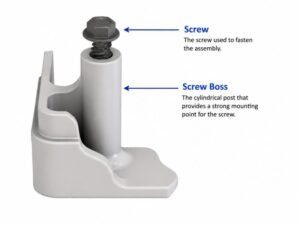
A poorly designed screw boss can create practical production problems, including stripped threads that require rework and cracks during assembly that stop production lines. Both problems, once they appear in a production run, tend to recur throughout the batch rather than appear as isolated defects.
A reliable screw boss design needs to solve two key problems: selecting the right fastening method and determining the correct dimensions for strength and durability. For basic boss structure factors such as wall thickness, draft angle, and spacing, refer to our complete boss design guide.
Screw Boss
Screw Boss Types: Which Fastening Method Fits Your Part
Different products require different fastening solutions. The correct choice depends on factors such as assembly frequency, required holding strength, production volume, and plastic material performance. A proper plastic screw boss design should consider not only the boss geometry but also the complete fastening system.
Self-Tapping Screw Boss
Self-tapping screw bosses are the most commonly used fastening method for injection-molded plastic parts. In this design, the screw forms its own threads directly inside the molded boss hole during assembly, which eliminates the need for additional metal components and reduces manufacturing complexity.
This solution is widely used for materials such as ABS, PC/ABS, and nylon because these plastics provide good toughness and can withstand the expansion force generated during screw installation. It is suitable for products that require simple assembly and occasional disassembly, such as electronic housings, plastic covers, and consumer products.
However, the performance of a self-tapping screw boss depends heavily on proper dimension control. If the pilot hole is too small, the installation torque may become excessive, increasing the risk of cracking. If the hole is too large, the screw may not achieve sufficient thread engagement, resulting in reduced pull-out strength or stripped threads.
Heat-Set / Ultrasonic Insert
Heat-set and ultrasonic inserts are used when a plastic screw boss requires higher strength or repeated assembly performance. Instead of relying on plastic threads directly, this method installs a metal threaded insert into the molded boss, providing a more durable connection point.
Heat-set inserts are installed by heating the insert so that the surrounding plastic softens and flows around the insert. Ultrasonic inserts use high-frequency vibration to generate heat and embed the insert into the plastic part. Both methods improve thread durability and are commonly used in products that require maintenance access, frequent opening and closing, or higher mechanical loads.
Compared with self-tapping screws, threaded inserts increase manufacturing steps and tooling considerations. The boss design must provide sufficient surrounding material to support the insert and prevent cracking during installation. Insert selection should also consider the plastic material, insert size, and expected service conditions.
Press-Fit (Pressed) Insert
Press-fit inserts are installed by pressing a metal insert into a pre-designed hole in the plastic boss. The connection relies on interference between the insert and the molded plastic, without requiring heat or ultrasonic equipment.
This fastening method offers a relatively simple installation process and can provide better thread performance than direct self-tapping screws. It is often used when a product requires improved fastening reliability but does not require the additional equipment needed for heat-set or ultrasonic installation.
The main design challenge for press-fit inserts is controlling the interference fit. If the hole diameter is too small, the insertion force may create excessive stress and crack the boss. If the hole is too large, the insert may become loose during use. Therefore, accurate control of insert dimensions and boss material properties is essential in plastic screw boss design.
Molded Thread
Molded threads are created directly during the injection molding process, allowing the threaded feature to become part of the plastic component without using screws or metal inserts. This approach can provide a clean appearance and eliminate additional assembly steps.
However, molded threads usually require more complex mold structures and careful consideration of demolding methods. Internal threads may require unscrewing mechanisms or collapsible cores, which can increase tooling cost and maintenance requirements.
This fastening method is generally selected for applications where thread performance, appearance, or integrated design is more important than minimizing tooling complexity. Before choosing molded threads, engineers should evaluate production volume, mold investment, material behavior, and long-term usage requirements.
Screw Boss Dimensions for Thread Engagement and Pull-Out Strength
Once the fastening method is selected, the boss dimensions need to be calculated against the specific screw or insert.
Pilot Hole to Screw Diameter Ratio
The pilot hole is the opening inside the screw boss before the screw is installed. Its diameter directly affects thread formation, installation torque, and cracking risk.
If the pilot hole is too small, installation torque increases, internal stress becomes higher, and the boss may crack during screw insertion.
If the pilot hole is too large, the screw cannot form sufficient threads, pull-out strength decreases, and the connection becomes less reliable.
The recommended pilot hole size depends on several factors, including screw type, plastic material, and required fastening performance. The same screw size may require different dimensions when used with different polymers.
Thread Engagement Length
Thread engagement length refers to the length of the screw that contacts the plastic material inside the boss. It directly affects resistance against pull-out forces and thread stripping.
A short engagement length may cause low holding strength, thread damage under load, and early failure during assembly.
Increasing engagement length can improve strength, but excessive length is not always beneficial. A deeper boss increases material usage and may create molding problems such as sink marks or uneven cooling.
The correct engagement length should be determined based on screw diameter, material strength, and application requirements.
OD-to-Screw-Diameter Ratio
The outer diameter of the screw boss needs to provide enough material around the screw hole while maintaining good molding quality.
A boss with insufficient outside diameter may have reduced mechanical strength, higher risk of cracking, and poor screw retention.
However, an oversized boss can create molding defects, especially when the boss wall becomes significantly thicker than the surrounding part.
A balanced OD-to-screw-diameter ratio helps maintain both fastening performance and injection molding quality.
Counterbore Design for Deep-Hole Screw Bosses
Counterbore design is a detail that should be discussed with the supplier during the early design stage. When a self-tapping screw is installed into a plastic boss, it displaces plastic material while forming threads. A counterbore provides additional space for this displaced material, helping reduce installation stress and the risk of boss cracking.
For deep-hole screw bosses, the counterbore location also needs to consider mold structure. In some cases, deep and narrow holes are produced using steel core pins, which can make it difficult to add a counterbore directly on the boss side. A common solution is to place the counterbore on the opposite part where the screw passes through.
Reviewing counterbore design with the supplier before tooling helps avoid mold limitations and assembly issues. Through Jiangzhi’s DFM service, screw boss structures can be evaluated early to improve manufacturability and reduce design changes during production.
Common Screw Boss Failures and Root Causes
Understanding common failure modes helps engineers improve the design before production.
Stripped or Pulled-Out Threads
Thread stripping usually occurs when the connection between the screw and plastic is not strong enough. Common causes include incorrect pilot hole diameter, insufficient thread engagement length, excessive tightening torque, and weak material selection.
Solutions include optimizing screw boss dimensions, increasing engagement length, adjusting assembly torque, or changing from self-tapping screws to threaded inserts.
Cracking During Screw Insertion
Cracking often happens when the plastic around the boss cannot withstand the expansion force generated during screw installation. Typical causes include brittle plastic material, oversized screw selection, excessive interference, and sharp corners causing stress concentration.
Design improvements may include adding proper fillets, adjusting boss wall thickness, reducing installation stress, and selecting a more suitable material.
Loosening Over Time
Screw loosening can occur after long-term use, especially in products exposed to vibration, temperature changes, or repeated assembly cycles. The main causes include plastic creep, material deformation, and insufficient thread retention.
For applications requiring repeated maintenance or high reliability, metal inserts are often a better choice than direct self-tapping screws.
Material Considerations for Screw Boss Design
Material selection plays an important role in screw boss performance. A design that works well with one plastic material may fail when applied to another resin.
Materials Suitable for Self-Tapping Screw Bosses
Materials commonly used with self-tapping screw bosses include:
ABS
PC/ABS
Nylon
These materials generally provide good toughness and enough flexibility for thread formation. For these materials, proper pilot hole size and screw selection are usually more important than adding additional reinforcement.
Materials Recommended for Threaded Inserts
Some materials are better suited for inserts rather than direct self-tapping screws, including:
Brittle engineering plastics
Highly filled reinforced materials
Some high-performance polymers
These materials may have limited ductility, making them more sensitive to stress concentration during screw installation. Using threaded inserts can improve connection reliability and reduce the risk of cracking.
Prototype Testing Is Still Necessary
Although material datasheets provide useful information, they cannot fully predict screw boss performance in a real product.
Factors such as screw geometry, assembly torque, boss dimensions, and environmental conditions can significantly affect results. For this reason, screw boss performance should be verified during the prototype stage instead of relying only on theoretical material selection.
Conclusion
A successful screw boss design requires more than selecting a screw size and adding a cylindrical mounting feature. The fastening method, boss dimensions, plastic material, and assembly conditions must work together to achieve reliable performance.
Jiangzhi provides DFM analysis, injection molding support, and screw boss design reviews to help customers optimize plastic parts before mass production. Share your 3D drawings, material requirements, and fastening specifications to receive professional design recommendations.
FAQ
How many times can a self-tapping screw be reused in a plastic boss?
A self-tapping screw boss is usually designed for limited reuse. The exact number depends on the plastic material, screw type, boss dimensions, and assembly torque. If the product requires frequent disassembly, a threaded insert is usually a better option.
When should I use a threaded insert instead of a self-tapping screw?
A threaded insert is recommended when the connection needs repeated assembly, higher holding strength, or better long-term reliability. It is also a good choice for brittle plastics or highly filled materials that may crack during self-tapping screw installation.
Why does my screw boss crack during assembly even with correct wall thickness?
Correct wall thickness alone does not guarantee a reliable screw boss. Cracking can also be caused by an incorrect pilot hole size, excessive screw torque, unsuitable material, sharp corners, or insufficient clearance around the screw.
What's the difference between screw boss design and general boss design?
General boss design focuses on the basic structure, including wall thickness, draft angle, height, and spacing. Screw boss design focuses on these factors plus fastening requirements, such as screw type, thread engagement, pull-out strength, and assembly performance.
Mold & Tooling Service
Learn more about our mold and tooling services. Explore our capabilities, tooling solutions, maintenance support, and quality control processes for reliable projects.