
Adhesive bonding is increasingly replacing welding, screws, and rivets across electronics, automotive, medical devices, and custom plastic products. The reason is simple: it can join dissimilar materials, spread load evenly, and produce a cleaner finished part.
This guide covers what adhesive bonding is, how it works, the main adhesive types, where it is used, and what actually determines whether a bond holds up in production and in the field.
What Is Adhesive Bonding?
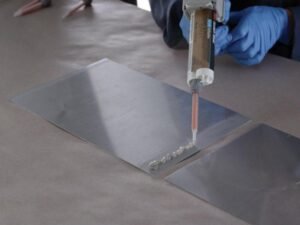
Adhesive bonding is a joining process that uses an adhesive material, such as liquid adhesive, paste, film, or tape, to attach two or more surfaces together. The adhesive forms a bond at the interface of the materials and, once cured or set, holds the assembly together under normal service loads.
It is one of several joining methods used in manufacturing, alongside welding, soldering, and mechanical fastening.
Adhesive Bonding vs. Welding and Mechanical Fastening
Welding melts and fuses the base materials themselves, so it generally only works on similar materials, most often metals. Mechanical fastening, such as screws or rivets, joins parts through physical hardware and requires drilling or pre-formed holes.
Adhesive bonding does not rely on melting the base material or adding hardware. It can join different types of materials, such as plastic to metal or plastic to glass, and it spreads stress across the entire bonded area rather than concentrating it at a few points.
If you’d like to explore these joining methods further, see our guides on plastic welding and screw assembly.
How Adhesive Bonding Works
Adhesive bonding depends on two forces: adhesion and cohesion. Adhesion is the attraction between the adhesive and the surface it is applied to. Cohesion is the internal strength of the adhesive itself, holding its own molecules together. A strong bond needs both.
These forces work through two main mechanisms:
- Mechanical Interlocking: The adhesive flows into the microscopic texture of a surface and hardens there, creating a physical grip similar to roots anchoring into soil.
- Chemical or Molecular Bonding: Molecules in the adhesive form intermolecular attractions, and in some adhesive systems, actual chemical bonds, with molecules on the surface of the substrate.
Once applied, the adhesive needs to cure or set before it reaches full strength. Depending on the adhesive type, this happens through heat, UV light, pressure, or simple solvent evaporation. The curing method and conditions have a direct effect on final bond strength.
Types of Adhesives
Adhesives are generally grouped by their chemistry and format. Each type has different strengths, cure times, and material compatibility.
- Epoxy Adhesives: Two-part systems known for high strength and good chemical resistance. Commonly used for structural bonds in metal, plastic, and composite assemblies.
- Cyanoacrylate (Super Glue): Fast-curing, single-part adhesives that work well for small parts and quick assembly, though they are less suited to flexible or high-impact joints.
- Structural Acrylics: Offer a strong balance of speed and durability, and tolerate some surface contamination better than epoxies.
- Polyurethane Adhesives: Flexible once cured, with good impact resistance and gap-filling ability, often used where some movement between parts is expected.
- Hot Melt Adhesives: Applied molten and set as they cool, giving very fast bonding for high-volume assembly lines.
- Pressure-Sensitive Adhesives (Tapes): Bond on contact with light pressure, useful for lightweight components, labels, and low-profile bonding applications.
The table below summarizes the key characteristics and typical substrates for each type.
| Adhesive Type | Key Characteristic | Common Substrates |
|---|---|---|
| Epoxy | High strength, chemical resistant | Metal, plastic, composites |
| Cyanoacrylate | Fast cure, low flexibility | Small plastic and rubber parts |
| Structural Acrylic | Fast cure, tolerates some contamination | Metal, plastic, painted surfaces |
| Polyurethane | Flexible, gap-filling | Plastic, wood, composites |
| Hot Melt | Very fast set, low cost | Packaging, textiles, plastics |
| Pressure-Sensitive Tape | Instant bond, no curing needed | Electronics, labels, thin components |
What Is Adhesive Bonding Used For?
Adhesive bonding is used across almost every manufacturing sector.
- Consumer Electronics: Bonding phone screens, device housings, and heat sinks, often where space is limited and mechanical fasteners are not practical.
- Automotive: Joining body panels and assembling battery packs, where adhesives help reduce weight and manage vibration.
- Medical Devices: Assembling housings and components that require a clean finish and a reliable, contamination-free seal.
Advantages of Adhesive Bonding
- Even Stress Distribution: Load is spread across the full bonded area instead of concentrated at a few fastener points.
- Joins Dissimilar Materials: Plastic, metal, glass, and composites can be bonded together in combinations that welding cannot handle.
- Sealing and Corrosion Protection: A continuous adhesive layer can seal out moisture and prevent corrosion between dissimilar metals.
- Weight Reduction: No added hardware mass, which matters in automotive, EV, and aerospace applications.
- Cleaner Appearance: No visible screws, welds, or rivet heads on the finished part.
- Simplified Assembly: Fewer components and process steps, which can lower overall production cost.
However, adhesive bonding also has limits: Bonded joints are generally designed not to be taken apart, most adhesives need curing time before they reach full strength, and achieving full strength requires extra careful surface preparation.
What Factors Affect Adhesive Bonding Strength?
Bond strength is rarely determined by the adhesive alone. Several factors interact to decide whether a joint holds up in production and in the field.
Surface Condition and Cleanliness
Dust, oil, mold release residue, or oxidation on a surface prevents the adhesive from making proper contact. Even a thin film of contamination can significantly weaken a bond.
Material Compatibility
Some plastics, such as polypropylene (PP) and polyethylene (PE), have a naturally slick, non-stick surface. Adhesives behave the same way on these plastics, which makes them naturally difficult to bond without extra treatment.
Adhesive Selection
Not every adhesive works with every substrate. Choosing an adhesive designed for the specific material combination and expected load is one of the most common points of failure when it is overlooked.
Curing Conditions
Temperature, humidity, time, and applied pressure during curing all affect how fully an adhesive develops its strength. Curing too fast, too slow, or under the wrong conditions can leave a bond underperforming.
Bond Line Thickness and Joint Design
An adhesive layer that is too thick or too thin, or a joint design that concentrates stress at one edge, can reduce strength even when the right adhesive is used.
How to Improve Adhesive Bonding: Surface Preparation for Stronger Adhesive Bonding
Of all the factors above, surface preparation is the most directly controllable, and it is often where bond failures originate. Below are some specific methods of surface preparation for adhesive bonding.
Cleaning
Remove dust, oil, and mold release agents before applying adhesive. Even a clean-looking surface can carry contamination that is invisible to the eye but still blocks proper adhesion.
Mechanical Treatment
Light sanding or abrasive blasting increases surface roughness, giving the adhesive more surface area and texture to mechanically interlock with.
Chemical and Physical Treatment
For plastics like PP and PE, which naturally resist adhesion, plasma treatment, corona treatment, or a primer coating is needed to change the surface at a molecular level and significantly improve adhesion. This step matters most in custom plastic manufacturing, where resin selection is often driven by cost or performance rather than how easily the material bonds.
Conclusion
Adhesive bonding is a joining process built on two simple forces: adhesion and cohesion. To get a reliable bond in production, you should choose the right adhesive for your materials and prepare the surface correctly.
From material and adhesive selection to surface treatment, Jiangzhi helps achieve reliable, production-ready adhesive bonding for custom plastic parts. Contact us to get a free quote for your project.


