
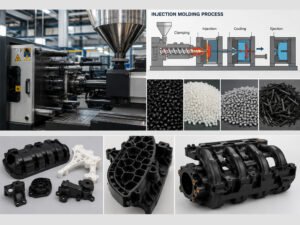
Composite injection molding is the process of manufacturing plastic parts using fiber-reinforced or filled thermoplastic materials. Instead of molding standard plastics alone, engineering plastics reinforced with glass fibers, carbon fibers, or mineral fillers are used to improve strength, stiffness, heat resistance, and dimensional stability.
Although the term composite injection molding is widely used in the plastics industry, it is not a separate molding technology. The injection molding process remains the same—the difference is the material being molded. By combining the efficiency of injection molding with high-performance composite materials, this approach produces lightweight components capable of replacing metal in many structural and semi-structural applications.
What Is Composite Injection Molding?
Composite injection molding refers to the injection molding of thermoplastic composite materials. These materials consist of a polymer base combined with reinforcing additives that improve mechanical or thermal performance.
Unlike processes such as insert molding or overmolding, composite injection molding does not require special molding equipment or an entirely different manufacturing method. Standard injection molding machines can process many composite materials, although molding parameters such as drying temperature, injection pressure, and cooling time often need to be optimized.
The primary advantage of this approach is that it combines the design flexibility of injection molding with the improved performance of reinforced plastics, allowing products to be stronger, lighter, and more durable.
Common Composite Materials
The choice of material depends on the mechanical requirements, operating environment, and production cost of the finished part.
| Material | Key Benefits | Typical Applications |
|---|---|---|
| Glass-Filled Nylon (PA6/PA66) | High strength, stiffness, and wear resistance | Automotive brackets, gears, housings |
| Carbon Fiber Reinforced Nylon | Lightweight with excellent rigidity | Robotics, drones, sporting equipment |
| Glass-Filled Polypropylene (PP) | Improved rigidity at a lower cost | Electrical housings, appliance parts |
| Mineral-Filled Polypropylene | Better dimensional stability and reduced shrinkage | Covers, panels, industrial enclosures |
| Carbon Fiber Reinforced PEEK | Outstanding heat and chemical resistance | Aerospace, medical, semiconductor equipment |
Each material offers different advantages. Selecting the right materials depends on factors such as load requirements, operating temperature, chemical exposure, wear resistance, and budget.
Benefits and Limitations
Composite materials can significantly improve product performance, but they also introduce additional manufacturing considerations.
| Benefits | Limitations |
|---|---|
| Higher strength than standard plastics | Higher material cost |
| Improved stiffness and rigidity | Increased mold wear due to abrasive fibers |
| Better dimensional stability | Surface finish may be less smooth |
| Reduced thermal expansion | Fiber orientation affects part strength |
| Better wear and heat resistance | Process optimization is more important |
For many structural applications, the improved mechanical performance outweighs the higher material cost. However, for cosmetic products or low-cost consumer goods, standard plastics may still be the better choice.
Composite Parts Design Considerations
Designing parts for composite injection molding requires more attention than simply replacing an unfilled plastic with a reinforced one. A few design decisions can have a significant impact on part quality and performance.
Maintain Uniform Wall Thickness
Uniform wall thickness helps materials flow consistently through the mold, reducing internal stress, sink marks, and warpage while improving dimensional accuracy.
Optimize Gate Location
Gate position influences how the molten material flows through the cavity, which also affects fiber orientation. Proper gate placement helps improve structural strength and reduce weld lines.
Consider Fiber Orientation
Glass and carbon fibers tend to align with the direction of material flow. Since strength is often greatest along the fiber direction, designers should consider how the part will be loaded during service.
Use Wear-Resistant Tooling
Reinforced materials are more abrasive than standard plastics. For high-volume production, hardened tool steel or surface-treated molds can help extend tool life and maintain consistent part quality.
Composite Injection Molding vs. Standard Injection Molding
Although both methods use the same manufacturing process, the materials and resulting part performance are different.
| Feature | Standard Injection Molding | Composite Injection Molding |
|---|---|---|
| Material | Standard thermoplastics | Fiber-reinforced or filled thermoplastics |
| Strength | Moderate | High |
| Stiffness | Moderate | Excellent |
| Weight | Lightweight | Lightweight with improved strength |
| Heat Resistance | Standard | Higher |
| Dimensional Stability | Standard | Better |
| Material Cost | Lower | Higher |
| Typical Applications | Consumer products, packaging | Structural and engineering components |
If a component must withstand higher loads, elevated temperatures, or demanding operating conditions, composite materials are often a better choice than standard plastics.
Typical Applications
Composite injection molding is widely used in industries that require lightweight components with improved mechanical performance.
Common applications include:
- Automotive brackets and engine components
- Pump and valve housings
- Electrical enclosures and connector housings
- Industrial machine covers
- Gear and bearing components
- Robotic structural parts
- Consumer products requiring high stiffness and durability
Conclusion
Composite injection molding combines the efficiency of traditional injection molding with the performance advantages of reinforced thermoplastics. With the right material selection and part design, it offers a reliable solution for lightweight, high-strength components used in demanding engineering applications.
If you’re developing a custom composite plastic component, contact Jiangzhi for engineering support, DFM review, and a fast manufacturing quotation.


