Copper CNC machining provides an effective solution for producing precision metal parts that require excellent electrical conductivity, thermal performance, and corrosion resistance. As industries such as electronics, automotive, and industrial equipment demand more customized components, CNC machining copper has become a reliable method for manufacturing complex parts with tight tolerances and consistent quality.
What Is Copper CNC Machining?
Copper CNC machining is a precision manufacturing process that uses CNC equipment to produce custom copper parts with tight tolerances and complex designs. Copper is a non-ferrous metal with the chemical symbol Cu. It is widely used in engineering and industrial applications due to its excellent electrical conductivity, thermal conductivity, corrosion resistance, and durability.
Copper is suitable for CNC machining because it can efficiently transfer heat and electricity while maintaining good dimensional accuracy. It is commonly used to manufacture electrical components, thermal management parts, and precision mechanical components. Although pure copper is relatively soft and difficult to machine, copper alloys such as brass, bronze, and tellurium copper can provide improved machinability, strength, and wear resistance.
With proper tooling and machining parameters, CNC machining can produce high-quality copper parts for applications in electronics, automotive systems, industrial equipment, and other specialized industries.
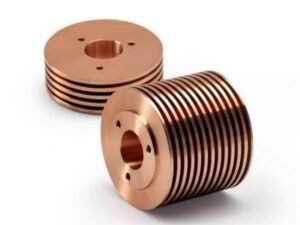
Copper and Its Alloys Used in CNC Machining
Different copper materials provide different performance advantages depending on the application requirements.
- Pure Copper (C101, C110): Pure copper offers excellent electrical and thermal conductivity. It is commonly used for electrical components, heat transfer parts, and high-performance conductive applications.
- Brass (Copper-Zinc Alloy): Brass provides better machinability and higher strength than pure copper. It is widely used for fittings, connectors, valves, and precision mechanical parts.
- Bronze (Copper-Tin Alloy): Bronze has excellent wear resistance and mechanical strength. It is often selected for bearings, bushings, and components exposed to friction.
- Tellurium Copper: Tellurium copper maintains good conductivity while offering significantly improved machinability. It is suitable for electrical contacts and precision CNC parts.
CNC Machining Techniques for Copper
Copper can be processed using various CNC machining methods depending on part geometry, production requirements, and tolerance specifications.
- CNC Milling: CNC milling is commonly used for copper parts with complex shapes, slots, pockets, and detailed features. It provides high precision for customized components.
- CNC Turning: CNC turning is suitable for cylindrical copper components such as shafts, bushings, fittings, and rotating parts.
- CNC Drilling: CNC drilling creates accurate holes and threaded features required for assembly and connection applications.
Advantages of Copper CNC Machining
Copper CNC machining offers unique advantages for applications that require more than basic mechanical performance. Its combination of conductivity, thermal efficiency, and precision makes it a preferred solution for many industries.
Superior Electrical Performance
Copper’s conductivity makes it the standard choice for busbars, terminals, connectors, and battery contacts in power distribution and EV systems. Machined copper parts carry current with minimal resistance loss, which matters directly to product performance and safety in high-load applications.
Efficient Heat Dissipation
Machined copper heat sinks, cold plates, and heat exchanger components are common in electronics, LED lighting, and industrial equipment. Copper’s ability to move heat away from sensitive components quickly helps extend the service life of the surrounding assembly.
Long-Term Corrosion Resistance
Marine hardware, plumbing fittings, and outdoor electrical enclosures benefit from copper’s natural oxide layer, which protects the part without additional plating in many environments. This reduces the need for secondary finishing steps on parts exposed to weather or moisture.
Precision on Small, Detailed Features
Because copper machines cleanly at low cutting forces, it holds tight tolerances on fine features such as connector pins, EDM electrodes, and RF waveguide components. This makes it a practical choice for parts where dimensional accuracy directly affects electrical fit and function.
Antimicrobial and Hygienic Applications
Copper has natural antimicrobial properties, which is why machined copper parts also appear in medical devices, food processing equipment, and touch surfaces where hygiene is a design requirement.
Copper vs Other Metals in CNC Machining
Copper is not always the best choice for every CNC machining project. Material selection depends on electrical requirements, mechanical strength, weight, corrosion resistance, and cost.
| Feature | Copper | Brass | Aluminum | Stainless Steel |
|---|---|---|---|---|
| Electrical Conductivity | Excellent | Good | Moderate | Low |
| Thermal Conductivity | Excellent | Good | High | Low |
| Strength | Moderate | Moderate | Moderate | High |
| Machinability | Moderate | Excellent | Excellent | Moderate |
| Corrosion Resistance | Good | Good | Good | Excellent |
| Common Applications | Electrical and thermal parts | Precision fittings and connectors | Lightweight components | Structural and industrial parts |
Choosing the right metal material is essential for achieving the required performance and cost efficiency. For more information about other CNC machining materials, you can explore our guides on brass CNC machining, aluminum CNC machining, and steel CNC machining.
Design Considerations for Copper CNC Machining
Getting a copper part right starts at the design stage, not on the machine. A few practices help control cost and improve manufacturability:
- Use copper only where its properties are required. Combining a small copper insert or contact with a lower-cost base material often reduces part cost without sacrificing performance.
- Choose the right grade for the application. High-purity C101 suits electrical performance, while C110 or tellurium copper suits parts where machinability and cost matter more.
- Keep wall thickness above roughly 0.5 mm to avoid distortion during machining and handling.
- Loosen tolerances where function allows. Copper can hold tight tolerances, but specifying them only where needed keeps lead times and costs down.
- Avoid deep pockets with small internal radii, which increase tool wear and machining time on soft metals.
Conclusion
Copper CNC machining is an effective manufacturing solution for producing precision components that require excellent conductivity, thermal performance, and long-term reliability. From electrical connectors and cooling components to industrial parts, copper materials provide unique advantages for specialized applications. Selecting the right copper alloy, machining process, and design approach is essential for achieving high-quality results while controlling production costs.
Jiangzhi provides professional CNC machining services for custom metal parts with flexible manufacturing capabilities and strict quality control. Whether you need copper CNC machined components for prototypes or production projects, our team can help develop reliable solutions based on your requirements. Contact Jiangzhi today to discuss your project.