
The gap between a finished design and a physical part is often where a project loses the most time. Rapid CNC machining exists to close that gap: it delivers precision-machined parts in as little as one to five business days.
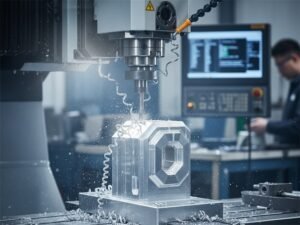
What Is Rapid CNC Machining?
Rapid CNC machining is a CNC manufacturing approach focused on reducing the time between receiving a design and delivering finished parts. The equipment and machining methods can be similar to those used for standard CNC production, including CNC milling, turning, drilling, tapping, and multi-axis machining.
What sets rapid CNC machining apart is the workflow built around it — automated quoting that returns a price within hours instead of days, and a streamlined review process that skips steps a traditional shop would normally handle by hand, such as manual programming adjustments and scheduled production queues. That compressed workflow is what turns a multi-week job into a one-to-five-day one, without changing how the part is actually cut.
Subtractive Manufacturing vs. 3D Printing
Rapid CNC machining is a subtractive process — it starts with a solid block and removes material to reach the final shape. 3D printing works the opposite way, building a part layer by layer from the ground up. That difference has practical consequences. A machined part has no layer lines and behaves consistently in every direction, which makes it a better match for functional testing under real load or wear conditions. 3D printing tends to work better for complex internal geometries where strength is not the main concern. Neither method replaces the other; they solve different problems at different stages of development. More details can be found in our guide comparing CNC machining and 3D printing.
Rapid CNC Machining Process
A rapid CNC machining project still requires several technical stages. The goal is to make each stage efficient and prevent problems from appearing later in production.
CAD Design & DFM Check
The process starts with a 3D CAD model, 2D drawing, or both. Before programming begins, the design should be reviewed for manufacturability. The DFM check normally considers part geometry, wall thickness, internal corners, hole sizes and depths, machining access, required tolerances, datum references, material, surface finish, and required secondary operations.
A good DFM review can identify features that would require additional setups, special tools, or slower machining strategies. It is usually more efficient to address these issues before production rather than after the first part has been machined.
Material Selection
Material affects cutting speed, tool wear, and surface quality, so it has a direct effect on both cost and turnaround. Aluminum, for example, typically machines two to three times faster than stainless steel because of its lower hardness. Choosing a material that’s easy to cut, when the application allows it, shortens the schedule without changing the outcome.
CNC Programming
CAM software converts the CAD model into toolpaths and machine instructions. Five-axis programming allows complex geometry to be machined in a single setup rather than requiring the part to be repositioned multiple times. Fewer setups generally means a faster job and fewer opportunities for alignment error.
Machining
The programmed instructions are transferred to the CNC machine. Depending on the part geometry, the process may include milling, turning, drilling, boring, tapping, reaming, or other operations. For suitable components, 3-axis, 4-axis, or 5-axis machining can be selected according to geometry and production requirements. Multi-axis machining may reduce the number of repositioning operations and improve access to difficult features. The machining strategy should be based on the actual part requirements. Thin walls, deep cavities, small internal features, and difficult-to-reach surfaces may require slower cutting conditions.
Surface Treatment & Finishing
Depending on the application, parts may require deburring, polishing, bead blasting, brushing, anodizing, plating, powder coating, painting, or another surface treatment. These steps generally add two to three days to a project, so it’s worth specifying only the finishes that serve a real appearance or functional requirement rather than defaulting to a treatment that isn’t needed.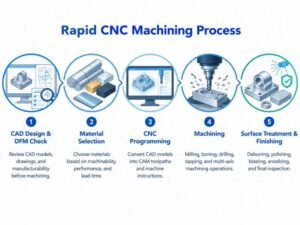
Best Materials for Rapid CNC Machining
There is no single material that is best for every rapid CNC machining project. The correct choice of CNC machining materials depends on mechanical performance, environmental conditions, appearance, machinability, availability, and cost.
| Material | Machinability | Typical Advantages | Common Applications |
|---|---|---|---|
| Aluminum | Excellent | Lightweight, corrosion-resistant, easy to machine | Housings, brackets, prototypes |
| Stainless Steel | Moderate | Corrosion resistance and strength | Industrial and mechanical parts |
| Mild Steel | Good | Strength and relatively low material cost | Fixtures, brackets, machine components |
| Brass | Excellent | Good machinability and appearance, fast cutting | Fittings, electrical components |
| Copper | Moderate | High electrical and thermal conductivity | Electrical and thermal components |
| POM | Excellent | Low friction, dimensional stability | Gears, bushings, mechanical parts |
| Nylon | Good | Lightweight and wear-resistant | Bushings, guides, functional prototypes |
| ABS | Good | Easy to machine and relatively low cost | Housings and prototypes |
| PC | Moderate | Impact resistance and transparency options | Covers, housings, functional prototypes |
| PMMA | Good | Optical clarity and appearance | Transparent covers and displays |
How to Choose the Right Process for Your Project?
The right manufacturing method depends less on the part itself and more on where the project sits in its production timeline.
Prototype Stage
For prototyping, typically one to ten units, rapid CNC machining is almost always the better choice. There’s no tooling to build, turnaround runs one to five days, and the low cost per iteration makes it easy to absorb design changes as they come up.
Low-Volume Production
For low-volume production, roughly tens to a few hundred units, CNC machining generally still makes sense, especially while the design is still likely to change. Injection molding tooling is a fixed cost that’s hard to justify at this volume, while CNC’s per-part pricing scales more naturally with smaller runs.
High-Volume Production
For high-volume production, usually several thousand units and up, injection molding becomes the more economical route. The mold itself is a significant upfront investment, but the per-part cost drops sharply as volume increases, which CNC machining cannot match at that scale.
Rapid CNC Machining vs. Traditional CNC Machining vs. Injection Molding
Choosing between rapid CNC machining, traditional CNC machining, and injection molding depends on many factors. The chart below highlights the key differences:
| Factor | Rapid CNC Machining | Traditional CNC Machining | Injection Molding |
|---|---|---|---|
| Quote turnaround | Hours to 24 hours | 3–7 days | Longer, includes mold design review |
| Lead time | 1–5 business days | 10–22 days | Weeks to months, including tooling |
| Minimum order | 1 piece | Often 5–25 pieces | Higher, to offset mold cost |
| Best volume range | 1–500 parts | 500+ parts | Typically several thousand or more |
| Per-part cost trend | Lower at low volume, savings taper off at scale | Improves as setup cost is spread over more parts | Highest upfront cost, but lowest at true volume |
| Design flexibility | High | High | Limited by mold design |
| Initial investment | Low to moderate | Low to moderate | Higher |
How Much Does Rapid CNC Machining Cost?
There is no fixed price for rapid CNC machining because each part has different manufacturing requirements.
The main factors in CNC machining cost include:
- Material
- Part dimensions
- Part geometry
- Machining time
- Number of setups
- Required tolerances
- Production quantity
- Surface treatment
- Secondary operations
- Material availability
A simple aluminum bracket with loose general tolerances may be relatively straightforward to manufacture. A small steel component with deep cavities, tight tolerances, multiple setups, and several finishing operations can cost considerably more even if the physical size is similar.
Machining time is one of the most important factors. Complex geometries require more toolpaths and may require smaller tools or slower cutting conditions.
Quantity also changes the economics. Increasing the order quantity can spread programming and setup costs across more parts, although CNC machining does not achieve the same high-volume cycle economics as injection molding for many plastic products.
Applications of Rapid CNC Machining
Rapid CNC machining is used across product development and industrial manufacturing.
Product Development
Engineering teams use CNC prototypes for functional testing, assembly verification, dimensional validation, and design evaluation.
Industrial Equipment
Typical applications include:
- Machine brackets
- Shafts
- Fixtures
- Housings
- Mounting components
- Mechanical components
- Replacement parts
Electronics
CNC machining can produce aluminum or plastic housings, heat sinks, brackets, panels, and other components used in electronic equipment.
Automotive
During vehicle and component development, CNC machining can be used for prototype brackets, housings, testing components, and other mechanical parts before production tooling is finalized.
Medical and Instrumentation Equipment
Precision machined components are also used in equipment housings, mechanical assemblies, fixtures, and laboratory instruments where dimensional consistency is important.
Common Design Mistakes That Slow Down Rapid CNC Machining
A part can be technically machinable but still take much longer than expected. Several design decisions commonly create unnecessary production delays.
Missing or Unclear Tolerance Requirements
Missing tolerance callouts. Submitting only a 3D file without a 2D drawing that specifies critical dimensions and GD&T forces back-and-forth clarification before machining can even start.
Choosing Hard-to-Source Materials
Choosing hard-to-source materials. Specialty alloys with limited availability delay a project before the machine ever runs. A common, comparable material usually performs the same job with faster sourcing.
Geometry Design Beyond Practical Machining Capability
Designing beyond standard machining capability. Deep pockets, compound angles, and helical features often require 5-axis machining or multiple setups. Designing with these limitations in mind from the start avoids delays discovered later in the quoting process.
Mixing Multiple Surface Treatments
Mixing multiple surface finishes on one part. Each additional finish requires its own masking and handling step. Consolidating to a single finish, where the application allows it, keeps the process moving faster.
Conclusion
Choosing the right process comes down to where a part sits in its development, not which method sounds fastest on paper. Confirm the production stage first — prototype, low-volume, or high-volume — then match the material and tolerances to what the part actually needs. If you have a design ready to machine or a project approaching the point where injection molding starts to make sense, send us your drawings and expected volume, and Jiangzhi will help you figure out the right process and a working cost estimate.


