
Threads are one of the smallest features on a machined part, yet they often determine whether that part fits, seals, or holds up under stress. Thread grinding is one of the most reliable ways to produce threads that meet tight precision requirements. This article explains what thread grinding is, how it works, how it compares to other methods, and where it is typically used.
What Is Thread Grinding
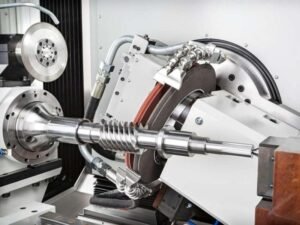
Thread grinding is a precision machining process that forms or finishes a screw thread by removing material with an abrasive grinding wheel. The wheel is shaped to match the thread profile, and it rotates against the workpiece while following the lead of the thread, gradually cutting the form to the required dimensions.
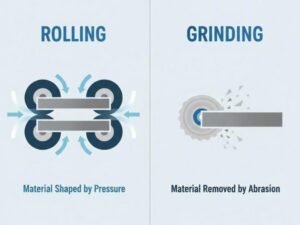
Thread grinding is different from most other thread-making methods. Thread cutting and thread milling also remove material, but typically with a single-point or multi-point cutting tool rather than an abrasive wheel. Thread rolling, on the other hand, does not remove material at all; it forms the thread by pressing and displacing metal into shape. Because grinding removes material in very fine increments, it can achieve tighter tolerances and finer surface finishes than most alternative methods.
How Thread Grinding Works
A typical thread grinding process follows a consistent set of steps:
1. Pre-processing: the workpiece is usually turned or otherwise machined close to final dimensions first.
2. Setup and Workholding: the part is mounted between centers or in a chuck on a thread grinding machine.
3. Wheel Selection and Dressing: a grinding wheel matching the required thread profile (such as 60° V-thread or Acme) is selected and dressed to the exact form before grinding begins.
4. Grinding Pass: the wheel is fed along the lead of the thread, removing material in controlled passes until the thread reaches its target dimensions.
5. Cooling: coolant is applied continuously during grinding to control heat, prevent thermal distortion, and wash away abrasive residue.
Thread grinding is performed on dedicated thread grinding machines, ranging from manual units to CNC thread grinders. CNC machines automatically control the wheel’s feed and lead, making them well suited to tight tolerances, while manual machines still handle simpler, lower-volume work. Universal grinding machines with thread-grinding attachments are also used for smaller or mixed-batch production.
Thread Grinding vs. Thread Rolling
Thread rolling is one of the most common alternatives to thread grinding, and the two methods serve different purposes. The following are some key differences between them:
| Factor | Thread Grinding | Thread Rolling |
|---|---|---|
| Material removal | Removes material | Forms material through pressure, no removal |
| Best suited for | Hardened or high-hardness materials | Softer to medium-hardness materials |
| Achievable precision | Very high, fine tolerances | Good, but generally less precise |
| Thread strength | High, but can introduce grinding stresses | Typically higher fatigue strength due to grain flow |
| Production speed | Slower, suited to precision or low-to-mid volume work | Fast, suited to high-volume production |
| Typical use case | Precision components, hardened parts, tight tolerances | Standard fasteners produced in large quantities |
In short, rolling tends to be the more economical choice for high-volume standard fasteners in softer materials, while grinding is generally preferred when hardness, tolerance, or surface finish requirements exceed what rolling or cutting can reliably deliver.
Materials Suitable for Thread Grinding
Several material types appear regularly in thread grinding work, mainly because of their hardness:
- Hardened Alloy Steels: common after heat treatment, when cutting tools would wear quickly or struggle to hold tolerance.
- Stainless Steel: valued for corrosion resistance, but often abrasive and prone to work hardening during cutting.
- Tool Steels: used in mold and die components where wear resistance is critical.
- Carbide and Other Very Hard Materials: cutting tools are largely ineffective here, so grinding becomes one of the few practical options.
Because grinding does not rely on a cutting edge shearing through material, it remains effective even when a workpiece has already been hardened, which is a significant advantage over methods that must be performed before heat treatment. To get more information about the materials used in the machining process, please check our guide on CNC machining materials.
Common Applications of Thread Grinding
Thread grinding is widely used wherever thread accuracy directly affects a component’s performance, including:
- Precision lead screws and ball screws used in positioning systems and CNC equipment
- High-precision fasteners for aerospace, medical, or instrumentation applications
- Mold and die components requiring hardened, wear-resistant threaded features
- Hydraulic and pneumatic fittings where thread accuracy affects sealing performance
- Gauges and measuring tools that rely on extremely tight thread tolerances for calibration
Benefits of Precision Thread Grinding
A thread’s accuracy affects far more than whether two parts screw together. Precision threads influence:
- Fit and Interchangeability: parts from different batches need to assemble consistently without excessive play or interference.
- Sealing Performance: in hydraulic, pneumatic, or fluid-handling applications, thread accuracy directly affects leak resistance.
- Fatigue Strength: threads are common failure points under repeated load; consistent thread geometry reduces stress concentration.
- Torque and Clamping Consistency: accurate thread form ensures predictable clamping force in fastening applications.
Conclusion
Thread grinding exists because some applications simply cannot tolerate the dimensional variation that comes with faster, less precise methods. From lead screws to hardened fasteners, it plays a quiet but essential role in parts that need to fit, seal, and perform consistently over time.
In practice, thread grinding is usually one stage within a broader precision machining sequence: turning or milling to shape the part, heat treatment for hardness, grinding for final thread accuracy, and inspection to confirm the result. Jiangzhi provides professional CNC machining services covering this full sequence, coordinating turning, milling, grinding, and quality inspection within a single production flow. Feel free to contact us and start your project.


