Optical clarity is no longer exclusive to glass. More and more lenses, light guides, covers, and display components are now molded from optical plastics. Understanding the different types of optical plastics, their properties, and how they’re processed is key to specifying the right material and avoiding costly mistakes.
This guide covers the fundamentals of optical plastics: what they are, their pros and cons, the most common types, typical processing methods, how they compare to optical glass, and where they’re used.
What Are Optical Plastics?
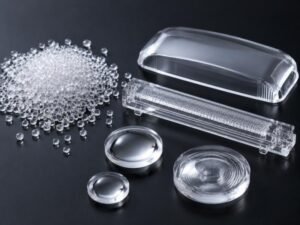
Optical plastics refer to a category of transparent (or semi-transparent) polymer resins engineered specifically for applications where light transmission, clarity, and precise optical performance matter. Unlike standard commodity plastics, optical-grade resins are formulated and processed to minimize internal stress, haze, and distortion, while maximizing light transmittance, often above 90%.
Key properties used to evaluate an optical plastic include its light transmittance (the percentage of light that passes through), haze (how much light scatters and blurs the image), and refractive index (how strongly the material bends light).
Advantages and Disadvantages of Optical Plastics
Like any engineering material, optical plastics come with trade-offs. Knowing them upfront helps set realistic expectations before committing to a material and a manufacturing process.
Advantages of Optical Plastics
- Lightweight: Optical plastics typically weigh less than half of comparable glass components, which matters for automotive, wearable, and aerospace applications.
- Impact Resistance: Most optical resins are far more shatter-resistant than glass, reducing breakage during shipping, handling, and end use.
- Design Flexibility: Injection molding and machining allow for complex, integrated geometries (built-in mounts, textures, multi-curvature lenses) that would be difficult or expensive to achieve in glass.
- Cost Efficiency at Volume: Once tooling is made, injection-molded optical parts have a much lower per-unit cost than precision-ground glass optics, especially for large orders.
- Design Freedom for Color and Coatings: Plastics can be tinted, coated, or surface-treated more easily during processing.
Disadvantages of Optical Plastics
- Lower Scratch Resistance: Most optical plastics are softer than glass and require hard coatings for demanding environments.
- Lower Thermal Stability: Plastics generally have lower heat deflection temperatures and can deform or yellow under prolonged heat or UV exposure.
- Birefringence Risk: Improper molding can introduce internal stress that distorts light transmission, which requires tight process control.
- Lower Refractive Index Precision Over Time: Some resins are more prone to long-term optical drift from environmental exposure than glass.
Common Types of Optical Plastics
There are many types of optical plastics, but not all optical plastics perform the same. Here’s an overview of the materials commonly used for custom optical components.
Polymethyl Methacrylate (PMMA / Acrylic)
PMMA is the most widely used optical plastic, prized for its exceptional clarity (often over 92% light transmission), UV resistance, and low cost. It’s a good general-purpose choice for lenses, light guides, and covers, though its brittleness and moderate heat resistance limit its use in high-impact or high-temperature settings.
Polycarbonate (PC)
PC offers outstanding impact resistance, good optical clarity, and a wide operating temperature range. It’s the go-to material for safety-critical optics like automotive lighting, protective eyewear, and machine guards, though its surface is prone to scratching and typically needs a hard coating for demanding use.
Cyclo Olefin Polymer (COP)
COP is a premium optical resin known for very low birefringence, excellent moisture resistance, and high purity, making it popular in medical devices, diagnostic equipment, and precision optics. Its raw material and processing costs are relatively high, so it’s typically reserved for applications such as diagnostic instruments and precision lenses, where its purity and dimensional stability are worth the added expense.
Polystyrene (PS)
PS is a low-cost, rigid optical plastic with good clarity, commonly used for disposable optical components, lenses in low-cost devices, and packaging with optical requirements. Its brittleness and limited weather resistance make it best suited for indoor or short-life applications.
Styrene Acrylonitrile (SAN)
SAN improves on standard polystyrene with better chemical resistance and rigidity while maintaining good transparency. It’s often used where a balance of clarity, stiffness, and cost is needed, such as housings with optical windows.
Polyethylene Terephthalate (PET)
PET offers good clarity, strong barrier properties, and excellent processability, especially in sheet and film form. It’s widely used for optical films, packaging, and thin transparent components where flexibility and dimensional stability matter.
Selecting the right optical plastic requires considering various factors. For more details, you can explore our guidance on the key factors of plastic material selection.
Processing Methods for Optical Plastic Components
The right process depends on part geometry, tolerance requirements, and order volume.
- Plastic Injection Molding: The standard method for high-volume production. Molten resin is injected into a precision tool to produce consistent, repeatable parts at scale, ideal for lenses, light guides, and covers.
- Precision Machining: Best for prototypes, low volumes, or tight tolerances that molding tooling can’t easily achieve. CNC machining of optical-grade blocks or sheets allows design iteration without the cost of a mold.
- Thermoforming: Heated sheets are formed over a mold into curved or large-format parts like covers, domes, or panels. It’s a cost-effective option where injection molding tooling would be too expensive.
- 3D Printing: Used for rapid prototyping and design validation before tooling investment. Print quality is improving, but most 3D-printed optical parts still need post-processing to reach production-grade clarity.
Optical Plastic vs. Optical Glass
Glass has traditionally been the material of choice for optical components due to its excellent optical performance and long-term stability. However, optical plastics are increasingly used in optical applications as an alternative material with their own unique characteristics. The table below compares the key differences between optical plastics and optical glass to help illustrate their respective advantages and limitations.
| Factor | Optical Plastic | Optical Glass |
|---|---|---|
| Weight | Significantly lighter | Heavier |
| Impact resistance | High | Low, prone to shattering |
| Optical clarity | Very good, resin-dependent | Excellent, industry benchmark |
| Scratch resistance | Lower (unless coated) | Higher |
| Heat resistance | Moderate, resin-dependent | High |
| Design flexibility | High (complex geometries, integrated features) | Limited by grinding/molding constraints |
| Cost at volume | Lower, especially with injection molding | Higher, especially for complex shapes |
| Long-term optical stability | Can drift with UV/heat exposure | Very stable |
In short, glass remains the choice for the most demanding precision optics and extreme environments, while optical plastics are typically preferred where weight, cost, impact resistance, and design complexity are priorities.
Conclusion
While optical plastics are primarily developed for optical applications, many of these high-performance resins are also widely used in other plastic products. Beyond optical components, materials such as PC and PMMA can also be found in applications including protective covers, electronic housings, and consumer products.
With expertise in plastic injection molding and material selection, Jiangzhi can manufacture high-quality custom plastic parts for various applications. Contact our team to discuss your project requirements and find the right manufacturing solution.