
Plastic has become an important material group in modern vehicle manufacturing. In the past, many automotive components were made primarily from steel, aluminum, and other metals. Today, some of these applications have shifted to plastics because manufacturers need to reduce vehicle weight, simplify part production, improve corrosion resistance, and integrate more functions into individual components.
The use of automotive plastics also extends far beyond interior trim. Plastics are found in bumpers, dashboards, lighting components, engine-bay parts, connectors, fluid tanks, gears, seals, sensor housings, and battery-related components.

Why Is Plastic Used in the Automotive Industry?
The growing use of plastic in automotive manufacturing is driven by several practical requirements. Weight, production efficiency, chemical resistance, electrical insulation, and design flexibility all influence material selection.
Lightweighting
Weight reduction remains one of the strongest reasons for adopting automotive plastic materials. A lighter vehicle requires less energy to accelerate and maintain speed. In conventional vehicles, this improves fuel economy. In electric vehicles, it extends driving range. Studies indicate that a 10 percent reduction in vehicle mass can increase EV range by 5 to 8 percent. Plastics achieve this reduction while still meeting mechanical demands that previously required metal.
Cost and Manufacturing Efficiency
Many automotive plastics can be processed efficiently through auto injection molding. A properly designed mold can produce complex geometries, mounting features, ribs, bosses, clips, and other details in one production process. This can reduce the need for separate machining and assembly operations. For high-volume automotive components, these manufacturing advantages can have a direct effect on production cost.
Corrosion and Chemical Resistance
Unlike conventional steel components, plastics do not develop rust in the same way when exposed to moisture. Many grades also provide good resistance to automotive fluids and chemicals. This makes selected plastics suitable for fluid tanks, underbody components, protective covers, housings, and other parts exposed to moisture or chemical environments. However, chemical compatibility still needs to be checked against the actual fuel, oil, coolant, cleaning agent, or other medium involved.
Design Flexibility
Plastics can be molded into intricate geometries that would be difficult or expensive to form in metal. Ribs can increase stiffness, snap-fits can simplify assembly, and integrated channels or mounting features can reduce the number of separate parts. For this reason, plastics in automobile applications are not simply replacing metal components. They can also allow manufacturers to redesign parts around a different production method.
Electrical Insulation
Modern vehicles contain an increasing number of electrical and electronic components. Plastic materials provide electrical insulation while also protecting sensitive components from moisture, dust, vibration, and mechanical damage.
Noise and Vibration Control
Certain plastics and elastomers can also be used for vibration isolation, sealing, and acoustic applications. TPE, PU, PVC, and rubber materials are used in components where flexibility, damping, or sealing performance is more important than structural stiffness.
What Properties Should Automotive Plastics Have?
There is no single plastic material that is suitable for every vehicle component. Material selection should begin with the operating conditions of the part.
Mechanical Strength and Impact Resistance
Automotive components may experience impact, vibration, repeated loading, and assembly forces. Parts exposed to direct impact may require higher toughness, while structural or semi-structural components may require greater stiffness and strength.
Heat Resistance
Temperature varies significantly throughout a vehicle. Interior components may operate at moderate temperatures, while components located near the engine, motor, battery, exhaust, or thermal management system may experience much higher temperatures.
Chemical Resistance
Automotive plastics may come into contact with fuel, oil, coolant, brake fluid, cleaning chemicals, and other substances. Chemical resistance therefore needs to be evaluated together with temperature and exposure time.
Dimensional Stability
Dimensional stability is especially important for connectors, sensor housings, gears, clips, and other precision components. Moisture absorption, thermal expansion, molding shrinkage, and warpage can all affect final dimensions.
Wear and Friction Resistance
Moving components such as gears, bushings, sliding guides, and seat mechanisms require suitable friction and wear performance. POM is widely considered for these applications because of its low friction and good wear resistance. PTFE can also be used where very low friction is required, although its mechanical and processing characteristics must be evaluated for the specific design.
Electrical Performance
Electrical and high-voltage automotive components may require good insulation, dimensional stability, heat resistance, and resistance to electrical tracking. PBT, PA, PC, PPS, and LCP are among the materials used for connectors, sensor housings, relay components, and other electrical applications.
Common Plastic Materials Used in Automotive Parts
Several polymers dominate current usage. Each offers a distinct combination of properties that matches specific vehicle needs.
PP — Polypropylene
PP is one of the most widely used automotive plastics because it combines low density, good chemical resistance, good processability, and relatively low cost.
Typical applications include bumpers, door panels, dashboards, underbody shields, and fluid tanks. Glass-fiber-reinforced PP can be considered when higher stiffness and dimensional stability are required.
ABS — Acrylonitrile Butadiene Styrene
Acrylonitrile butadiene styrene (ABS) provides good impact strength, dimensional stability, and surface quality. It is frequently chosen for instrument panels, center consoles, trim, and wheel covers. ABS can be painted or plated easily. Heat resistance is moderate, so it is less common in high-temperature zones.
PC — Polycarbonate
PC is known for high impact resistance and can also provide transparency. This makes it useful for lamp covers, sensor windows, display covers, and other components where impact performance or optical properties are required. It can be alloyed with ABS to improve processability and reduce cost. UV stabilizers are normally added for exterior use.
PA — Polyamide
Polyamide (PA), commonly known as nylon, delivers high strength and heat resistance. Engine covers, intake components, door handles, gears, and sensor housings often use PA6 or PA66. Glass-fiber reinforcement further raises stiffness and heat deflection temperature. Nylon absorbs moisture, which can affect dimensions, so conditioning or barrier grades may be specified.
PVC — Polyvinyl Chloride
Polyvinyl chloride (PVC) is valued for its flexibility when plasticized and for its resistance to chemicals and flame. It appears in wiring insulation, underbody protection, and some interior surfaces. Rigid grades are less common in modern vehicles because of weight and environmental considerations.
PU — Polyurethane
Polyurethane (PU or PUR) is used in both rigid and flexible forms. Flexible foam provides seating and headrests. Rigid or semi-rigid grades serve in bumpers, sound-insulation systems, and structural foam components. Energy absorption and comfort are the primary benefits.
POM — Acetal
Polyoxymethylene (POM), or acetal, offers low friction, high stiffness, and good dimensional stability. Gears, bushings, clips, seat mechanisms, and fuel-system parts frequently use POM. It resists fuels and many chemicals but can be sensitive to strong acids.
PBT — Polybutylene Terephthalate
Polybutylene terephthalate (PBT) provides electrical insulation, heat resistance, and dimensional stability. Connectors, sensor housings, and under-hood electrical components commonly employ PBT. Hydrolysis resistance is improved with stabilizers when the part faces hot, humid conditions.
PE — Polyethylene
PE provides low density, good moisture resistance, toughness, and chemical resistance. It is used in selected fluid tanks, protective components, containers, and underbody applications. PE is not a universal replacement for engineering plastics. Temperature, stiffness, dimensional requirements, and the specific chemical environment should be checked before selection.
PC/ABS
PC/ABS combines characteristics from polycarbonate and ABS. It can provide good impact resistance, surface quality, and heat performance while remaining suitable for injection molding. Typical applications include instrument panels, center consoles, interior trim, and electronic housings.
PPS and PEEK
PPS and PEEK are high-performance engineering plastics used when conventional thermoplastics cannot meet the required temperature, chemical, mechanical, or dimensional performance. They may be considered for pumps, valves, sensor components, engine-bay parts, and thermal management systems. Their higher material cost means that they should generally be selected for applications where their performance provides a clear technical benefit.
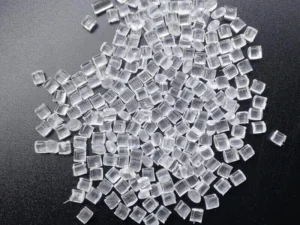
Automotive Plastic Material Selection Guide
Plastic material selection should start with the requirements of the component rather than simply choosing a familiar plastic grade.
| Automotive Requirement | Recommended Materials | Typical Automotive Applications |
|---|---|---|
| Lightweight and cost efficiency | PP, PE | Bumpers, door panels, dashboards, underbody shields, fluid tanks |
| Good interior appearance | ABS, PC/ABS, PVC | Instrument panels, center consoles, trim, buttons, door panels |
| High impact resistance | PC, ABS, PP | Lamp covers, mirror housings, bumpers, protective covers |
| High strength and heat resistance | PA, PBT | Under-the-hood brackets, intake parts, sensor housings, connectors |
| Low friction and wear resistance | POM, PTFE | Gears, bushings, clips, sliding parts, seat mechanisms |
| Electrical insulation and connector performance | PBT, PA, PC, PPS, LCP | High-voltage connectors, relay housings, sensor covers, cable supports |
| High-temperature and chemical resistance | PA, PPS, PEEK | Pumps, valves, engine-bay parts, thermal management components |
| Flexible sealing and soft-touch performance | TPE, PU, PVC | Gaskets, seals, hoses, armrests, vibration dampers, acoustic parts |
| Transparent automotive components | PC, PMMA | Lamp lenses, sensor windows, display covers, transparent trim |
| Lightweight structural components | Glass-fiber PP, glass-fiber PA, long-fiber thermoplastics | Front-end carriers, instrument-panel carriers, door modules, battery-related structures |
Advanced Plastics for Electric and Lightweight Vehicles
For electric and lightweight vehicles, the plastics are optimized through reinforcement, flame-retardant additives, heat-resistant formulations, improved electrical insulation, and better dimensional stability.
Such as glass-fiber-reinforced PA and PP, long-fiber thermoplastics, PPS, PEEK, and specialized flame-retardant grades.
These improvements allow plastics to meet more demanding conditions in battery systems, high-voltage connectors, thermal management components, electronic housings, and lightweight structural parts.
By combining lower density with improved mechanical and thermal performance, advanced plastics can replace selected metal components while meeting the functional requirements of newer vehicle platforms.
Conclusion
The use of automotive plastics continues to grow as vehicles require lower weight, higher production efficiency, and more electrical and electronic functions. Jiangzhi provides custom automotive plastic injection molding services. From material selection and mold design to injection molding and finished-part production, solutions can be developed according to the specific requirements of each component. Welcome to contact us and get a professional solution.


