
Plastic parts can experience hidden internal stress after injection molding, machining, or other manufacturing processes. Over time, these stresses may cause problems such as warping, cracking, or dimensional changes, especially in precision components. For precision plastic components, optical parts, thick-wall products, and applications requiring long-term dimensional accuracy, annealing can be an important secondary process. However, not every plastic part requires this treatment. The necessity of annealing depends on the material type, part structure, manufacturing method, and final application requirements.
What Is Plastic Annealing?
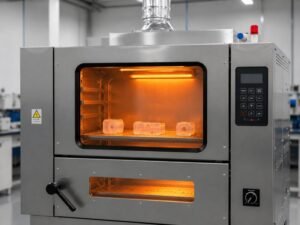
Plastic annealing is a controlled heating and cooling process designed to relieve residual stress inside plastic components. Plastic annealing follows three sequential stages.
The part is first heated gradually to the target temperature. This temperature is typically set between one-third and one-half of the material’s melting point, or just below the glass transition temperature for amorphous polymers. Heating most often takes place in a recirculating air oven; nitrogen atmospheres or liquid media are used when oxidation must be avoided.
The second stage is the hold, or soak. The part remains at the annealing temperature long enough for polymer chains to relax and reorganize. Hold time is governed primarily by the thickest cross-section.
The final stage is controlled cooling. Rapid cooling reintroduces thermal stress, so parts are normally left inside the oven as it cools or cooled at a rate not exceeding 0.5 °C per minute until they approach room temperature. Proper support during the entire cycle prevents sagging once the material softens.
Why Do Plastic Parts Need Annealing?
Residual stress is one of the main reasons plastic parts require annealing. During injection molding, molten plastic enters the mold cavity and cools under pressure. Different areas of the part may cool at different speeds, especially in products with uneven wall thickness or complex structures. This uneven cooling creates stress inside the polymer structure. Machining can also introduce stress. If these stresses remain inside the part, they may gradually release over time and cause dimensional movement. Without proper stress control, plastic parts may gradually change size after manufacturing. This can result in assembly problems or performance issues. Annealing provides a controlled method to release these stresses before the product is used.
Two distinct application points exist. Post-molding annealing and intermediate annealing.
Post-Molding Annealing
Post-molding annealing is performed after processes such as injection molding. The main purpose is to reduce residual stress created during molding. This is commonly considered for precision injection molded parts, thick-wall components, transparent plastic products, and parts exposed to temperature variation. For these applications, annealing can improve dimensional stability before final assembly or use.
Intermediate Annealing Before Machining
Some plastic materials are annealed before secondary machining operations. When plastic stock materials are machined directly, internal stress may be released during cutting, causing deformation after material removal. Pre-machining annealing helps stabilize the material before processing. This approach is often used for engineering plastics that require tight machining tolerances, including materials such as POM, nylon, and certain grades of PC.
Choosing whether to perform annealing before or after machining depends on the material condition, part geometry, and required accuracy.
Which Plastics Can Be Annealed?
Not all plastics respond to annealing in the same way. The effect of plastic annealing depends largely on the polymer structure and types of plastic materials, including whether the material is amorphous, semi-crystalline, or thermosetting.
In general, thermoplastics are the main materials suitable for annealing because their molecular structure can respond to controlled heating. However, the purpose and result of annealing can vary significantly between different plastic types.
| Plastic Category | Common Materials | Effect of Annealing |
|---|---|---|
| Amorphous plastics | PC, PMMA, ABS, PS | Mainly used to relieve residual stress and reduce cracking risk |
| Semi-crystalline plastics | PE, PP, PA, POM, PEEK | Helps relieve stress and may affect crystallinity and dimensional stability |
| Thermosetting plastics | Epoxy, some silicone materials | Generally not suitable for traditional annealing because the cross-linked structure cannot be reshaped by heating |
How the Annealing Process Is Carried Out?
Three parameters determine success: temperature, hold time, and cooling rate. Temperature must allow sufficient chain mobility without causing deformation or degradation. Typical ranges include 120–130 °C for polycarbonate and lower temperatures for many nylons, often under a controlled atmosphere to limit oxidation.
Hold time is calculated from the thickest section. Thin-walled parts may require one to two hours; thicker sections need longer exposure for full heat penetration.
Cooling must be slow and uniform. Oven loading density also affects results; overcrowding restricts air circulation and produces inconsistent outcomes across a batch. Parts must be adequately supported throughout the cycle.
Typical Annealing Considerations for Common Plastics
The annealing purpose varies depending on the plastic material. The following table shows common annealing considerations for several widely used plastics.
| Material | Main Reason for Annealing |
|---|---|
| PC | Reduce molding stress and improve crack resistance |
| PMMA | Minimize stress cracking and improve stability |
| PA (Nylon) | Improve dimensional control while considering moisture effects |
| POM | Reduce machining stress and improve precision |
| PEEK | Improve stability for high-performance applications |
When Is Annealing Truly Needed?
Annealing is appropriate under defined conditions rather than as a routine step.
- Parts with tight dimensional tolerances benefit because residual stress can cause progressive movement after machining or assembly.
- Hygroscopic materials such as nylon often show improved long-term stability after annealing, particularly when subsequent moisture absorption is expected.
- Thick-walled or highly asymmetric geometries are prone to warping from uneven residual stress distributions.
- Components scheduled for secondary machining that involves substantial material removal gain from intermediate annealing.
- Parts that will experience sustained mechanical loads, temperature cycling, or contact with stress-cracking agents also justify the process.
Annealing is frequently unnecessary for thin-walled parts of uniform section that face only mild service conditions. Components containing metal inserts risk distortion of the insert or the surrounding plastic if heated. High-volume consumer parts where cost outweighs the need for long-term dimensional precision may also omit the step. The decision rests on the specific combination of material, geometry, manufacturing sequence, and end-use requirements.
Annealing vs. Other Heat Treatment Processes
Plastic annealing differs from other post-processing treatments that aim to stabilize parts.
| Process | Mechanism | Typical duration | Relative effectiveness for residual stress |
|---|---|---|---|
| Plastic annealing | Controlled heating below Tg followed by slow cooling | Hours | High and predictable |
| Natural aging | Room-temperature relaxation over time | Days to weeks | Low to moderate |
| Humidity conditioning | Moisture absorption and plasticization | Hours to days | Limited to hygroscopic materials; secondary effect on stress |
Natural aging relies on extended storage at room temperature and produces only partial stress relief. Humidity conditioning, used mainly with nylon, plasticizes the material through controlled moisture absorption and addresses brittleness rather than thermal or molding stresses.
How to Specify Annealing Requirements When Inquiring?
Clear communication at the quotation stage reduces the need for iteration.
Specify the exact material grade and the part’s thickest section. Indicate whether the treatment is post-molding or intermediate.
Provide the critical dimensional tolerances and the expected service environment, including temperature range, chemical exposure, and mechanical loading.
Ask for the supplier’s standard temperature and time parameters for the material, whether dimensional measurements are recorded before and after annealing, and what fixturing methods are used to maintain geometry during the cycle.
Supplying this information allows the processor to confirm capability and to quote both process cost and expected lead time accurately.
If you are developing custom plastic parts and are unsure whether annealing is necessary, providing your drawings, material requirements, and application details allows Jiangzhi to recommend the most suitable production process. This helps achieve the required performance while avoiding unnecessary processing costs.


