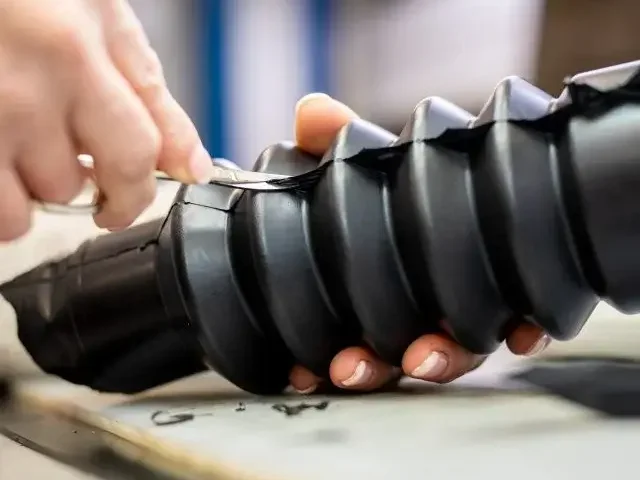
Mold texture is an important part of injection-molded plastic part design. It determines more than the visual appearance of a finished part. The selected texture can affect surface gloss, tactile feel, grip, glare, fingerprint visibility, draft requirements, and part ejection. For this reason, injection mold texture should be considered during product and mold design rather than added as an afterthought.
What Is Mold Texture?
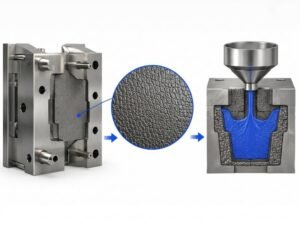
Mold texture refers to the three-dimensional surface features deliberately formed on the cavity of an injection mold. These features include patterns, grains, or controlled levels of roughness. During the injection molding process, molten plastic fills the cavity under pressure and cools against the textured surface. As a result, the mold texture is replicated on the exterior of the finished plastic part.
The transfer is physical rather than applied after molding. The accuracy of this replication depends on factors such as the plastic material, melt temperature, mold temperature, injection pressure, and the geometry of the part. When conditions are suitable, the injection mold texture appears uniform across the surface. When conditions are less favorable, incomplete filling or uneven gloss can occur. Mold texture is therefore both a design decision and a process consideration.
Surface texture itself is described by three basic characteristics: lay (the general direction of the pattern), waviness (longer-scale variations), and roughness (finer irregularities). In practice, mold texture specifications focus on the visible and tactile outcome rather than these technical terms alone.
Why Use Mold Texture?
Injection mold texture serves several practical purposes.
Improve Surface Appearance
One of the most common reasons for using mold texture is to control the appearance of a plastic part. A textured surface can provide a matte or low-gloss finish and create a more consistent visual appearance across a molded product. It is one of several options available for achieving different injection molding surface finishes. It can also reduce the visibility of minor surface variations compared with a highly polished surface.
Common applications include:
- Electronics housings
- Automotive interior components
- Appliance panels
- Industrial enclosures
- Consumer products
Improve Grip and Friction
Texture can also provide a functional surface. A patterned or rough surface can increase friction between the product and the user’s hand, which is useful for handles, knobs, tools, and handheld equipment. A controlled texture provides better hand contact without requiring secondary coatings.
Reduce Glare and Fingerprint Visibility
Glossy surfaces can reflect light strongly and may show fingerprints more easily. Fine matte or textured surfaces can reduce these visual effects.
This is particularly relevant for:
- Electronic devices
- Control panels
- Automotive interiors
- Equipment housings
- Consumer products
- Provide a Decorative or Tactile Finish
Common Types of Mold Texture
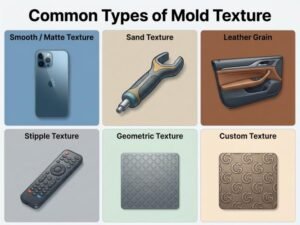
Several mold texture categories are widely used in injection molding. Each produces a distinct visual and tactile result.
Smooth / Matte Texture
Smooth and matte finishes range from high-gloss polished surfaces to low-gloss uniform matte surfaces. High-gloss versions are achieved through fine polishing and are often specified for optical or premium appearance parts. Matte versions reduce reflections and help conceal minor surface variations. These textures are relatively shallow and require lower draft angles for part ejection.
Sand Texture
Sand texture creates a fine, non-directional granular appearance similar to lightly blasted metal. It is commonly produced by media blasting the mold surface. The result is a consistent matte finish that hides small defects effectively and provides moderate grip. Sand texture is frequently chosen for industrial housings and consumer products where a neutral surface is preferred.
Leather Grain
Leather grain textures reproduce the appearance and feel of natural or synthetic leather. Patterns vary from fine pebble to deeper, more pronounced grains. These are typically created by chemical etching or specialized texturing processes. Leather grain is used on automotive interior components, electronic enclosures, and certain packaging items where a soft-touch visual effect is required.
Stipple Texture
Stipple texture consists of fine raised or recessed dots distributed across the surface. It offers a soft grip and reduces glare while remaining relatively easy to eject from the mold. Stipple patterns are common on control panels, remote controls, and handheld devices. Depth is usually kept moderate to balance function with moldability.
Geometric Texture
Geometric textures include regular patterns such as grids, diamonds, lines, or other repeating shapes. These can serve both decorative and functional roles, for example, improving drainage or providing directional grip. Geometric patterns are often produced by laser texturing or precision etching. Careful attention to draft angles is necessary because sharp edges or deep recesses can impede part release.
Custom Texture
Custom textures are developed for specific brand or product requirements. They may combine elements of the types above or introduce unique patterns. Custom work usually requires reference samples, detailed drawings, and close coordination with the mold maker. Lead time and cost are higher than standard textures, and production validation is essential.
How Is Mold Texture Created?
Different textures require different mold surface treatment methods. The appropriate method depends on the required pattern, texture depth, mold material, surface area, geometry, and production requirements.
Common approaches include:
Polishing and Sanding: Used for smooth, satin, and certain fine surface finishes.
Media Blasting: Used to create uniform matte or rough surfaces.
Chemical Etching: Commonly used for detailed decorative and functional patterns.
EDM: Can create characteristic textured surfaces and is also relevant to specific mold features.
Laser Texturing: Suitable for controlled, detailed, and customized surface patterns.
These processes should not be treated as interchangeable. Two textures may appear similar at a general level but require different tooling processes to achieve the required surface condition.
The required texture should be defined before the mold manufacturing process is finalized.
Mold Texture Standards and References
A clear reference is important when communicating an injection mold texture to a mold manufacturer. Three commonly encountered references are Mold-Tech®, VDI, and SPI.
- Mold-Tech Texture supplies physical plaques and coded patterns for a wide range of grains, leather effects, and other designs. These books allow designers to select a specific Mold-Tech texture by code and then request matching samples. Mold-Tech texture references are especially practical for complex or organic patterns because they provide both visual and tactile confirmation. When using a Mold-Tech® reference, the exact grade or pattern should be specified rather than simply stating “Mold-Tech texture.”
- VDI 3400 Numbers describe surface roughness on a numerical scale commonly associated with EDM processes. Higher numbers correspond to rougher surfaces. VDI is useful when a measurable roughness value is required.
- SPI Surface Finish standards classify surfaces into four main groups: A for high-gloss polished finishes, B for semi-gloss finishes produced with abrasive paper, C for matte finishes produced with stones, and D for textured finishes produced by blasting. SPI grades provide a practical starting point for communication between designers and mold makers.
The Difference between Mold-Tech, VDI 3400, and SPI
The main difference is that SPI focuses on general gloss and finish categories, VDI provides roughness numbers, and Mold-Tech texture systems offer specific pattern codes with physical samples. In practice, many projects combine a standard code with an approved physical reference to ensure consistency.
How to Choose the Right Mold Texture?
Choosing a mold texture starts with the product requirements, not the texturing process.
Appearance Requirements
First, determine how the surface should look. Should it be matte or glossy, fine or coarse, smooth or granular, decorative or understated, uniform or patterned? A specific texture reference is preferable when visual consistency is important.
Functional Requirements
Next, determine whether the texture needs to provide a function. Possible requirements include grip, friction, slip resistance, glare reduction, tactile feedback, and improved handling. A surface selected for grip may require a different texture depth and pattern from one selected only for appearance.
Product Structure
Part geometry directly affects texture feasibility. Factors such as draft angle, ejection direction, ribs, bosses, and curved surfaces should be considered during plastic part design.
A deeper texture generally requires more attention to draft and ejection. If the texture is specified after the mold design is complete, design changes may become necessary.
Material and Molding Conditions
The plastic material also affects texture reproduction, making plastic material selection an important consideration during product development. Consider resin type, shrinkage, flow behavior, fillers and additives, mold temperature, injection speed, and cooling conditions.
The same mold texture may not produce exactly the same visual result with different plastics. For demanding cosmetic applications, texture approval should be evaluated using the intended production material and molding conditions.
Texture Reference
The final specification should be as clear as possible. A useful reference may include Mold-Tech® code / VDI grade / SPI finish/texture sample/drawing / approved master sample.
Avoid relying only on descriptions such as “rough,” “fine,” or “leather-like.” Different suppliers may interpret these terms differently.
Quick Mold Texture Selection Guide
| Question | What to Consider |
|---|---|
| What should it look like? | Matte, fine grain, leather, decorative, geometric |
| Does it need a function? | Grip, friction, slip resistance, glare reduction |
| How strong should the texture be? | Fine vs. coarse; shallow vs. deep |
| Can the part release from the mold? | Draft angle, texture depth, geometry, ejection direction |
| Will the material reproduce the texture well? | Material, shrinkage, flow, additives, molding conditions |
| Is there a reference standard? | Mold-Tech®, VDI 3400, SPI, sample, drawing |
Conclusion
Before mold manufacturing begins, the texture specification should be reviewed together with draft angle, ejection, material selection, and molding conditions. Early coordination with the mold maker, clear documentation of the chosen injection mold texture, and validation through molded samples. Jiangzhi is a professional one-stop molding manufacturer. We supply custom mold design and manufacturing. Welcome to contact us and get a solution.