
Thread tapping is one of the most common ways to cut internal threads in machined parts. It is fast, low-cost, and reliable when done right. But it’s also easy to get wrong: a hole that’s slightly off, a crooked start, or the wrong speed for the material can break the tap or weaken the thread. This guide walks through the process, the parameters that matter, and the design choices that keep tapped holes from failing.
What Is Thread Tapping?
Thread tapping cuts internal threads into a pre-drilled hole using a tap — a hardened tool that removes material as it turns, forming threads that match a bolt or screw.
Thread Tapping Process: Step by Step
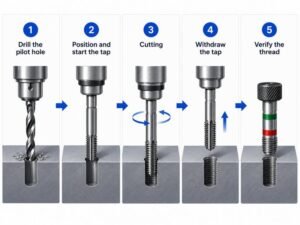
A tapping operation, whether done by hand or on a CNC machine, follows the same basic sequence:
1. Drill the pilot hole: The hole diameter is chosen based on the thread size, pitch, and desired thread engagement (see Design Considerations below). This step has the biggest influence on tap life.
2. Position and start the tap: The tap must enter straight. Any angle at the start carries through the whole thread and can’t be fixed once cutting begins.
3. Cut the thread with controlled chip evacuation: As the tap goes deeper, cutting resistance builds. Manually, this is managed by reversing the tap periodically to break the chip. On rigid-tapping CNC setups, spindle speed and feed are synced to the tap automatically.
4. Withdraw the tap and clear the hole: Back the tap out along the same path, then clear any remaining chips, especially in blind holes.
5. Verify the thread: Check the thread with a go/no-go gauge or by test-fitting the fastener — it should engage smoothly, without excessive play or binding.
Thread Tapping Cutting Parameters by Workpiece Material
Cutting speed and lubrication should match the material — using the same settings for everything is a common cause of tap wear and inconsistent threads.
Carbon Steel (Baseline)
Serves as the reference point for most tap manufacturer speed and feed charts. Moderate cutting speed with a general-purpose cutting oil is typically sufficient.
Stainless Steel
Requires reduced cutting speed and a sulfur-based extreme-pressure (EP) lubricant. Austenitic stainless grades work-harden quickly, so any dwell or hesitation during the cut increases torque and accelerates tap wear.
Aluminum Alloys
Tolerates higher cutting speeds but is prone to galling — aluminum tends to adhere to the tap flutes rather than shearing cleanly. A kerosene-based or aluminum-specific cutting fluid reduces this tendency significantly.
Cast Iron
Can often be tapped dry or with minimal lubrication, since the graphite content in cast iron provides a degree of self-lubrication during cutting. Chip form is typically short and granular rather than continuous.
These are general starting points. For a fuller breakdown of how different alloys behave under machining, see our guide to CNC machining materials.
Thread Tapping Design Considerations
Drill Size and Thread Engagement
Thread engagement is how much of the full thread depth actually gets cut. More engagement means a stronger thread, but also more torque and more risk of breaking the tap. Most applications aim for 65–75% engagement rather than 100%, since going higher adds strength that barely matters while the breakage risk keeps climbing.
The pilot hole size shouldn’t be a guess, but it uses a tap drill chart. Too small, and torque builds up and breaks the tap. Too large, and the thread ends up too shallow to hold, even if the tapping itself goes fine.
Common Metric Coarse Tap Drill Chart
| Thread Tap Size | Pitch (mm) | Tap Drill Size (mm) |
|---|---|---|
| M3 x 0.5 | 0.50 | 2.5 mm |
| M4 x 0.7 | 0.70 | 3.3 mm |
| M5 x 0.8 | 0.80 | 4.2 mm |
| M6 x 1.0 | 1.00 | 5.0 mm |
| M8 x 1.25 | 1.25 | 6.8 mm |
| M10 x 1.5 | 1.50 | 8.5 mm |
| M12 x 1.75 | 1.75 | 10.2 mm |
Blind Hole vs. Through Hole
Through holes and blind holes handle chips differently. In a through hole, chips can push out the far side. In a blind hole, they have nowhere to go but back up the tap, so tap choice matters more.
A blind hole also needs extra depth beyond the thread you actually need, since the first few threads at the tip of the tap aren’t fully formed. On tap type: taper taps work well for through holes since there’s room for chips to clear; bottoming taps are for blind holes needing thread close to the bottom; spiral-flute taps pull chips up and out, which is useful in blind holes generally.
Get this wrong — wrong tap, not enough clearance — and chips pack in, and the tap seizes. This is worse in aluminum, where galling can jam the tap mid-cut. If it won’t back out cleanly, work it gently back and forth instead of forcing it.
Start Alignment
Since the tap follows the path it starts on, any angle at the beginning carries through the whole thread and can’t be corrected partway through. By hand, this means starting under light pressure and checking it’s square before applying full force. On CNC rigid tapping, alignment comes from the machine setup rather than operator feel, which is part of why it’s more consistent.
A crooked start means the thread sits off-axis from the hole, so the fastener doesn’t seat evenly — a problem that often only shows up once the joint is under load.
Conclusion
Reliable thread tapping comes down to three things: the right pilot hole for your target thread engagement, cutting parameters matched to the material, and a straight start. Get those right and tapping is fast and cost-effective at scale. Get one wrong, and you’re looking at broken taps, weak threads, or failed parts.
For trickier jobs, such as deep blind holes, hard-to-machine alloys, and tight engagement specs, it helps to work with a shop that treats these as standard practice rather than an afterthought. At Jiangzhi, thread tapping is part of our CNC machining services, with parameters set per material and part rather than applied generically. Have a part with threaded holes coming up? Contact us, and we can look at the drawing together.


