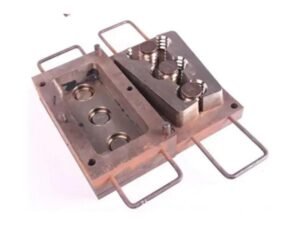
Compression molds are commonly classified in two ways: by cavity structure and by press installation method. The first determines material flow, flash control, and part quality, while the second affects production efficiency, labor requirements, and workflow. Together, these classifications help engineers select the most suitable mold for both product performance and manufacturing efficiency.
Why Compression Molds Have Two Classification Systems
The available types of compression molds fall into two separate classification systems. The two classification systems exist because they address different aspects of mold design and use. One system focuses on the internal cavity structure. It examines how the mold controls material flow, excess plastic (flash), pressure distribution, and the resulting part density and accuracy. This technical perspective helps determine the quality and performance of the molded part.
The second system addresses the mold’s interaction with the hydraulic press. It classifies types of compression molds by installation method and operational workflow. This practical perspective covers labor needs, production efficiency, cycle times, and suitability for different batch sizes.
These two classification systems complement each other and are often used together when evaluating compression molding solutions. Understanding both systems helps engineers make more informed decisions in compression molding design and production.

Compression Mold Classification 1: By Cavity Structure
The first classification system focuses on cavity structure. It divides types of compression molds into flash molds, positive molds, and semi-positive molds. Each design handles excess material, known as flash, in a different way. The design directly affects part density, dimensional accuracy, and the precision needed in material charging.
Flash Mold
Flash molds represent the simplest design among types of compression molds. They feature a horizontal land area around the cavity. As the mold closes, excess material escapes across this land and forms a thin flash layer. This design does not require the exact measurement of the material charge. The process tolerates slight variations in the amount of material added. They work well for high-volume runs of flat or simple parts where minor variations in wall thickness remain acceptable.
However, the escaping material creates waste that needs trimming after molding. Parts produced in flash molds may show lower density and less uniform mechanical properties compared with other types.
Positive Mold
Positive molds operate at the opposite end of the spectrum. In this design, the mold halves fit together with tight tolerances. The structure traps all material inside the cavity and prevents flash from escaping. Pressure from the press transfers directly to the material. This produces parts with high density and strong dimensional accuracy. Positive molds suit applications that demand tight tolerances and high performance, such as certain electrical or structural components.
The main limitation lies in the need for precise material charging. Too little material leaves the cavity underfilled. Too much material can damage the mold or create excessive pressure. These molds also tend to cost more to build and require greater operator skill during setup.
Semi-Positive Mold
Semi-positive molds combine features from both flash and positive designs. The mold halves telescope together for part of the closing stroke to apply direct pressure. After reaching a set point, controlled amounts of excess material can escape through designed vents or gaps. This approach delivers better density and accuracy than flash molds while remaining more forgiving than positive molds on material charge variations. Many production environments use semi-positive molds because they balance quality and practicality. The design works for parts with moderate complexity and helps reduce surface damage during ejection.
Comparison of Cavity-Based Mold Types
The following table compares the three types of compression molds based on cavity structure.
| Aspect | Flash Mold | Positive Mold | Semi-Positive Mold |
|---|---|---|---|
| Flash Control | High flash | No flash | Minimal flash |
| Precision | Lower | High | Medium to High |
| Cost Level | Low | High | Medium |
| Typical Applications | Large/simple parts | Precision components | General industrial parts |
| Main Limitations | Lower density, requires trimming | Needs exact charge, higher risk | Moderate complexity in construction |
Classification 2: By Press Installation Method
The second classification system organizes types of compression molds according to installation method on the hydraulic press. It includes mobile molds, semi-fixed molds, and fixed molds. This system addresses operational efficiency, labor requirements, and suitability for different production scales.
Mobile Mold
Mobile molds remain separate from the press during material loading and initial setup. Operators add material and inserts outside the machine, place the closed mold between heated press plates, and apply pressure. After forming, they remove the mold, separate the plates, and extract the part. This method requires full manual operation. It involves higher labor and slower cycles. Mobile molds are used mainly for prototypes, small test runs, or new product development, where quick setup and low initial cost matter more than efficiency. The repeated handling increases mold wear over time.
Semi-Fixed Mold
Semi-fixed molds attach the upper half to the press while the lower half moves along guide rails. Operators pull the lower section out after opening to load material and remove parts outside the press. This arrangement reduces labor compared with fully mobile molds. It allows faster cycles than mobile designs while keeping mold construction relatively simple. Semi-fixed molds suit small to medium production batches where some manual steps remain acceptable.
Fixed Mold
Fixed molds attach both upper and lower halves directly to the press platens. All steps—loading, closing, pressing, and ejection—occur inside the machine. This design supports the highest efficiency and lowest labor per part. Fixed molds work best for large-volume production. They reduce operator fatigue and extend mold life through smoother operation. However, they require more complex construction and higher precision in manufacturing the mold itself, which raises upfront costs.
How to Choose the Right Compression Mold Type
Selecting among the types of compression molds depends on a combination of product requirements, production scale, and cost considerations.
- Product Requirements: For high-precision components, positive molds are generally preferred due to their tight dimensional control and absence of flash. In contrast, flash molds are more suitable for cost-sensitive applications where post-processing is acceptable.
- Production Scale: When production flexibility is important, mobile molds offer advantages due to their ease of changeover. Semi-fixed molds provide a balanced solution for medium-scale operations, while fixed molds are best suited for high-volume, stable production environments.
- Material Behavior: Material characteristics also play a role. Materials with more variable flow behavior may benefit from mold designs with greater tolerance, such as semi-positive or flash molds.
In practical engineering decisions, no single mold type is universally optimal. The selection must be aligned with both product performance requirements and production strategy.
Jiangzhi Engineering Support
There is no universally best compression mold. Balancing part density, flash control, and production throughput requires a thorough analysis of your material’s bulk factor and project budget.
At Jiangzhi, we provide the design and manufacturability support. Send us your 3D CAD files today. Our engineering team will provide a complimentary Tooling Feasibility Review to help you select the exact mold type that minimizes scrap rates and maximizes production efficiency.
FAQ
A flash mold allows excess material to escape from the cavity during molding, forming flash that is usually trimmed later. A positive mold is fully enclosed and does not allow any material overflow, so it produces parts with higher dimensional accuracy and no flash.
Semi-positive molds balance the advantages of both flash and positive molds. They provide good density and accuracy while being more forgiving with material amounts and easier to operate than pure positive molds.