Injection Molding Tonnage: What It Is, How to Calculate It, and Why It Matters

When sourcing injection molded parts, buyers often encounter inconsistent quotations. One supplier recommends a 120-ton injection molding machine, while another suggests 200 tons for the same part. During injection molding, injection molding tonnage is not just a machine parameter. It directly affects part quality, mold reliability, and overall production cost.

What Is Injection Molding Tonnage?

Injection molding tonnage, also known as clamping tonnage or clamping force, measures the force an injection molding machine applies to keep the mold closed during the injection process. The unit is tons. This force counters the pressure from molten plastic inside the mold cavity. Without sufficient tonnage, the mold halves can separate slightly.

When the tonnage is lower than required, quality risks begin to emerge, including instability and defect formation, while selecting a tonnage that is higher than necessary usually leads to increased machine investment, higher energy consumption, and less efficient cycle performance. In contrast, when the tonnage is properly matched to the actual molding requirements, the production process becomes more stable, cost control is more predictable, and overall manufacturing efficiency is maintained at an optimal level.

Injection Molding Tonnage

How to Calculate Injection Molding Tonnage?

The calculation of injection molding tonnage is based on a simplified engineering formula:

Tonnage = Projected Area × Cavity Pressure × Safety Factor

Where:

  • Projected Area: The total surface area of the part projected onto the mold parting line, including runners
  • Cavity Pressure: The pressure required to fill the mold, influenced by material and geometry
  • Safety Factor: A margin to account for process variation, typically between 1.1 and 1.5

Example Calculation

Consider a part with the following parameters:

  • Projected Area: 100 cm²
  • Cavity Pressure: 400 kg/cm²
  • Safety Factor: 1.2

The required tonnage is:

100 × 400 × 1.2 = 48,000 kg ≈ 48 tons

This provides a baseline estimation. In practice, engineers may adjust for flow behavior, gate design, or multi-cavity configurations.

Generally, suppliers use an internal injection molding tonnage calculator to perform these estimations quickly. While buyers are not expected to calculate tonnage independently, understanding this structure helps assess whether a quoted machine size is reasonable.

How to Calculate Injection Molding Tonnage

Key Factors Affecting Required Injection Molding Tonnage

A single variable does not determine injection molding tonnage. It is the result of multiple interacting factors. Proper engineering adjustments can significantly optimize the final tonnage requirement.

Projected Area

The projected area remains the most direct driver of injection molding tonnage. A larger part surface increases the clamping force required to counteract cavity pressure during filling and packing. Inefficient part geometry or poorly positioned parting lines can unnecessarily increase projected area and projected tonnage.

At Jiangzhi, the projected area is evaluated at the early DFM stage. Our engineers analyze parting line design, wall distribution, and runner layout to determine whether the effective projected area can be reduced without affecting functionality. In many cases, minor geometric adjustments help lower tonnage requirements and improve long-term cost efficiency.

Material Properties

Different polymers exhibit distinct flow behaviors under heat and pressure. High-viscosity materials or reinforced compounds typically require higher injection pressure, which directly increases the clamping force demand.

At Jiangzhi, material data such as melt flow index, viscosity curve, and shrinkage behavior are reviewed together with the part design. If a high-pressure material is required, process parameters and gating systems are adjusted accordingly to avoid unnecessary tonnage escalation while maintaining fill quality.

Mold Design

Mold design has a significant impact on pressure distribution inside the cavity. Factors such as gate type, gate locations, runner balance, and venting efficiency all influence how pressure builds up during injection. Poorly balanced molds can create localized pressure peaks, which increase the effective tonnage requirement and introduce the risk of flash or incomplete filling.

At Jiangzhi, we use mold flow analysis (Moldflow simulation or equivalent tools) to identify pressure imbalance before tooling is finalized. We optimize gate locations and runner systems to ensure uniform filling, reduce peak cavity pressure, and maintain tonnage within a controlled range.

Wall Thickness and the Number of Cavities

Thinner walls increase the required pressure, while multi-cavity molds significantly increase the total projected area.

Jiangzhi manages this through systematic wall thickness optimization during the DFM (Design for Manufacturability) phase. For multi-cavity setups, we balance cavity layouts and runner systems to distribute pressure evenly, often allowing the use of lower tonnage machines than initially estimated.

Process Parameters

Process parameters like injection speed and pressure directly affect the force exerted on the mold.

Jiangzhi establishes standardized process windows through scientific molding studies. Our technicians monitor real-time data during setup and production to fine-tune parameters, ensuring the selected tonnage remains effective across production runs.
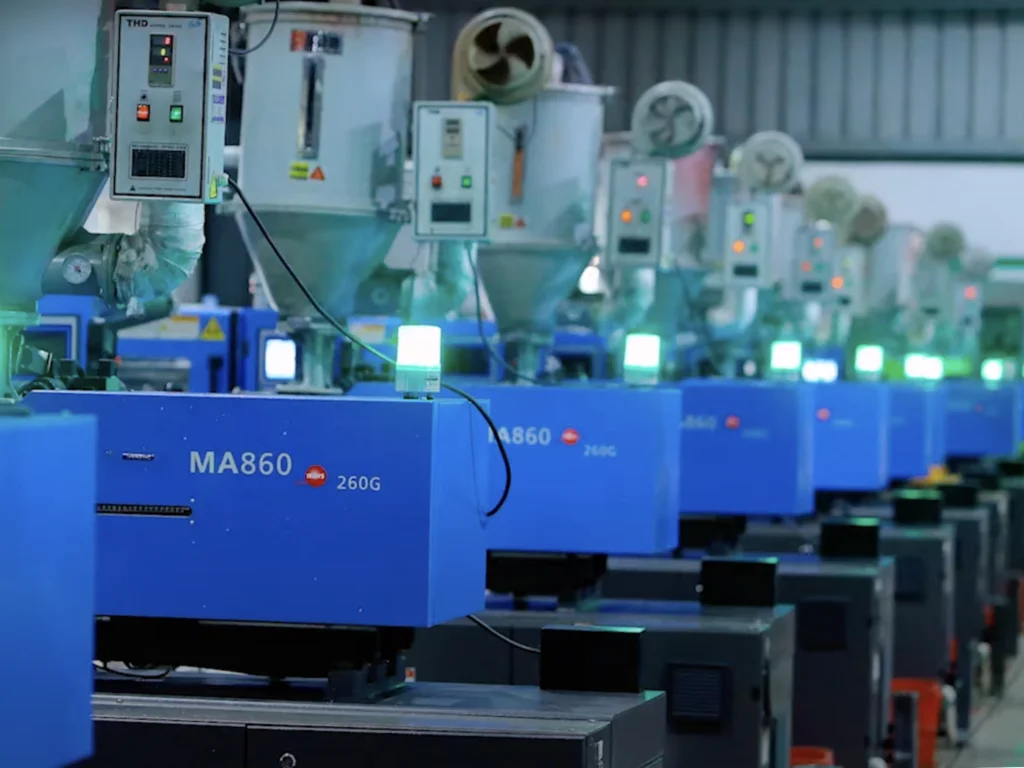
Injection Molding Workshop strong capacity

Injection Molding Solution

Unsure which injection molding machine tonnage your part requires? Jiangzhi can evaluate projected area, material behavior, mold design, and cavity pressure before production. Talk to our engineers for a practical DFM and tonnage recommendation.

What Happens If Tonnage Is Too Low?

Insufficient injection molding service and tonnage planning leads to several production issues.

The mold can separate under injection pressure. This results in flash, which is excess plastic that escapes between the mold halves. Flash requires additional trimming and finishing work, increasing labor and material costs.

Other defects include short shots, where the mold does not fill completely, and dimensional variations across parts or production runs. Surface imperfections and inconsistent part weights may also appear. In severe cases, repeated mold separation can damage the mold surfaces or parting lines, leading to higher maintenance expenses and longer downtime.

These problems often extend lead times and raise overall project costs. For buyers, parts with such defects may fail quality inspections, resulting in rejected shipments or field failures.

What Happens If Tonnage Is Too High?

Over-clamping compresses the mold beyond what is necessary, which can accelerate wear on the mold components and reduce tool life. Vents in the mold may close prematurely, trapping air and causing burn marks on parts due to diesel effect from compressed gases.

Higher-than-needed tonnage also increases energy consumption during each cycle. This raises production costs, particularly for high-volume runs. In some instances, excessive force can introduce internal stresses in the molded parts, leading to warpage or reduced mechanical performance after cooling.

Selecting a larger machine does not inherently improve quality. In many cases, it only shifts the cost structure without addressing process requirements.

How to Select the Right Injection Molding Machine Tonnage: Step-by-Step

Follow these steps to determine suitable injection molding tonnage for a project.

  • Gather detailed part information, including dimensions, projected area at the parting line, material specifications, and expected number of cavities.
  • Apply the tonnage formula or use an injection molding tonnage calculator for an initial estimate. Include areas for runners and sprues.
  • Incorporate a safety margin of 10 to 20 percent to account for process variations.
  • Consider future needs, such as potential design changes or higher production volumes that might affect tonnage.
  • Consult with experienced suppliers who can run mold flow simulations for validation. Review their recommendations against your calculations.
  • If possible, conduct trial molding on the proposed machine to confirm performance before full production.

Clear communication with suppliers about part requirements and tolerances supports accurate machine selection. Avoid basing decisions solely on the lowest quoted price, as it may reflect under-specified equipment.

Conclusion

Injection molding tonnage is a central parameter in process design. It influences part quality, production stability, and manufacturing cost. For buyers, understanding the logic behind tonnage calculations enables more informed decision-making and clearer communication with suppliers. Confused about the required tonnage for your next project? Contact Jiangzhi’s engineering team to run a free Moldflow simulation and DFM analysis for your part.

FAQ

Yes, but it is usually not recommended. A higher-tonnage machine will work, but it often increases energy consumption and machine costs and may impose unnecessary stress on the mold. The best practice is to match tonnage as closely as possible to the real requirement.

Flash can still happen due to several reasons besides tonnage. Common causes include poor mold fit, uneven cavity pressure, worn parting surfaces, or incorrect process settings such as injection pressure or temperature.

A multi-cavity mold increases the total projected area, which directly increases the required clamping force. So higher tonnage is needed to keep the mold fully closed during injection.

Yes. Gate location influences how the melt flows and how pressure builds inside the cavity. Poor gate placement can create uneven filling and pressure spikes, which may increase the effective tonnage requirement.

Ask for their tonnage calculation, mold flow simulation report, and trial run samples. Check the parts for flash, short shots, or dimensional issues. Request details on the machine size and process parameters used.

Scroll to Top