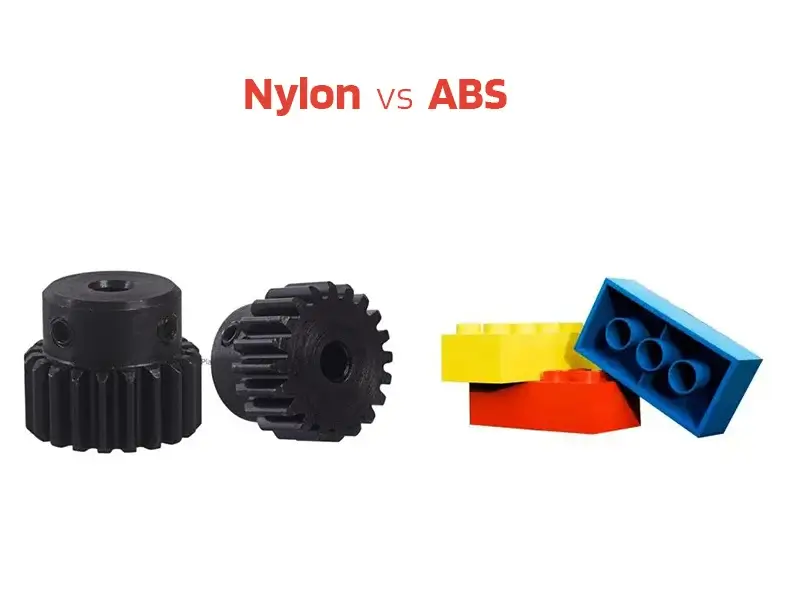
ABS machining defects tend to surprise people, mostly because ABS has a reputation as an easy material to work with. However, there are two problems in ABS machining parts: warping and poor surface quality.
Why Does ABS Warp During Machining?
ABS warping can occur when the material changes shape during or after machining. Several factors can contribute to this problem, and they often interact with each other.

ABS Thermal Expansion
The first is thermal expansion. ABS expands and contracts at a rate of roughly 70–90 × 10⁻⁶ per °C, which is several times higher than aluminum’s rate of around 23 × 10⁻⁶ per °C. The same temperature swing that barely affects a metal part can shift an ABS part’s dimensions noticeably.
The Heat Buildup
The second is heat buildup. ABS has a heat deflection temperature around 80–100°C and a glass transition temperature near 105°C, but its thermal conductivity is only about 0.15–0.20 W/m·K — low enough that it behaves more like an insulator than a conductor. Heat generated at the cutting edge doesn’t dissipate quickly. It builds up locally, softening the material right where the tool is working.
Residual Stress in ABS Stock
The third factor is residual stress already present in the stock material. ABS rod and sheet stock is typically produced by extrusion or injection molding, both of which leave internal stresses locked into the material. Machining removes material asymmetrically, and that process can release those stresses unevenly, causing the part to warp even when every cutting parameter is correct.
Excessive Clamping Pressure
ABS is much softer than steel or aluminum. Excessive fixture pressure can locally compress or distort the material. The CNC machine then cuts the part while it is being held in this distorted condition. After the clamps are released, the material can partially return to its original shape. This can create a difficult inspection problem. The part may appear to meet the required dimensions while it is clamped but move outside tolerance after release.
Common ABS Machining Defects
ABS machining defects are not limited to warping. Surface problems and dimensional errors can also occur when the process is not properly controlled.
| Defect Type | Common Causes | Typical Appearance |
|---|---|---|
| Warping / Distortion | Heat buildup, residual stress, excessive clamping | Part bends, or dimensions change after machining |
| Rough Surface | Vibration, unsuitable speed/feed, worn tool | Uneven or rough machined surface |
| Chatter | Unstable fixturing; cutting speed or feed inducing vibration | Regular wave-like marks on the surface, more pronounced on high-impact grades |
| Tool Marks | Dull tool, excessive feed, unsuitable tool geometry | Visible lines or marks on the machined surface |
| Melting / Smearing | Excessive heat, low feed, poor chip removal | Softened, melted, or smeared areas |
| Burrs | Dull tools, excessive cutting force, unsuitable cutting direction | Raised material along edges |
| Scratches | Poor chip evacuation, contaminated fixture, improper handling | Linear marks on the surface |
| Poor Dimensional Accuracy | Thermal expansion, stress release, unstable fixturing | Dimensions outside the specified tolerance |
How to Prevent ABS Machining Defects: Process Control?
Preventing ABS machining defects requires control over the material, cutting tool, machining parameters, fixture, and inspection process.
Use Suitable ABS Stock
Machine-grade ABS has a more uniform internal structure than extrusion- or injection-grade stock, which produces cleaner chip formation and reduces surface defects from the outset.
Use Sharp, Suitable Cutting Tools
A sharp cutting edge helps remove material cleanly while reducing unnecessary friction. Sharp carbide tools designed for plastics, typically with 2 to 4 flutes, cut cleanly and evacuate chips efficiently. A sharp tool generates less friction heat than a dull one, which directly reduces the risk of both melting and warping.
Control Cutting Parameters
Spindle speed and feed rate need to match the specific ABS grade being cut. A common working range runs from 2,000 to 6,000 RPM with feed rates of 0.1 to 0.5 mm/rev, though the right numbers depend on tool diameter and grade. Excessive spindle speed can generate unnecessary heat, while an excessively low feed rate can cause the tool to rub against the material rather than produce an effective chip. On the other hand, an overly aggressive feed can increase cutting forces and vibration.
Control Heat and Remove Chips
Effective chip evacuation is particularly important when machining ABS. If chips remain around the cutting area, they can be recut by the tool. This creates additional friction and heat and can damage the machined surface.
Air blast is commonly useful for removing chips and controlling the cutting zone. Depending on the machining process and equipment, an appropriate coolant may also be considered.
Reduce Clamping Stress
The fixture should provide enough force to keep the workpiece stable without significantly deforming it. Soft jaws or vacuum and low-pressure clamps hold the part without over-compressing it. Excessive clamping force is a direct contributor to both stress cracking and warping.
Annealing
Stock with higher residual stress, such as glass-filled grades, benefits from plastic annealing before machining, typically 80–95°C held for two to four hours. A second annealing pass after machining can sometimes correct minor distortion that shows up post-cut.
Design Considerations to Reduce ABS Machining Parts Risk
Some ABS machining defects can be prevented before production by improving the part design.
Avoid Unnecessarily Thin Walls
Thin walls are more sensitive to cutting forces, vibration, heat, and clamping pressure. If the application allows it, increasing wall thickness can make the part more stable during machining. When thin sections are unavoidable, the machining sequence and fixture design should be planned around them.
Keep Wall Thickness as Consistent as Practical
Large differences in material thickness can make stress release less predictable. A more uniform design can reduce the amount of material removed from one region compared with another and can make the machining process easier to control.
Avoid Excessively Deep Cavities
Deep cavities often require longer tools. Longer tool lengths increase tool deflection and can reduce machining stability. They may also require multiple passes and additional tool changes. If a deep pocket is not functionally necessary, reducing its depth or modifying the geometry can simplify machining.
Specify Tolerances Based on Function
Tolerance tiering matters more for ABS than for metals, given its higher thermal expansion rate. Tighter tolerances can require slower machining, additional finishing passes, more inspection, and greater control of temperature and fixturing. Critical dimensions should receive the appropriate tolerance. Non-critical features can generally use more practical tolerances. This approach can reduce cost and production time without affecting the function of the part.
Design for Tool Access
CNC tools need sufficient access to the features they are machining. Very small internal corners, deep narrow slots, and difficult-to-reach surfaces may require small or long tools. These tools can reduce machining efficiency and increase the risk of vibration.
When Is CNC Machining Not the Best Choice for ABS Parts?
CNC machining is useful for prototypes, custom components, and low-volume ABS production, but it is not always the most economical process.
For high-volume production of stable ABS parts, injection molding may be a better option. A mold requires upfront investment, but the cost per part can become lower as production volume increases.
Injection molding can also be more suitable for ABS components with complex molded features such as ribs, bosses, snap-fits, and certain undercuts. These features may require considerable machining time if produced entirely through CNC machining.
Material waste is another consideration. CNC machining starts with a larger block or sheet and removes material, while injection molding forms the plastic close to the required geometry.
Conclusion
ABS is relatively easy to machine, but consistent results still require careful process control. If you have an ABS part in development, send us your drawing and expected volume, and we can help you decide on material grade, process control, and whether CNC machining or injection molding is the better fit.