
Threaded components are everywhere in industrial products, from fasteners to precision shafts. How those threads are formed affects strength, finish, and cost. Thread rolling is one of the most efficient ways to produce them, and understanding how it works helps choose the right process for a given part.
What Is Thread Rolling?
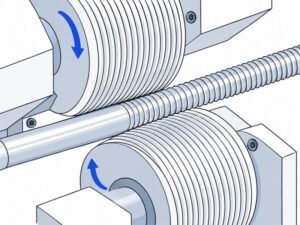
Thread rolling is a cold-forming process that shapes threads by pressing a cylindrical blank between hardened dies. In this process, no material is removed. The dies displace metal outward, and it flows into the die cavities to form the thread profile. Because the metal’s grain structure is pushed and reshaped rather than cut through, the finished thread tends to be stronger and more resistant to fatigue than a cut thread of the same size.
The Thread Rolling Process: Step by Step
The process begins with a blank machined or ground to a specific diameter, slightly smaller than the target pitch diameter. Even small deviations of this blank diameter change the final thread size.
The blank is then fed between two or more dies with a thread profile ground into their surface. As the dies rotate or reciprocate, they press into the blank, and the displaced metal rises to form the thread crests. Depending on part length, one of a few feeding methods is used:
- Thru-feed: the part travels through the dies continuously, suited to long threaded sections.
- Infeed: the part stays in place while the dies press inward, used for shorter thread lengths.
- Infeed/thru-feed: a combination approach for long threads that need a clean start and finish.
The result is a finished thread with a smooth surface and no chips or cutting fluid residue to manage afterward.
Materials Suitable for Thread Rolling
Not every metal responds well to this process. A material generally needs an elongation of about 12 percent or more to handle the displacement forces without cracking. Steel, aluminum, brass, and other ductile alloys typically roll well, producing threads with good form and finish.
Harder or more brittle materials, such as cast iron, are not good candidates and are usually cut instead. Stainless steel can be rolled successfully, but it wears down dies faster, so the blank surface needs to be prepared carefully before rolling begins.
Since the blank itself is usually produced by CNC machining, the CNC machining material selection often needs to account for both machinability and rollability together.
Thread Rolling Design and Tooling Considerations
Parts intended for rolled threads need a slightly different design approach than parts intended for cut threads. Because material is displaced rather than removed, the blank diameter, chamfer angle, and thread length all affect how cleanly the thread forms.
A few practical points worth keeping in mind:
- Blank diameter should sit close to, but below, the target pitch diameter.
- Small changes in blank diameter have an outsized effect on the finished thread diameter, so tolerances matter.
- The die working face should extend slightly beyond the thread length itself, allowing room for metal to flow without chipping at the part ends.
- Both straight and tapered threads can be produced with the right die design.
Getting these details right at the design stage helps avoid rework and extends die life.


