Injection molding threads are essential in many molded parts, providing a means for fastening, assembly, and adjustment. In injection-molded components, threads are often integral to the design, allowing parts to be screwed together or attached to other components securely. Molded threads are used in a wide range of applications across various industries. In this post, we will explore the details of injection-molded threads.
Types of Injection Molding Threads
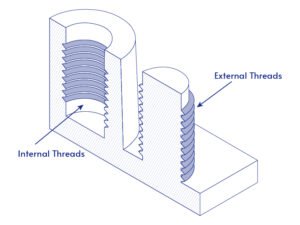
Injection-molded threads are created through the process of creating threaded features directly during the injection molding of plastic parts. Here are two types of molded threads:
Injection Molding External Threads
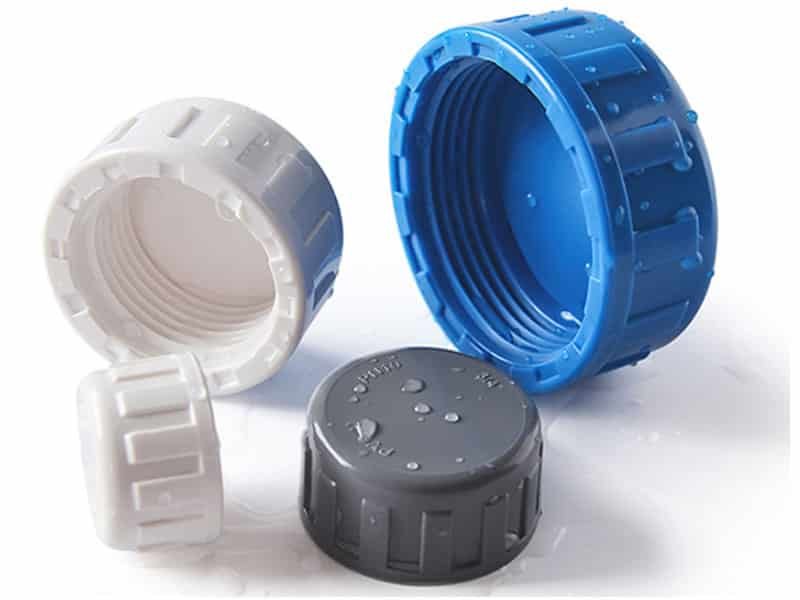
External threads are those formed on the outer surface of a molded part. They are commonly found on bottle caps, jar lids, and other closures that require a secure fit. These threads are essential for applications where parts need to be screwed together or where a cap needs to be securely fastened to prevent leakage or contamination. The external threads can be made by an injection mould tool with half of the thread in the core and half of the thread in the cavity.
Injection Molding Internal Threads
Injection molding internal threads are those formed on the inner surface of a molded part. They are used in applications such as threaded inserts in plastic housings, fluid connectors, injection molding thread inserts, and various fastening components. The plastic thread design guide is crucial for parts that need to be assembled with screws or bolts, providing a secure and reusable fastening method. To obtain a plastic molded part with a thread on the inside, a removable threaded core is placed inside the injection mold tool. Then, inject the polymer into the mold tool and set it to create the thread.
Internal threads are commonly incorporated into plastic bosses to provide fastening points for screws, inserts, and mating components. Proper boss geometry is critical to prevent sink marks, cracking, and thread failure under load. See our Bosses in Plastic Design guide for detailed design recommendations.
Need strong and accurate threads in your plastic components? We provide professional injection molding solutions for threaded parts. Request a quote.
Draft angles are essential in injection molding to facilitate the removal of the molded part from the mold. For threaded parts, incorporating an appropriate draft angle ensures that the threads do not get damaged during ejection.
External Threads: A slight outward draft angle helps in the easy ejection of the part without distorting the threads. Typical draft angles range from 0.5° to 2°.
Internal Threads: A slight inward draft angle aids in removing the core that forms the internal threads. Ensuring this angle is not too steep is crucial to maintaining the thread profile.
Thread Depth
Thread depth refers to the distance from the crest (top) to the root (bottom) of the thread. Proper thread depth is crucial for ensuring a secure fit and adequate engagement between mating parts.
Deeper threads provide better engagement and strength, but they are more challenging to mold accurately. Deeper threads may require more complex mold designs and advanced ejection mechanisms like unscrewing molds or collapsible cores.
Thread Pitch
Thread pitch is the distance between adjacent thread crests. It affects how the threads engage and function. The thread pitch must match the corresponding mating part for proper engagement. Finer pitches are used for precise adjustments, while coarser pitches are better for quick assembly and disassembly.
Tolerance and Fit
Maintaining tight tolerances and ensuring proper fit between mating threaded parts are critical for the functionality and reliability of the product. Account for potential variations in the molding process to ensure threads fit properly, even with slight deviations. Choose between an interference fit (tight fit) for secure connections or a clearance fit (slightly loose fit) for easier assembly, depending on the application.
Lead-in and Lead-out
The lead-in and lead-out areas of threads are crucial for ensuring smooth engagement and disengagement of threaded parts. The first few threads at the start of the external or internal thread. A tapered or chamfered lead-in helps guide the mating part into place, reducing the risk of cross-threading. The end of the thread is often designed to gradually transition to the non-threaded portion of the part. This design ensures that the threads can be fully engaged and disengaged without abrupt stops.
Material Flexibility
Choose materials flexible enough to avoid cracking during the unscrewing process (e.g., PP, ABS, POM, PA)
Thread Profile
Opt for thread profiles with radiused crests and roots, thicker cross-sections, and wider spacing between threads. Consider acme or buttress thread profiles for better results in plastic parts.
In some applications, molded threads may be replaced by post-machined tapped holes to improve dimensional accuracy or reduce tooling complexity. Understanding the trade-offs between molded and machined threads is essential when selecting a fastening solution. Learn more in Tapped Hole vs Threaded Hole.
Mold Design for Threaded Parts
Parting Line Placement
For External Threads: Place the parting line for injection molding along the centerline of the thread. This is cost-effective but may result in slight imperfections due to the parting line. Consider incorporating a small flat (typically 0.005″) at the parting line to prevent flash development in the thread root.
For Internal Threads: The parting line for injection molding is typically not a concern as internal threads are usually formed using unscrewing devices or collapsible cores.
Core and Cavity Design
External Threads can be Molded Using Two Methods:
a) Parting line on the thread centerline (less expensive but may have undercuts).
b) External thread-unscrewing device for higher precision.
For Internal Threads:
Require more complex mold designs.
Often use collapsible cores or automatic unscrewing devices.
Consider using hydraulic motors to unscrew internal threads before mold opening and ejection.
Cooling System Design
Design the cooling system to ensure uniform cooling across the threaded area. This helps prevent warpage and ensures the dimensional accuracy of the threads.
Efficient cooling system design can significantly reduce cycle times.
Faster cooling allows for quicker part ejection and higher production rates.
Proper cooling helps maintain the integrity of the thread profile during solidification. Prevents issues like sink marks or deformation that can affect thread functionality.
Adjust the cooling system design based on the specific thermal properties of the chosen plastic material.
Complex thread designs need careful planning to avoid defects. Work with our specialists to ensure durable, high-quality threaded parts. Request a quote now.
Force release is suitable for threads with smaller sizes, pitches, and depths. The injection material must be flexible enough to avoid cracking issues. Materials like polypropylene (PP) and certain grades of ABS work well for this method.
2. Manual Insert Release
Manual insert release method: a threaded core or cavity is placed into the mold before each cycle. The core is ejected with the part, and an operator manually unscrews it from the finished product. Multiple cores are often used to improve efficiency.
Manual insert release is best suited for low-volume production runs or prototyping. It offers flexibility and lower initial tooling costs but requires more labor and has longer cycle times compared to automated methods.
3. Fully Automatic Release
Fully automatic release, also known as unscrewing molding, uses hydraulic or electric motors to rotate the threaded core or cavity. This process automatically unscrews the part from the mold during the ejection phase. It is a fast way of making parts. It is ideal for high-volume production runs. While it has a higher initial tooling cost, the high- andlong-runn products will be more cost-effective.
Conclusion: Injection Molding Threads
Proper thread design is essential for ensuring reliable assembly, load capacity, and long-term performance in injection molded plastic parts. Factors such as thread geometry, material selection, moldability, and fastening requirements should all be considered during the design stage to avoid manufacturing challenges and premature failure.
Threads are only one component of a successful plastic part design strategy. For a broader understanding of bosses, ribs, draft angles, wall thickness, corners, holes, and other critical design features, refer to our comprehensive Plastic Part Design Guideline.
Professional Injection Molding One-Stop Service Company
Improve production efficiency and choose efficient injection molding solutions!